Everyone who doesn"t like Assassin"s Creed Odyssey hasn't played with Cassandra as the Protagonist.
Showing posts with label Quote. Show all posts

Wednesday, 27 June 2018

Lessons from Seven to Eternity


"There's the way things are and the way you want 'em to be.
One way you can navigate with compromise.
The other you have to throw your life at with no promise of even affecting the smallest change."


"The balance between doing what's right an' the overwhelmingly human sense of self preservation.
Justice is a mortal-made concept and every man's definition's different.
A billion souls, all knowing what's right for everyone else, until their justice conflicts with their interests."


"No one is a good person.
You tell yourself people are good for an artificial sense of order and security.
We are simply machines fueled by desire.
Fulfilled by any means.
Men like you and your father punish themselves by adhering to values that the world around them does not share.

-Striving for freedom and helping others ain't a punishment.

That road isn't really about helping others...
... it's about making yourself a hero.
But the pragmatist lives on the graves of those idealists.

-An ideal gives a man something to live for.

It also makes them delusional and easier for men like me to manipulate them.
Convince a man he's a righteous hero and he'll march to any war with fervour.
He knows he's good and right, thus his enemy must be wrong and evil."


Yeah. I only finished it yesterday after the two available volumes had been sitting on my shelves for months and months, and I'm feeling a bit stupid. This one is going to grow bigger with time. If you want a comparison: It's like a mix of the ideas behind the Darkness that Comes Before, Tokyo Ghost's more fantastical elements (read: it's definitely more fantasy than sci-fi), and something that is obviously out of its mind on drugs. There's just so much going on: The constantly widening and opening up magic system, the insanely varied environments, the ideas, the story, the pacing, it's all just so damn fast.

This is by the same team that created that other super good sci-fi comic; Fear Agent, so there's no reason why this should've taken so long to get a look, and honestly, I have no excuses. Either way though: it was totally worth it.

As you can see, Jerome Opena's art style is insanely intricate.


It's maintained throughout 9 issues except where James Harren takes over in issues 7 and 8 where different stories start to diverge. Anything other than the art style featured above can only be a step down, so don't hold that against him.


And the story, man, the story is a moody one. Though, I'll admit, it can be quite hard to follow.


We follow around Adam Osidis on a quest of vengeance and self-preservation after an attack on his father's farm where he and his family live. The Mud King, the so-called God of Whispers, has finally come to deal with the last of the magic-wielding Mosak warriors. That's issue one.
By the end of Issue three we finally understand what the title is about* and we've been constantly bombarded with some rather original world building.

-----

This story and especially the art style needs a large print version though. I do believe I'll be getting the deluxe version when it finally comes out, probably somewhere, some months after volume 3 comes out, if Image does its usual thing. Volume 2 ended on a very nice emotional cliffhanger so as Volume three is slated for release somewhere in December so I'll be getting that when it comes out too.


*although I'm guessing it's one of those titles that's going to have multiple meanings when the entirety of the telling has been done.

Saturday, 10 March 2018

Warhammer: Van Horstmann, Ben Counter


Gorgeous dragon artwork by Cheoljoo Lee

After Emperor Magnus' victory at the end of the Great war against Chaos, he requested of the Elven Lord, High Mage Teclis to help him form in the Empire's capital of Altdorf, for each of the 8 winds of magic a corresponding school.
A little over a hundred years later a young man arrives to demand entry into the Light College.
His name is Egrimm van Horstman and his rise through the ranks will be meteoric.
But Van Horstmann has dark secrets, and his gaze is fixed on terrible goals. And if he attains them the purity of the Light college will be stained a darker shade of magic.

There's your unrevealing cover blurb., it even fits on the back of a novel, and doesn't spoil anything. Not that hard was it?

The prologue opens with the sealing of the chaos dragon Baudros in a magical construction in the place where later the Buchbinder's district of Altdorf will be. This sealing is done by Teclis and the 8 founding wizards of the colleges of magic. Try as I might, the only hints to place this in Altdorf's history and the Warhammer history in general were that this takes place after the great war against Chaos. and according to the  Empire codex (7th edition), this takes place in 2304.
Now, the problem with the prologue in regards to this date is that it depicts Altdorf as... still pretty small, or at the very least that is the impression given, and not the grand opulent thing it will become. Despite that this is a city that's been around since Sigmar himself (then known as Reikdorf).
A chapter later, when the main story begins Altdorf is grand and impressive, burst out of its initial shell, sprawling across both sides of the river. An entire new district of wanted-to-be-opulent-but-kinda-failed squatting over the place where the events of the prologue took place. This has as a side-effect, this kind of vague-speak, where no dates are being mentioned, where it's implying right off the bat that quite a lengthy amount of time has passed between the prologue and the events of the main story. Enough for rising and falling of generations of family fortunes. Without any actual dates one has that unmistakable impression. But... as the colleges were founded by Teclis somewhere in 2304 at the request of Emperor Magnus, and Van Horstmann's arrival in Altdorf takes place in 2437 (which I deduced myself quite easily, my dear Vido; the key is of course is the novel's use of the Great Altdorf Fire in 2431), that's not in fact the case, and it's a little confusing and something that I, obviously, got stuck on.
But in the end, I admit, it does all fit... and now that I've got that out of my system, let's get on with the rest. 

-----

I very much enjoyed the novel.

It focuses on the Empire's colleges of magic by way of a Chaos hero character. One who arguably did the most damage to the Light college since its very founding; the sorcerer Egrimm van Horstmann.

Van Horstmann is a fascinating character, even though we are mostly deprived of his inner workings. We get partial glimpses of his schemes, and of the interesting way his magic works, and prett damning reveals of the deals he makes, but though we know what drives him pretty early on, the exact origins of why aren't shown until the very end. Counter keeps his cards close to the chest.
And this can be a bit of a problem. In a way; holding off this reveal lends him strength and will, and by keeping him so enigmatic Counter manages to make of him a force rather than a character, grieved by an unimaginable trauma, enough to make him staggeringly patient and deliberate, as if mountains were to tolerate climbers, because their mouths are at the top and it'd be more satisfying to grind them with teeth of ice than to crush them with hands of stone.

But, there's also a problem with this, because even though it's clear that Van Horstmann is working towards a goal, acting towards a terrible vengeance, the glimpses we've been given are not enough to make coherent sense on their own, and they seem improbable and unlikely to give rise to such a monomaniacal quest, never once hinted at outside of his own mind. In a way that's interesting, but this means that there isn't an overarching story that isn't just 'Van Horstmann working towards something to do with the Light college', and from the start we are waiting for that reveal.
It as if you start watching a movie, already knowing there's going to be a twist.

The novel's cover blurb works directly on this as well, by stating black on white how the novel ends... Yes. Really.
It's a strategy akin to the recent movie-trailer trend where if you piece together what the trailer is showing, you're likely to figure out what'll happen. The argumentation there is that the average moviegoer doesn't want to be surprised and instead wants to be coddled; hence, give the viewer what is expected and they'll go home satisfied, even if that necessitates spoiling things beforehand.
Here the reasoning is that, most readers will come here from the gaming background, and will already be in the know on who this character is, what he did, and where he ended up, which the blurb indeed reveals.
For someone not in the know, this can be a little frustrating, making it seems as if you already know everything.
Hence, Counter's withholding of the object of and reason for Van Horstmann's vengeance. But I do have to say, when this is finally delivered on, when it is actually revealed:... it's... quite special.
The moment of vengeance is the lure that will draw you through the novel, and if you go with it, (and if you're a bit of an evil bastard in your fiction) you will not be disappointed by its attainment. It is very, very good. It's malign and sadistic and it's delivered in a climax that's already exploding left and right, with chaos and magic spreading through the halls, with collateral damage going through the roof (literally).
There were some sad moments amongst all that carnage. And you could see them coming, the significant deaths, of those who managed to grow on you.  It was expected, but damn... Chaos characters can be evil. And yet, the deliveries, though brutal, also held some unexpected deeper emotions.

It's generally why I love them, the bad guys, because these characters are interesting of themselves. Whereas the good ones always need to stand for something, fight for something, uphold and live by a set of rules, it's always the flawed who will hold my whole attention. Because they work for themselves they become unpredictable, and their designs and goals will necessitate elaboration, and they frequently don't fit in any mold. And van Horstmann is like that.

The ending, past our main character's anticipated climax, is a little rushed. A side-effect, I guess, of the origin-story nature of the novel. I can't label it much else other than being a bit of a let-down.
You expect a good culmination, but it's just another status-quo delivery. For the gamers and those in love with the setting, this is absolutely not a bad thing. But those here for a good story might end up a little underwhelmed.

-----
.
Like many of Warhammer's novels primarily set in the empire's many sprawling cities, these stories carry easily recognizable shades of Leiber's Lankhmar. With narrow, shadow-darkened alleys infested by giant scheming rats (and lets call them Skaven, rather than Beastmen, though I did love that aspect of the story, if I'm honest. I always love seeing the denial of Chaos or the monsters in our midst.) to name the easiest of many similarities. And in Van Horstmann it goes an extra length, by focusing on an aspect of another who was influenced by him; Terry Pratchett and his Unseen University. I'm not saying that one looked at the other and crafted a different shape out of what was already there, just that there's only so much one can make out of a medieval setting using wizards, without coming out rather familiar.
The Dark shadow cast by the Unseen university then; Warhammer's colleges of magic are delved into, and their various hierarchies, methods and themes are neatly explored.
Counter also offers up a great and convincing conceit that allows for the verisimilitude in which most Warhammer authors tend to depict magic, explaining away why magic might not always work like it does in other stories, based on the wizard in question's interpretation of magic and how they use it.

The predominant colour here, obviously, just as one might expect, is white, for purity and light (after all, our main focus here is on the college of Light), and the pervading background effect for the novel then is one of exaggerated and holy austerity, despite that there's obvious wealth on display, in the golden trim to every robe, or in the magisters' private chambers.
Initially I thought this would end up boring, but thank Sigmar for the schemes of Chaos, lending a much needed variety to what otherwise would be a very bland colour scheme throughout.

A large focus is given, of course; to the schools' several rivalries, certain of which are fired up by Van Horstmann's scheming.
And it's great to see these schemes come to fruition as they inevitably end in terrible violence as wizards wage appalling war. There's a wizard duel at one point, between the Light and Gold college, that was both horrifying and exhilarating, as two monstrously powerful warlocks use items of power in brutal and imaginative ways. It's pretty memorable, as besides the inventive and colourful ways the two antagonists battle it out, this particular clash of two different schools of magic clash is set to high stakes, and when it's done there's some well-earned pathos.

For most of the novel, Counter progressively lifts more and more curtains that hide the inner workings of the Light college and it's always interesting. I myself didn't know a thing about the colleges, as the wizards I met in my experiences with Warhammer fiction have always been travellers, enigmatic and isolated power-hoarders.

At the last, there were two things I wanted to remark on.
Two segments that I loved especially:

Despite Van Horstmann's hunger for vengeance, he occasionally shows other hungers. Something to indicate he might have been uniquely suited for the life of a scholar, if events had not intervened p161:

'I think it must have been compulsion that must have made us walk into this pyramid in the first place.'
  Van Horstmann indicated the books piled around him. 'Thousands of years ago,' he said, 'something happened in the far north of the Empire, near the shore of the Sea of Claws. Perhaps on the edge of the Kislevite steppe. It left its scars in folk songs and legends, but nowhere is it attested in its entirety. Something fell from the sky, perhaps, or a great magic was wrought. I do not know yet, but I can feel it building up, piece by piece in my mind. Perhaps eventually there will be enough to sponsor to find what traces of it remain in the earth. or perhaps it will never be found, and it will always be that maddeningly final step away. It would not be the first. Knowledge degrades such that without diligent custodians it will corrode until it is useless. A sad state. A tragedy. When I think of what has been lost, I feel the need to claw back what I can. Compulsion, as you say, without a doubt.'


And then this other bit, effortlessly evoking wonder and mystery p198:

'This was built to echo the pyramid above,' said Pendorf. 'But it changes. We cannot map it. Takes this old man's intuition to know the way. What is it you seek?'
  'The Scimitar of the Thirteenth Dynasty.'
  Pendorf sucked at his teeth like a craftsman sizing up a fee. 'That will not be easy. Some of the artifacts are better at hiding than others. The Scimitar thinks itself a noble among commoners, and it disdains their company. As I said, stay close.'

-----

 The write-up took a while to get to. and then longer to actually get done... Still, I did have fun.

Monday, 5 March 2018

Gormenghast love

English at its best.


-----

This is Gormenghast's first page in its entirety (divided up into 3 because scanning straight without creasing the book is hard) and a little bit from page 2.
I left out a bit at the end of part 2 of as there was a spoiler in there for those who'd like to read book 1. 

Book 1 is Titus Groan, 2 is Gormenghast, and 3 is Titus Alone.
Together they form the Gormenghast trilogy.

The trilogy wasn't supposed to be a trilogy, and the author died before he could finish his vision, apparently at least 2 more books were planned before Parkinson's disease intervened.

Despite that, I very much recommend it, even if what there is is all there is. It's very unlike any type of read I know and though granted; it is slow, the beauty of its prose is second to none.


Wednesday, 24 January 2018

Bourbon and Big Black Delta

Current Mood:

Fear Agent's Out of Step by way of Big Black Delta's Huggin' and Kissin'.


That whole issue is just so damn perfect.


If you've read one, look at the other and tell me they don't invoke the same feelings.
Or just watch it anyway, it's a good song and an interesting clip.

I'm having a good time, how about you?

-----

"Life was not a valuable gift, but death was.
Life was a Fever-dream made up of joys embittered by sorrows,
pleasure poisoned by pain,
a dream that was nightmare-confusion of spasmodic and fleeting delights,
ecstasies, exultations, happinesses, interspersed with long-drawn miseries,
griefs, perils, horrors, disappointments, defeats, humiliations, and despairs,
the heaviest curse devisable by divine ingenuity.
But death was sweet.
 Death was gentle.
Death was kind.
Death healed the bruised spirit and the broken heart,
and gave them rest and forgetfulness.
Death was man's best friend.
When man could endure life no longer,
death came and set him free."

Samuel Clemens,
aka
 Mark Twain

Friday, 5 January 2018

Dunsany Appreciation

I was reading a short story the other day: The Sword and the Idol by Lord Dunsany.
It's par the norm for his stories; lyrical, with quick but perfect scene setting, always told with a soft, fairy-tale voice. As I'd like to finish a few short story collections this year (more on that later this week) I try to read a short story a day whenever I find I have a little extra time. You know, in between doing nothing and feeling violently ill. That day it was one from Gollancz' Fantasy masterworks collection Time And the Gods.

As I read it I was struck by a line.

"... And the wolves came trotting in and sat down again on their haunches much closer than before; and the fierce and valiant dogs that belonged to the tribe believed that their end was about to come while fighting, as they had long since prophesied it would."

The Sword and the Idol isn't exactly a tale of anthropomorphic beasts, although the creatures that live alongside Man do regard him with certain thoughts and emotions and almost show a level of reasoning in their approach with him. But in the dogs' long since prophesied it becomes something of a level above the primal. It becomes storied myth. At a stroke, with half of a sentence, Dunsany imbues his narrative with unexpected depth. Alongside the tale that is already unwinding he lays out another narrative, heretofore completely unknown and when conveyed; still unknowable. Something pointing to a world apart, above that of Man: The prophecies of Beasts.
It's something almost whimsical and yet so powerful, effortlessly summoning up such fantastic imagery.

It's only a small part of the tale, and not what this story really is about. But having given you the start of this segment, I'd be remiss in not giving you the end of it.

"Then the flame caught the lofty stack of brushwood, and rushed out of it, and ran up the side of it, and stood up haughtily far over the top, and the wolves seeing this terrible ally of Man revelling there in his strength, and knowing nothing of his frequent treachery to his masters, went slowly away as though they had other purposes. And for the rest of that night the dogs of the encampment cried out to them and besought them to come back."

Tuesday, 17 October 2017

Review: The Traitor, Michael Cisco


I am dying. I sit in a cell, waiting for my execution.
My jailors are kind and would give me everything I ask, they would not hurt me.
They would execute me, but my illness will do it for them, so instead they are kind and request if there's anything I would want. 
My illness is my execution. I am dying, but this is not the sum total of my being.

I have only strength for this and when it is done, I will be done.
This writing is my strength.
I have only strength for this, to tell of Wite.
This is my account of Wite and who he was and what he is.
But this is not Wite's story. I could never tell his story. There is only one who can and I am not he.
This is only the account of my experience with Wite, no more no less, and when it is done I will be done.
I will tell you of spirit eaters and soul burners.
Of the Alaks, of my countrymen and of the apostates.
I will tell you of Tzdze and I will tell you of Nophta.
I will tell you of the mountain, I will tell you of Wite.

Self-made blurb which I thought might be necessary, because the back blurb to the book itself gave me a totally wrong impression of what I was going to read.
The text above at the very least captures the tone and stylistic approach of the novella if nothing else.
It's a little self indulgent and maybe a little expansive of me but I did try to keep it honest and in the vein of the story as I read it. I usually enjoy penning my own blurb but this was rather more fun than what I'm used to. I have a feeling that this novella is one of those that will loom larger the further I get away from it.
Needless to say, none of this is in the story verbatim. Or rather, alot of it is, but it's spread far and wide over the course of its narrative.

What we have is an endless monologue that over its rambling course becomes more and more unhinged and repetitive the more the narrator spirals into a kind of desperate mania, a fixed obsession with giving as complete an account as possible, to try and give every facet of the purpose that has given rise to the account, the ideas and reasons for its existence, or at least, allegedly. Because as readily becomes apparent the longer you read. The narrator is highly unreliable:

 p 97

"There's no end to the adjustments I can make in hindsight, and no value to them. I have little to say, but I'll say it over and over to keep it in view. If only to keep my attention fixed. Will you follow my every word, or will you skip a few here and there, and more and more often?"


A direct adressing of the reader, casting aspersion on any veracity to be found in the account of an unreliable narrator.
This little bit of text shows that Cisco is aware of the dangers of presenting a narrative such as this to an audience that likely has had no clear idea of how this story would go and how it would present itself, an audience that is maybe expecting a rather more traditional story and that likely, won't read it in its full, rambling nature.

 p98
"Who is reading me? I won't ask that seriously yet. I prefer this way, not knowing what I'm doing, not giving shape to things or refusing to."
Again, completely against the norm. Post modernism in full flow. A writer writing for himself while experimenting without restraint, going outside of convention. 

Unconventional is all well and good and it has its moments of sheer enlightened brilliance and more on that later but, for a compulsive reader, and I mean specifically someone who needs to read every sentence in a book and to have that sentence stretch, connected to the rest of the paragraph, be rooted safely, inextricably, amongst all the other sentences; conventional, there were definitely some things that rubbed me the wrong way.

For one, as should be apparent by the self-made blurb, there's alot of repitition.

It seriously got on my nerves, mostly due to that compulsion of having to read absolutely everything.

But it also added a level of anxiety to the protagonist's writings, the repetition adding a level of forceful cadence that underlined and bolded every other thought, description or justification.
The quality of the writing and the mode of delivery is rather unique. It's a success if all you're looking for is a novella that truly stands out.

The story, however, is a boring block of continuous misery, unhinged and experimental. Shades of nihilism and misanthropy a la Sartre and the unreliability of a Gene Wolfe narrator coupled with a very light lens of grimdark fantasy on a seemingly bare-bones story that hinges more on tortured character-, and I hesitate here to state character development because it seems to me that there is no progression in Noptha's character. This is likely a side product of a text written in the final miseries of a haunted man's life where everything is coloured by pain and anxiety- than any kind of actual plot.

The first person narrative is given to us from the deathbed account of a man whose time is running out. This gives Cisco the writer's conceit of repetition and grammatical errors adding to a text's alleged veracity.

The man, in a neutered, emotionless way, remembers in a few leaps and bounds, his life from his earliest remembered infancy, from the time of his being apart and being different, to his discovery of being soulless and becoming apostate and Spirit-Eater, to his fateful encounter with a Soul Burner named Wite. From this point on, the narrative becomes laden with an almost malign sort of self-recriminating introspection hinting at something awful yet to come.

It's not exactly fun to read although as remarked before, there are flashed of brilliance. moments that, for me, make the book stand out.

Oddly then, I don't have much to say about it. not much to remark on. And though the final parts of the book do give food for thought I'm not going to say much about that either as the book seems to encourage an introspective response in its reader. A personal tale, coming into its own only because of the reader. Personal, and yet, it ranges far.

It's certainly a unique book and though I doubted more than a little during the read itself over whether it was worth it to continue, I'm very glad that I did.
There was actual encouragement for this in the book as Nophta repeats time and again throughout his account to hold off judgement until it is done. That we can not yet judge until we know the full story.

And here, now that I do, I find that I have no judgement to give.

-----

Some random ideas. Possible spoilers in tow.

Saturday, 9 September 2017

Updates


So, I joined twitter for some comedic relief and for more at-the-source news of a few people, mostly authors, bloggers and/or artists.

You'll find my timeline just on the right beneath Blog Archive. Getting it there was a chore in and of itself and from now on there's where you'll find a lighter side to go with things whenever the blog gets a little too heavy, or even just on the regular days.

I'll refrain from sharing the depressing stuff, anything to do with sports and I'll certainly not touch politics, not even with a ten foot stick. I'm restraining myself purely to the light, the funny things and whatever I find cool enough to share.

Up next on the blog front is Ancient Blood, a warhammer novel concerning vampires with a dash of racial stereotyping on the side (which I'm taking a look at, or I might not), the continuation of the Sartre short story collection the Wall, and after that... I suppose I'll have to really kick myself back into reading Paradise Lost book 3 before I do anything else.

There's also some neat stuff coming accompanied by what is hopefully an overall better picture quality and some few purchased books that I'd like to share.

Positivity, sir.

-----

And to completely undercut that I'll just leave you with this quote from Matthew Stover's magnificent Heroes Die giving a mighty shitty look on escapism in books and fiction in general.


The Prince-Regent lies propped on pillows larger than my whole bed and snores happily, the silver hairs of his mustache puffing in and out with each wheeze.
A book lies face-down across his ample chest: One of Kimlarthen's series of Korish romances.
This draws another smile out of my dry mouth; who would have figured the Lion of Prorithun for a sentimentalist?
Fairy Tales - simple stories for simple minds, a breath of air to cool brows overheated by the complexities of real life.


Does he mean fiction in general though? There's probably some specific few genres that Stover via Caine is talking about. And I would assume Heroes Die doesn't lie among those because no author willingly takes the sledgehammer of disapproval to his own creation, especially not at the start of the novel.

It's instead a mild stay-away sign directed at the ones who are here for pure escapist comfort, those looking for a story without meaning, a story existing only within the confines of its own creation, with the plot tailored specifically to appeal to the masses, pre-chewed and readily familiar, to slot neatly into the tracks of dull, worn minds, enabling to groove all those easy ideas and opinions just a little deeper. Don't challenge, don't question, queu up and shut your mouth. Eyes front, hands behind your back and whatever you do, don't look at the terrified disillusion screaming behind every complacent, smiling face.

He reads quite fluently though, huh?

Small note, picture is actually from Caine Black Knife,
Book 3 of the acts of Caine.


No, he's definitely not talking about Heroes Die.

Monday, 14 August 2017

Men At Arms, Terry Pratchett Appreciation

'This anger was the engine that powered Good Omens.'

You know, that quote that Gaiman likes to use to talk about Pratchett's work, always mystified me a little.
I've read Good Omens and I thought it was good. Not great. But good. And I definitely not remembered it as very angry.

I never much saw the anger in Good Omens. Withering sarcasm, sure. Veiled contempt, sure.
Anger? Hmmm.
But turns out; there were seeds of it in Good Omens, likely restrained. And they led to this.

I just read a particular part from Pratchett's Men at arms.
Turns out what really got Sir Terry Pratchett's hackles up was bigotry. Small-minded bigotry for the people that are different than us and the facets of it that permeate our society, altering it, turning it into a sty of anti-inclusivity and hate. So utterly relevant.

The rage and plain all-out despair just came rolling off the page.
I had to look at the cover of the book I was reading as I had a momentary doubt that Terry Pratchett hadn't in fact written it.
It is shocking how teeth-grittingly angry it feels.
It wasn't even much present up until now. Hints maybe.

In this part, there's this character, who's described as not really a bad person, but my god, at what is likely the darkest point in the book, does Pratchett shower bile over him. Inherent in the scene comes an unapologetic deluge of disapproval and contempt for the people like him.

It's something that's quite...
I'm not even sure what I'm looking for here.

Awe-inspiring, I guess...

This level of utter certainty; the utter dismissal of this character's views and opinions because that characer is utterly, narrowmindedly, idiotically wrong and biased and that those opinions are that character. Stupid and unchangable. Too stupid to be changed. Set in his ways.
And that these people that the character represents hurt the world around them so much, dismissing others, stripping them bare to an evil-minded handful of xenophobe slurs and statements, completely sure of their own righteousness. Happily continuing on their way, oblivious, while people suffer in their wake.

Pratchett's passion and conviction of this leads to an unabashed and uninhibited flaunting of anger, hate towards people in general who subscribe to these views.

This segment suddenly skyrockets this book upwards towards very lofty heights. Such dripping hate. So deliciously pure and unrestrained.

But it's literature with thunderheads. It's dark and there's no humour in sight.

What used to be just a fun reading diversion has become so much more. The telling of a sad and despairing truth.
A reminder that humanity is still the same bastard it has been since the start. A bigoted moron, unable to look past his own nose. Locking tight, locking close and disparaging anyone and anything that looks, smells or sounds different. And moreover the belief we don't really want to look at; that humanity is likely unable to change, no matter how much we might wish it. That there's too much hatred in the world and that it always comes rolling back because hatred always begets more hatred. We're fighting a battle against the wind and the wind is endlessly renewed.

It's staggering, It's stunning. The idea is not new but I haven't felt this kind of outrage in quite a while.

This here, is a book to remember.

Wednesday, 9 August 2017

Paradise Lost Book 2: Infernal Affairs


Hahaha.
Before we start, let me first apologize for the ludicrous title. It works of course, aptly, on several levels, but it still makes me smile when I see it. It's such a stupid exploitative bit of silliness. But never mind about that; read on, Macduff!

Part 1: The Infernal Council

Satan is chosen to be the leader of the fallen host and sits on his throne in Pandemonium where he asks for guidance on what to do next.
Moloch, an angel described by himself to be as fierce and as strong as the Creator himself, proposes a blind resuming of open war. Belial speaks next, advising against it, either openly or covertly, and instead advises an acceptance of their current state.
Against both speaks Mammon, and Hell hears and positively responds to, his empassioned plea for the enlightened path for the renouncing of war with Heaven. But neither does his vengeful thought speak of peace. He instead speaks of independence from their erstwhile home, of raising themselves up, and he pleads for an empowered hell, away from the sight, power and dominion of the Thunderer.
But it is for nought as next, Beelzebub rises.
The second of Hell states then, that the Almighty would never allow for any glory for any the fallen and instead points to yet another option. He speaks of an ancient prophecy that tells of the creation of a new realm and of a new race in it, more favoured by the Highest and how delicious it would be if they could corrupt said race. It is a revenge swiftly concluded the most desirable to all and soon an agent is sought, to seek out this new earth.
While all gaze doubtful round to see the uncertainty reflected in each other's faces, Satan steps forward, and with his volunteering, cements his position as rightful ruler of hell.

Part 2: The Journey of the Morningstar

With the Council's end, Milton adresses us and asks us to take note of the contrast between the denizens of Hell, unified and united in single purpose behind their ruler, and the current race of man, at war with everything under the sun and most of all, at war with himself.

While the Fallen Angels range far and wide, exploring the limits of their dungeon, their leader journeys towards Hell's gate. Once he arrives he meets the two guardians. One is a shape of blackness, powerful and terrible and seemingly unformed. The other is a woman with the lower half of a serpent.
Her name is Sin and of her he learns that together they have sired the dark creature, named Death.
Satan manages to convince both to let him pass by promising them an answer to their respective hungers, and then continues on into the most perilous part of his journey.

His journey through the changing elements of the realm of Chaos is an arduous one but after a period of time he hears a multitudinous and stunning sound. Following it to its origin he finds Chaos on his throne alongside eldest Night.
To them he slyly starts suggesting and circumspecting, but soon leaves that by the wayside and just ends up boldly stating that he is on a quest to ruin the Creator's newest creation and to bring the newly born realm back into the fold of Chaos and old Night, to their betterment and his need for vengeance.
Chaos agrees and sends him in the direction of his goal.
Within sight of it he also sees Heaven that is tied to it with golden chain and beholding his once native seat, he is reminded in his lonely being that he is damned.

Interesting bits

Ironic Lucifer

Satan is chosen for his merit to be the leader of the fallen angels, but he himself gives another reason for his easy acceptance as leader. namely, that the one who sits astride the throne of hell will be the one who will bear the brunt of Heaven's ire when it is suitably provoked. Some dark ironic humour from the Morningstar.

A Heaven Divided

Lucifer claims that there are factions in Heaven because Heaven's ruler is in a position to be envied. But that, as in Hell there is no hope or aspiration for self-improvement of any kind there can actually be no factions. Nobody would want to be first among the fallen either because there are no benefits and only downsides to it.

The arguments of the defeated

The various arguments of the demons echoe various responses of a defeated enemy.
Moloch  argues for a blind rearing up, revenge, a recontinuing of a hopeless war, regardless of consequences.
Belial for acceptance of defeat and ensuing stasis leading up into complete inertia. Like a shock victim.
Mammon, counsels both against peace and war and proposes a different course of action, In fact he speaks for a rather enlightened path.
Satan, via Beelzebub, counsels revenge via subterfuge because strength will not do the task.

Moloch, the proponent of open war speaks with very beautiful rhethoric of flame and smoke. He also reasons that in the event of recontinuing their open war, and in the subsequent event of their re-defeat they would either "be quite abolished and expire." and that that would be preferable to being in hell. Which suggests that any end to the immortal angels would lead to something further; their oblivion.
Or, he asks the question, if they are indeed divine and would be unable to die they could keep resuming their war, despite being slapped down again and again. Which summons up the truly horrifying image of an immortal, unkillable fly, seeking out oneself time and time again in order to buzz irritatingly loud around the room.
It is an interesting paragraph as it implies that the fallen angels don't know themselves if they are immortal or not.

Belial counsels against war and peace and for inertia, reasoning that their present circumstance, dreadful though it is, could be made worse by the wrath of Heaven, and Instead counsels waiting, in the hopes of eventual redemption through atonement for their rebellion, or for random chance to alter their circumstance.

The arguments of the defeated; Mammon's proposal

Mammon's arguments strike an amazingly postive tone and above all one that is unrepentant and isn't reliant on God and this in itself is a breathtaking little sequence. He argues both against open war, and against peace. What he proposes then is in fact a different form of warfare. He proposes that like children cast out from their elderly home, they will build their own house and their own means to exist and from there vie with Heaven for glory, like children trying to outdo their parents. It's an extremely commendable outlook and proposition.

But of course Satan has his own plan already and despite the appearance of a fair council he has in fact already decided on the next course of action. Remember, he did already mention the prophecy in book one in his first conversation with Beelzebub, and it is via Beelzebub that he ruthlessly crushes Mammon's idea into dust by that one's harsh oratory.
It makes you wonder what could have been. Because we only have Satan, via Beelzebub's word for it; that God the Thunderer would cast the fame and glory of a rising, prosperous and dare we say, benevolent empire of Hell right back into shadow, that he would not allow  it. We only have his word for it, and he is, after all, the Prince of Lies. It's what makes the Mammon section so tragic.

But then again... These points are moot as the outcome is already known. Ah fiction, how you taunt and tease me!

The Sphere of Hell

When Satan cast himself up as the likeliest candidate to undertake the perilous journey out of Hell, he describes Hell as being a huge convex of fire, enclosing them nine-fold. He speaks of a gate of burning adamantium barring their way and beyond which lies the void of space.
When Satan arrives at the gate we see that gate in question is composed out of 9 gates "three folds of bronze, three of iron and three of adamantium" and impaled with circling fire, of which I'm not really sure what that means, but it sure sounds cool.
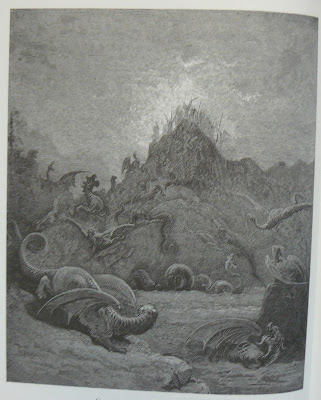
When the Angels travel across the realm of Hell, with the hope of finding the place more livable when first thought, while their leader is still travelling to the gate, we see that they find that Hell is composed of extremes. One half of burning fire, the other of burning cold.
They also speak of the 4 rivers leading away from the lake of fire. Styx, the river of hate.
Acheron, of sorrow. Cocytus, of lamentation. And most interestingly, the Lethe; the river of oblivion, the river that will make whosoever drinks of it forget their woes and their joys; a possible source of surcease for the blighted denizens of Hell. But it is guarded by all manner of creatures, from Medusa's womb, to keep the desperate denizens of Hell at bay.

Despite Hell being composed mainly of two extremes, there are vales, mountains, rocks caves, lakes, fens bogs, dens and shades of death. Quoted verbatim.

Lucifer Revered

As a small observation; It's quite thrilling to see how much the denizens of Hell rely and respect and maybe even love their chief.

He himself must have been taken aback when realising this, because right before that moment he was already scheming with an eye towards eliminating competition for the rule of hell.
It's these moments that really make this book stand out. There's alot of unforeseen subtlety to the character of Lucifer so far.

Panacea in Distraction

Milton speaks of Angels that think on their fates and that in their ruminations the possibility of their temporary forgetting of their pain and sorrow.
In particular the angels contemplate the inherent paradox of free will and divine prophecy with this line;

Of providence, foreknowledge, will, and fate.
Fixed fate, free will, foreknowledge absolute.


Dalliance With the Devil

"And such joy thou took'st with me in secret that my womb conceived a growing burden."

Oh really? Apparently, in Heaven angels have sex-drive. Obviously then they're not sex-less.
Milton had earlier already mentioned the concept of free will before the actual introduction of humanity, which suggests that the angels at that time also had been gifted with free will. Hence leading to this 'dalliance'. Come to think of it, without free will Lucifer could never even have revolted. So what am I actually saying here? I don't know. Doesn't matter. Continuing on.

The woman with half of a serpent was originally born in heaven, at the time of Satan's conspiracy against God. She literally burst, fully formed and fully armed from the left side of Satan's head.
Which begs some questions regarding the origins of angels. Regardless, she is called Sin.

Satan, as quite the narcisist, recognizing his own perfect image in her, immediately desires her and consequently adds incest to his repertoire of sin (but is it though? It's more than a little odd a situation, just like this sentence), and in due course, unbeknownst to him, pregnancy follows. Later they recall their time together as pleasant.

The Son

Pregnant, when the revolution fails, the she-angel is cast down alongside all the rest, but unlike all the rest she is specifically singled out and given a key by givers unknown; the key to the gate of Hell.
In Hell she gives birth to a monster and that monster tears open her lower half, presumably giving her the appearance of a serpent. She names him Death and recognizing lust and hate in its eyes she becomes terrified and flees. But it follows her and rapes her and she then gives birth to more monsters. Who daily crawl in and out of her womb, baying relentlessly, while gorging themselves on her entrails. Like insane little chihuahuas. How perfectly horrible.

She warns satan of the arrow carried by it, because it is capable of killing everything, except God.

Later both are said to follow Satan on a bridge over the realm of Chaos. An allegory for the coming of death to the world of man after his succumbing to sin.
This bridge will later be used by demons to torment the race of man. Except whom God and good angels guard by special grace.

That sentence straight-up managed to raise my hackles. Thanks Milton.

The Gate to Chaos opened

This is a short little segment that starts with the angel, Sin, throwing open the adamantine gates that hereafter can not be closed again and then Satan steps forward to look upon the void. We then get impressions of what he sees. This part contains a whole heap of abstract but fascinating descriptions. Again the primordial themes come into play, giving maximum imaginative jolt for a minimum of vague imagery.

Also, the eternal anarchy of Chaos (quoted verbatim) reminded me of the Warhammer worlds-workings of the realm of Chaos, in particular the referencing of the four different elements. In Warhammer you have Khorne, Tzeentch, Slaanesh and Nurgle. Rage/Bloodlust, Knowledge/Change, Lust/Pain and Entropy/Disease respectively.
Here, in Paradise Lost, we have Hot, Cold, Moist, Dry forever gathered beneath their differing champions under their own banners, with their different clans. Elements at continous war with eachother is very suggestive of warring tribes which only helps to heighten the feeling of similarities.
Likely it was one of the earliest inspirations for Moorcock's visions and ideas of the systems of Chaos and Law, which is after all the direct inspiration for the creation for the force of Chaos in the Warhammer universes.

Satan in the realm of Chaos/ On the nature of Chaos

In the realm of Chaos, Chaos rules supreme and enthroned by his side sits eldest Night.
Around him are Orcus and Hades and the dreaded name of the Demogorgon...


Heh, a dangerous loss of professionalism there but I just couldn't resist. Not as if the standards have been exactingly high up until now, but at least I'm having fun.

With these are also Rumour, Confusion and Discord.
Chaos and Night are more genuine characters while Orcus and Hades are here more to to evoke imagery of the mythological Underworlds, while the latter three names invoke cacophanous noise.
Regardless, I'm getting shades of Dunsany. Allegory, son!

In the realm of Chaos there is noise loud and ruinous. Which is another higly suggestive word in this context.

The fabric of the realm is not air, not water, not earth, not fire, but all of these combined, warring without end. Unless the almighty maker designates them His dark materials for the creation of new worlds. An unstable melting pot of raw materials for purposes of divine creation.

...which thus must ever fight,
unless the Almighty Maker them ordain
 his dark Materials to create more worlds...

This reminds me I should really go and read Pullman's trilogy one of these days.


Milton's foreshadowing

(such was the will of Heaven)

And here we have it; the justifying of the ways of God to men. Thus it begins.
Milton with this sentence states that it was God's will all along that Satan made his way to Earth.

But now at last the sacred influence
of light appears...

In book three we will see some of this from God's perspective when he at last enters the telling.

Badass quotes

-Long is the way, and hard, that out of hell leads up into light.-

-A universe of death, which God by curse
Created Evil, for evil only good;

Where all life dies, death lives,-

-This dark and dismal house of pain-

-With lonely steps to tread-

-Go, and speed.
Havoc, and spoil, and ruin are my gain.-


-With ruin upon ruin, rout on rout,
Confusion worse confounded.-


-Accursed and in a cursed hour,
He hies.-


Saturday, 5 August 2017

Paradise Lost: Book 1 Arrival in Hell


Part 1 The Fall from Grace

After the invocation of the muse, the text moves on to Satan, who has been lying on a lake of roiling fire, together with all the other fallen angels. He recalls, in abstract terms; this is a poem after all, the failed rebellion and the casting down of the rebellious host out of heaven. For 9 days he and the others lie there, immortal but still able to feel pain, unable to die, in tempests and whirlwinds of fire, at the bottom of an abyss, designated chaos.
Then the Morningstar lifts up his head and recognizing beside him, the second highest of the fallen after him, he calls out to him and responding to that one's despondency in the light of their complete failure and fall, he proposes a new ideology. one that is firmly and squarely opposed to God and that one's whims and designs.

Part 2 The Birth of Pandemonium

Satan rises and then calls out to the as yet unmoving host of the fallen angels and shames them into rising from their stupor, and from their bed of fire. A rollcall ensues, with a caveat that though most of these fallen have as yet no names, they will earn their names in due time, in the ages yet to come.
The Host then proceeds to build a city out of a sulphur-spewing mountain, and Pandemonium is born.
A blaring of horns then announces a gathering of council for the worthiest among the multitudes.


Interesting Bits

Thoughts on Description


I mentioned at the start that the descriptions are abstract, but in reality the setting is so primordial that It could simply not be described other than this. A summoning up of hellish imagery with fire and smoke, with an emphasis on light and dark. Archetypes that define the world and the characters in them. This is, and should be, after all, the text that comes before all others. An allegory for a growing imbalance in chaos. An imbalance that pushes that chaos aside and in its stead places Order supreme. Composed of Good and Evil. Light and Dark. God and the Devil.

I love the lyricism and the awesome and terrifying images it demands the reader creates. Reading it out loud, which is really the way these types of things should be read makes it seem like a litany, an invocation that summons up awe and horror.

The Devil and the Details

As a reader who always reads with a sympathetic view towards characters, someone who needs his villains to be well constructed and explained. I must say, Satan obviously comes out very reasonable and understandable in this. Prideful and arrogant, sure. But not even close to the despondant being, who as he was just cast down out of a paradise, he really ought to be. Though, like the other fallen, he exists for a while in a state of shock, he is the first to rally himself, and soon after, is the one to also rally the others, through guile and confidence. the host looks to him for surety, and he in turns provides it. It is courageaous and determined. He rises with the immediate idea to oppose himself completely to God and his creation.


Clad in War

Every angel is a warrior, all have weapons and are clad in armour.

God is frequently described as having 'thundered'. Satan himself is scarred by it and, though still magnificent, his light is dimmed. It's something that is present in some of the other books as well.

The Devils, named

One of the more surprising things was that when Satan shames the fallen angels and calls on them to arise, a host of recognizable names start to present themselves; most of them demonic entities and false gods that are referenced in the bible, but also some others from main religions, and references to the Greek and Roman Pantheons.
Other recognizables are Belial, Azazel (who you might know from the badass Denzel Washington movie; Fallen, If you haven't; go watch it, old but very moody and cool) and Dagon. which might have been the biggest surprise. I always thought that Dagon sprung forth out of Lovecraft's imagination but apparently he's been around a while already.


Bad-Ass Quotes

-Is this the region, this the soil, the clime?
This the seat that we must exchange for Heaven?
This mournful gloom for that celestial light?-

-Furthest from Him is best-

-Hail Horrors, Hail Infernal World!-

-The mind is its own place, and in itself, can make a heaven of hell, a hell of heaven.-

-Better to reign in Hell than serve in Heaven.-


Saturday, 1 July 2017

Next up...Personal stuff

With the big Ombria in Shadow post out of the way I'm at a point where I can devote more time to individual blogposts again. But during my life, I've found that my interests tend to move around in great cycles.
And now it seems I've arrived at an old one again and that this has become immediately reflected in my choice and acquisition of fiction.

Now, I've already started writing a whole bunch of personal posts to tie into this because I find (maybe wrongly) that this background information is necessary.
It's mostly personal stuff about me. Some background involving my religious upbringing, certain views I have of the world and how that relates to and influences my interests in books and fiction in general.

Some of these posts have already been brewing for a while in the background. And I guess now is when I loose them on the world.

There are alot of considerations that slide into focus with this. How much of yourself do you share? In essence, you are putting yourself on display, to be scrutinized, to be taken the piss out of, mocked, laughed at or maybe, possibly, hopefully even to be lauded or to become an inspiration for someone else. But first and foremost, without taking the consequences into account, you're telling strangers about yourself. Personal and maybe private stuff. It's scary.

There's also the pressure of getting it right. You don't want to piss people off.
For one, nobody likes being told that nothing really matters. It's a thing nobody wants to hear, let alone believe. But in the end you write what you want and what you have the energy for. And the stuff you love will end up giving you that energy. So you try to honour it and do the best you can.

You slave and you slave and there's this fear that this thing you're putting so much of yourself in can and will be shot down by some random commenter taking issue with your views, ideas or even just your phrasing. Glass houses break easily. And what comes next will take a great deal of transparency.

It's obvious that the blog has evolved from what it was in the beginning. There's less objectivity, but I believe still enough reasons to keep it up. There's always new stuff on the horizon and I'd like to share of it in the future.

To paraphrase Itkovian.
It seems my work is not yet done.

Sunday, 25 June 2017

Ombria in Shadow: an Explanation


Art by Grzegorz Domaradzki


Calling this post an explanation seems mightily bold though. It's in fact a very assumption-based analysis but as I'd like people to see it I'm keeping the title but I'm going to be slightly more humble and refer to it from hereon out as my interpretation. And to completely undercut that, I'll just share, with great pretentiousness, a quote by Lord Dunsany.

"And there is a path that winds over the hills to go into mysterious holy lands where dance by night the spirits of the woods, or sing unseen in the sunlight; and no one goes into those holy lands, for who that love Oojni would rob her of her mysteries, and the curious aliens come not."

---Part the third: A Dreamer's tales, The Idle City---

In my review of Ombria in Shadow I mentioned that interpreting and understanding how the narrative fits together isn't integral to the enjoyment of it. I'm reliably informed that having no clue as to the meaning of events in a Patricia Mckillip novel is part of the experience. But, of course, I couldn't let it go and despite my review, because I'm a contrary sort of person, I'm still going to talk about what I eventually made from it.

Specifically, this blogpost is about the nature of Faey; the sorceress who lives below the city, the nature of Ombria itself, the climax of the novel and the concept behind (hopefully) the reflected world.

I will not be talking about how satisfying the novel is. how good the relationships are and how unconventional it is to have the love between family members put center stage. For that I'll refer you to my review. Ombria in Shadow Review Maybe go read the review first and decide to read the novel, then of you can't figure it out I might be able to help out a bit.

What follows here is my attempt to rationalise many of the more mysterious elements of the story by giving them a place in a complete and all-encompassing narrative within the confines of Ombria in Shadow the novel. As such I'll be using any and all elements in the novel that fit my interpretation. Translation: Spoilers abound.

If you plan on reading Ombria in Shadow and don't want to be spoiled, I suggest you stop reading here. If you haven't read it, you're going to have difficulties following along anyway.


SPOILERS AFTER THE JUMP

Thursday, 8 June 2017

Clive Barker Quote

"That is not to say my attitude to the work does not continue to change. In the past 14 years I've gone through periods where I was thoroughly out of sorts with the novel, even on occasion irritated that it found such favour with readers when other stories seemed more worthy.

And in the troughs of my discomfort, I made what with hindsight seems to be dubious judgments about fantastic fiction as a whole. I have been, I think, too disparaging about the "escapist" elements of the genre, emphasising its powers to adress social, moral and even philosophical issues at the expense of celebrating its dreamier virtues.

I took this position out of a genuine desire to defend a fictional form I love from accusations of triviality and triteness, but my zeal led me astray.
Yes, fantastic fiction can be intricately woven into the texture of our daily lives, adressing important issues in fabulist form.
But it also serves to release us for a time from the definitions that confine our daily selves; to unplug us from a world that wounds and disappoints us, allowing us to venture into places of magic and transformation."

Clive barker, from his introduction to the 2001 Pocket Book edition of
Weaveworld

Tuesday, 16 May 2017

Reading Update

I've started reading Von Bek and it's already better and more engaging than the two Elric volumes I've read since last month.


It's not that the 2 Elric books were bad, boring or unambitious... They're not.
But still, they did take me a month to read though, both of them together at a little over 600 pages. I've literally read more of Von Bek, in one day (which was last saturday), in a few sessions than I have in any 4 consecutive days over the last month.
I also have no desire or interest to actually talk about the Elric books as they just seem so run of the mill. (though I did end up writing alot: completionist is as a completionist does, I suppose. As a consequence the two elric books will get their own post. )

So then, with that out of the way, about Von Bek.
The first thing that is noticable is that the story's in first person. the framing device and narrative conceit for the story is that this tale has been, not written by but, only translated by Michael Moorcock from an unearthed Manuscript found in the walls of an old monastary.

The second thing you'll most likely notice is the morally ambiguous, selfish and self-centered, very complex hero that puts what I've read of Elric to shame. (though as soon as we get a little mileage with him it does seem like Moorcock just put some dark stuff at the start of the book so he can be continuously noble later on.)

Something that I though was very well done was the build up for the various mysteries all leading up to the big reveal, even knowing beforehand what it is, it being the book's central premise, made me grin almost constantly.

The conversations with Sabrina, including underlying sexual tension, had me riveted and I can honestly say it's more fun than anything I've read in a month. Specifically I want to draw some attention to that part about Eve; you'd think this wouldn't be an original take on the serpent or used as a vehicle for feminism, but it's certainly the first time I've come across this idea.

 And then immediately after that, the lie is given to the lifting up of freedom as a concept and an ideal that everyone should and does strive toward. And I found myself easily agreeing.
It's like that time In The Dark Knight when the Joker equates himself to a dog chasing after cars. "I wouldn't know what to do with one if I'd caught it." A slave to nature, not logical reasoning.

Reading these parts it's like looking at constant barrage of fireworks, especially for me.

Of course none of these are new themes and virtually all of them have been adressed in, say for instance a work likex Malazan, but never just as plainly and clearly, without disambiguation, as here.


It's also that it feels like these themes speak directly to me.
Themes of faith, metaphysics and religion; specifically the variations of and in christianity.
Oh, and despite Ulrich strident complaints of not actually willing to engage in discussions of a metaphysical nature; at this point it's become unavoidable.
He's in the wrong series of books to get away from it.

Also this little quote. A very obvious recognition of the darkness that comes before.


Of course, this also ties into the straying into nihilism stemming from loss of faith that I've been suffering from (or been delivered into). This isn't a recent thing, it's just something that rises occasionally from its dormancy and starts yanking my chain, to drag me down into a dark well.
I suppose it's a goal and purpose thing. Or lack of it.

So anyway, so far, the book is a winner on almost every level for me.

Also. I saw a mouse when I came down the stairs this morning.

A terrified little creature, blinded by the (flash)light of a higher being.
Serves him right for keeping me up at night.

I gave him some cheese though, so it's all good.