Everyone who doesn"t like Assassin"s Creed Odyssey hasn't played with Cassandra as the Protagonist.
Showing posts with label Meta. Show all posts

Thursday, 10 October 2019

Bloodborne Comic, A Song of Crows


Well. Eh... This was weird.
I'm honestly quite unsure of how to begin this one.


     Song of Crows is the third installment in the Bloodborne comic series, though every installment stands alone, their stories unconnected. Right out of the gate everything seemed kosher and fine: The art was awesome and though the writing was a bit confusing, I did already get the sense of what the comic was going for, already seeing the hints of a full-circle-resolution type thing that was only going to make sense at the comic's eventual conclusion. But then... shit got really weird.

     Writer Ales Kot did make it pretty clear at the start that things weren't going to be so straightforward.
Woven into the narration where our protagonist Eileen questions her place in time and her reasons for her decision to bury the dead of Yharnam there is also a musing on the nature of the story about to be told. Tres meta.


If you put the fragmented narration together it states quite clearly, addressing both Eileen and us the readers, and it informs us:

No matter how hard you try to understand, you'll never know the whole story.
Not your own, not anyone else's. At certain points you may be convinced you do.
 You may even choose to convince yourself that you've found the right angle from which to see the totality of the world, of the universe. You'd be wrong.
For time is the deepest grave of all. And graves tell no complete stories.

There's a hole in the center of the story.
There's a hole in the center of my story. And time is the deepest grave of all.
It has no shape. But time has a flow.
Time doesn't have a shape. But we make shapes of time.


     First things first: This isn't exactly Eileen the Crow's story from the game. It is also not her origin story. Once again, if you came into this comic looking for answers, you're going to be disappointed. Eileen the Crow from the game either vanishes or is killed by you, at the end of her story arc in the game, never having given in to the insanity or the blood-lust that many of the game's other characters do. At no point before that ending did she gave in to madness.
    When we meet her in the game, she, in spite of her age, in spite of being cut off from the Hunter's Dream and thus susceptible to true death, continues to hunt the hunters who've gone mad or who've become beasts, holding fast to her duty, until it finally kills her, or until, after you've helped her in her fights and she finally realizes that she just cannot continue, she ends up giving you her blessing, after which she vanishes from the game. It is unclear what happens to her.

-----

     If you take the comic's story as possible, then it takes place after that vanishing. But almost nothing else of this story can be discerned. We follow Eileen as she tries to make sense of her situation, confused as she is about her place in time. At points we are gifted with flashes to her childhood, which may not actually be scenes from her childhood and instead could just be a symbolic representation of an event yet to come, or an event that has happened but which she is hiding from herself. Or there might be some strange synchronicity thing going on where one lake hides a dead child, the other a Vacuous Spider or something. The Child might also just be a representation of Eileen herself.
     There's also another hunter who shows up and tries to guide her and who Eileen ends up fighting, but who I'm sure is Eileen herself, and since this Hunter's eyes are visible, I think it's safe to say that this is a representation of Eileen's consciousness that has been given insight. Although she's likely not even there.


What I'm trying to get at is that this is a very non-linear comic book, and that it is all rather experimental. I ended up loving it, but even here at this time when I think I've understood a lot of it, it still remains bewildering and really quite disorienting.

     What does become clear is that there is a definite point where Eileen lost the plot, where she definitively lost her grip on her place in time and reality; at the end of Issue 2 when she met Rom the Vacuous Spider and the spider likely gifted her with eyes, though it is likely this event took place far in advance of issue 1.


     To Have Eyes in the world of Bloodborne is to have gained knowledge, and to have become intimate with the dark secrets of the Bloodborne universe, which frequently also leads to true Lovecraftian insanity of the mind. Which is where Eileen finds herself at the start of the comic.
     The meeting with the spider is represented by a rather experimental approach and the delivery of both subliminal and symbolic imagery. It might also have been padded out a little too much.


A hole in the ice, becomes a whirpool, which becomes a crow tearing out the eye of another crow, which, weeping suppurating goo, becomes the Blood Moon, gashed and weeping fluids, and becomes the other hunter with her visible eyes and all of them originate from the dark eyes of Rom the Vacuous Spider. Or something.


I honestly love it.


It's this type of convoluted story telling that is so easy to dismiss as a creator deep inside his own arse, or trying to be artsy or deep, but because Bloodborne's own stories tend to be focused on insanity, dreams and the nature of reality, and the stories and characters tend to be very difficult to follow or even understand, their information so hidden and secret, that I do think, that even though it certainly won't be for everyone, that of the three so far, this might be the comic that's closest to it in spirit. 

Either way, it was an unsettling but pretty great experience.
Early next year will see another Bloodborne comic and I'm really, really looking forward to it.


In the meantime. If you are confused by all of this but are starting to get interested in Bloodborne. You could do worse than to take a look at VaatiVidya's story video. The man gives a pretty coherent and insightful look at the world, and is likely to really calm you down with his dulcet tones.


-----

One last thing though. A little niggle I had about A Song of Crows:
Strangely enough. Though Eileen is said to perform sky burials in the game, as a way to honour and 'help' the Hunters who've gone mad, and the first time we see her there, she is standing by corpses she hoisted into the air, and even though there are a few depictions of a form of sky burial in both Eileen's investigation in issue 1 and her flashbacks to a time in her youth in subsequent issues, in issue 1 she bizarrely is introduced to us burying corpses in the ground. I'm not sure why she's introduced burying in the ground rather than actually performing sky-burial, which she then continues to end up doing anyway later in the comic. It's an odd little inconsistency, I think. Or it could be I'm just missing something.

Sunday, 2 July 2017

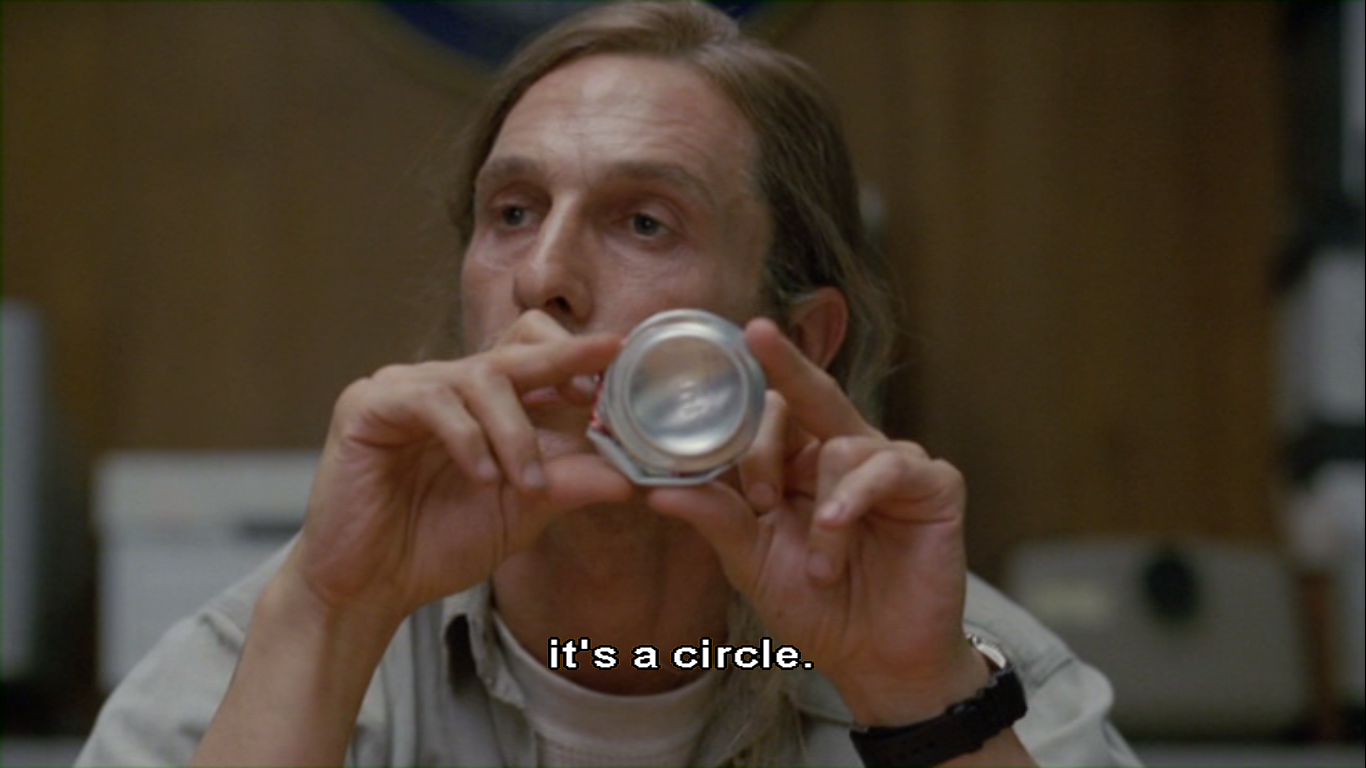
Personal: Time as a flat circle and déja vus


I used to have déja vus.
Over the space of a couple years, between 13 and 16, I guess, while growing up, these déja vus came accompanied with a sense of horrific and terrifying doom.
These days I only occasionaly have déja vus and then when I do, they pass pretty unremarkably.

But back then, they made me feel as if the world was going to end, or as if I had done all this before and it was all heading somewhere horrible.
During these times I moved through a waking nightmare.
Moving through the world, being dreadfully aware of everything I was doing, all my actions playing themselves out over and over again. without me being able to break the pattern.
It became a desperate game, laden with meaning, trying to anticipate where the déja vu would go.
These periods would last anywhere up to a minute and they would occur frequently, especially when I was sleep deprived.

A time of emotion close to terror. A horrible feeling accompanying every action.
I would desperately try to break the pattern of these actions, and instead; they would start to stack up.
So I would try and break their pattern by doing something a 'past self' wouldn't have done. and frequently this would only perpetuate and enhance the feeling.
It felt as if, in past lives, I had tried these same things already.

Naturally this would only terrify me even more, until after a while I would end up just sitting still, rigid in shock and horror, mostly passive, filled with a sense of doom, until it all went away.
Of course, all of this can be ascribed to growing up, to a changing body. hormones and sleep deprivation, together raging through a body under the control of a mind ill-equipped to fit into a world geared to maximum efficieny.

But still, you can never really know.

So when in True Detective, Rust Cohle starts to talk about his 'Time is a flat circle' theory. I sat up and sat waiting with bated breath.

"Someone once told me that time is a flat circle. Where everything we've ever done or will do we're gonna do over and over and over again"


"Ever heard of the M-brane theory detectives? It's like, in this universe, we process time linearly. Forward. But outside of our space-time, from what would be a fourth-dimensional perspective, time wouldn't exist. And from that vantage, could we attain it, we'd see, our space-time would look flattened. Like a single sculpture of matter in a superposition of every place it ever occupied. Our sentience just cycling through our lives like carts on a track.
See, everything outside our dimension, that's eternity. Eternity looking down on us.
Now, to us, it's a sphere. But to them, it's a circle."

"In eternity, where there is no time, nothing can grow, nothing can become, nothing changes.
So death created time to grow the things that it would kill. And you are reborn, but into the same life, you've always been born into.

Well how many times have we had this conversation, detectives?

Well who knows, when you can't remember your lives you can't change your lives. And that is the terrible and secret fate of all life.

You're trapped by that nightmare you keep waking up into."

"Again and again and again.
Forever."

Now, apparently this theory is based on Nietzsche's philosophising and I don't actually know If I believe anything of the flat circle view of the universe. But it's something that gives an explanation to something that really scared the shit out of me in the past.

A glimpse into the workings of the universe, hinged on, based on, seemingly backed up by the experiences that I myself had. A meta explanation for life. a reason, though not a purpose. In fact the opposite of purpose. A taking away of meaning. Utterly bleak nihilism. But not exactly.
There was still meaning and purpose given to moments of sheer existential dread. a tantalizing hint into the workings of reality. And it's here where the search for meaning becomes meaningful in itself.

 And for me the key is that the déja vus would end. There came moments when I would 'beat' the 're-living'; where I would do something new, that I hadn't done before and thus end up breaking the pattern.

Small victories.

Time as a flat circle.

An absurd notion, yes, of course.
Yes, Yes, but... also: Maybe.

Either way, it's one of the reasons why True Detective hits so close to home for me. It gives a meaning, to something I myself have experienced and it puts it into a grand, albeit horrific, narrative.
Purpose, out of a placing of the self that is me. Though it does place it into a bleak and uncaring, looping existence.

But hey, the Déja Vu ended, when I did something different either out of action or inaction. So, even though it's a drop in the ocean I still changed something. And though we might be placed in the same life and go through the same motions, sometimes things change. And maybe that small change could signal a big one. But then there would also have to be a final purpose and that's something that is very hard to credit.

You know, for all my shitting on King, he did do something very right.

The man in black fled across the desert, and the gunslinger followed.


Monday, 26 June 2017

A look-back at the Explanation post, with a sprinkling of Dream Bears

Phew.

The original number of post-its was much larger,
This is what I was left with on the final day of the post.

I'm really happy to have that done.

Remember when I said I'd like to say something special about every Fantasy Masterwork that I review/look at? (Wait, did I even say that here on the blog?)

Weeeeeell...

About Ombria in Shadow I didn't have much to say for the longest time because behind the scenes I kept working on that aspect of the review. I had figured out by that point that my hypothesis or at least that parts of my hypothesis concerning Faey was correct. But I was stumped on how it all tied into the rest.
One of the most glaring problems then was my inability to comprehend the nature and workings of Domina Pearl.

And then I had a moment of revelation. It tied into a dream I myself had during this period.
In the dream I was chased by a bear. Or rather in the dream I kept seeing a bear in the distance that I knew would come after me. Now, normally I'm not a lucid dreamer and I bearly (sorry) remember much of them afterwards. But I ended up remembering this one though.

So. I kept seeing a bear in the distance. And you know how in dreams, scenes flow seamlessly from setting to setting, location to location, day to night and so on? I kept flowing between various dreamscenarios and at various parts I remember seeing the bear. It kept coming closer and closer. but always took a while to arrive in the dream or dreamlocation of the moment.

In the end I arrived home; from Alaskan wilderness, to corrugated scrap construction towering in the middle of a primordial forrest, to woods, to the underbrush at the back of the yard. And I was walking from the brush to the windows at the rear of the house, one of which is a sliding door working on a set of tiny wheels within the heavy frame of the wood. And when I arrived I looked around and saw that damn bear again.

It was perched on the fence dividing our yard from that of our back-neighbours.
It was already on my home turf. And then it jumped from the fence into the brush like some ridiculously large cat.

At that point the dream was already spiralling out of control.
I ran inside and threw/slid the door closed with such force that it slid open a bit again, and without waiting for it to stop moving or put it in an even marginally more safe position threw the lever that switches the door's resting point from wheels to frame, thus locking it securely, or so I thought.

I ran to the dividing door to the living room where my dad and various family members were gathered watching tv. I slid it open and closed it behind me. I looked at the various members of my family gathered within.

In the hopes of conveying how much trouble we were in I swore at my dad, using various expletives I knew he wouldn't like. I gambled that he would either recognize my seriousness and follow orders without questioning them or that he'd start to chew me out over using swear words. Of course, because my subconscious is a little bitch, he did the latter.

He started to harangue me and my shoulders slumped. I turned around, opened the door and looked out at the sliding door to the backyard.

A nightmare.
The sun had dissappeared, hidden by dark clouds and everything had taken on hues of gray.
The bear was still a bear, but it was transformed.
It was still covered in brown fur, but its arms had elongated.
The upper arms were very thin, the almost human hands and forearms were grotesquely large, swollen shaggy with matted black clots of hair. It stood on its hind legs pressed against the crack of the door that I, in my haste, hadn't closed. Black shadows pooled out of and covered his eyesockets where black glistening marbles lay hidden. Something dripped from its open mouth.
I can't remember if it made a sounds.
Worst of all; with its shaggy paws it was slowly forcing open the sliding door.

I turned around and closed the living room door and looked at my family.
They hadn't moved. They had in fact all gone back to watching the tv. Behind me the bear was still forcing its way in and it would be in the room by the time I could get everyone out of the living room.

At that moment the realization came that I could still run out of the door to the hallway, but that everyone in this room would die.
And so I woke up.

In a way that dream gave me a good look at the nature of the Pearl. Spoilers particularily how she keeps popping up from dream to dream, escalating everything as she does. I wonder if there comes a time when Faey just loses complete control and as a result, the dream just ends and Ombria just disintegrates? end spoilers.

Anyway; So the Interpretation post took a very long time.
I've been busy with it rather constantly.  Writing, editing, fact checking, rewriting and re-fact checking whenever a new permuation of the theory presented itself. and believe me; there were more than a few times that that happened. A frustrating but at times also an exhilarating process.

I posted the final interpretation yesterday and though it isn't perfect by alot of standards, certainly not my own, I'm at the very least extremely glad it's now done.

The whole thing took me about 2 months maybe, from way back before I posted the Ombria in Shadow review itself. That original post took a while too. That was mostly because there was so much to look at and so many reasons and interpretations to think up for every aspect of the book, and at the time of the review, I still believed I could fit it in with the review itself.

Obviously that original intention didn't hold up.

There were times when I had given up and times when I just felt burnt out. But in the end it did get done.
Looking back at the whole thing I believe everything interlocks rather neatly, though still not perfectly. But you know, at one point you just have to say; this is enough.

Mostly because the focus on the interpretation devolved almost into a sort of mania and as a result everything else fell by the wayside. It's something that has happened a few times in the past whenever I bump on something that interests me deeply but that I can't immediately find any explanation for and I end up having to figure it out on my own. Most notably with a book I mentioned in the 'Extras' post: American Gods.
I took a stab at that book there But I'm really not of a mind to adress it any further.

Next up, a reading update.

Sunday, 25 June 2017

Extras regarding the interpretation

This post, if read at all, should be read after the Interpretation post.
Spoilers after the jump, Obviously.


Ombria in Shadow: an Explanation


Art by Grzegorz Domaradzki


Calling this post an explanation seems mightily bold though. It's in fact a very assumption-based analysis but as I'd like people to see it I'm keeping the title but I'm going to be slightly more humble and refer to it from hereon out as my interpretation. And to completely undercut that, I'll just share, with great pretentiousness, a quote by Lord Dunsany.

"And there is a path that winds over the hills to go into mysterious holy lands where dance by night the spirits of the woods, or sing unseen in the sunlight; and no one goes into those holy lands, for who that love Oojni would rob her of her mysteries, and the curious aliens come not."

---Part the third: A Dreamer's tales, The Idle City---

In my review of Ombria in Shadow I mentioned that interpreting and understanding how the narrative fits together isn't integral to the enjoyment of it. I'm reliably informed that having no clue as to the meaning of events in a Patricia Mckillip novel is part of the experience. But, of course, I couldn't let it go and despite my review, because I'm a contrary sort of person, I'm still going to talk about what I eventually made from it.

Specifically, this blogpost is about the nature of Faey; the sorceress who lives below the city, the nature of Ombria itself, the climax of the novel and the concept behind (hopefully) the reflected world.

I will not be talking about how satisfying the novel is. how good the relationships are and how unconventional it is to have the love between family members put center stage. For that I'll refer you to my review. Ombria in Shadow Review Maybe go read the review first and decide to read the novel, then of you can't figure it out I might be able to help out a bit.

What follows here is my attempt to rationalise many of the more mysterious elements of the story by giving them a place in a complete and all-encompassing narrative within the confines of Ombria in Shadow the novel. As such I'll be using any and all elements in the novel that fit my interpretation. Translation: Spoilers abound.

If you plan on reading Ombria in Shadow and don't want to be spoiled, I suggest you stop reading here. If you haven't read it, you're going to have difficulties following along anyway.


SPOILERS AFTER THE JUMP

The mysteries of Ombria

The Fairy Tales

To figure out the core mysteries behind Ombria in Shadow, we need to take these three Fairy Tales as scripture. Though all must be looked at with a wary and scrutinizing eye because Lydea, the teller of the fairy tales, is an unreliable narrator with an incomplete and skewed view of the narrative.

The Fairy tale of The Fan of Two Cities

"One side was a painting, the other an intricately cut silhouette, a shadow world behind a painted world that could be seen when the fan was held up to the light.

It had belonged to Kyel's mother.

Lydea opened the fan slowly, revealed the colored side.

'This is Ombria, my lord,' the goose said. 'The oldest city in the world.'

'The most beautiful city in the world.'

'The most powerful city in the world.'

'The richest city in the world.'

'This is the world of Ombria.' The goose tapped a tiny jade-green palace overlooking the sea, 'This is the palace of the rulers of Ombria. These are the great, busy ports of Ombria. These are the ships of Ombria...' The goose took the fan gently in its beak, angled it in front of the lamp. Light streamed through the fan. 'This is the shadow of Ombria.'

A city rose behind Ombria, a wondrous confection of shadow that towered even over the palace. Shadow ships sailed over the waters; minute shadow people walked the painted streets.
The future ruler of Ombria, lips parted, surveyed his domain.

'Tell me about the shadow city. Will I rule there too?'

The Goose's voice became dreamy, entwined in the tale.

'The shadow city of Ombria is as old as Ombria. Some say it is a different city completely, exisiting side by side with Ombria in a time so close to us that there are places - streets, gates, old houses - where one time fades into the other, one city becomes the other. Others say both cities exist in one time, this moment, and you walk through both of them each day, just as, walking down a street, you pass through shadow and light... So, my lord, who can say if you will rule  the shadow city? you rule and you do not rule: it is the same, for if you do rule the shadow city, you may never know it.

Then how- Then how do they know it is there?"


The Fairy Tale of the Sorceroress. Epilogue

The fox stroked the prince’s hair while he shook away the moon and replaced it with the sorceress, who had one amethyst eye and one emerald, and who wore a black cloak that shimmered with ribbons of faint, changing colors. “I am the sorceress who lives underground,” the prince said. “Is there really a sorceress who lives underground?” “So they — ” Lydea checked herself, let the fox speak. “So they say, my lord.” “How does she live? Does she have a house?” She paused again, glimpsing a barely remembered tale. “I think she does. Maybe even her own city beneath Ombria. Some say that she has an ancient enemy, who appears during harsh and perilous times in Ombria’s history. Then and only then does the sorceress make her way out of her underground world to fight the evil and restore hope to Ombria.” “My tutor goes everywhere in Ombria. Maybe she knows where the sorceress lives.” “I wouldn’t be surprised at anything your tutor knows.” The sorceress descended, long nose down on the silk. Kyel picked another puppet up, looked at it silently a moment. The queen of pirates, whose black nails curved like scimitars, whose hair was a rigid knoll in which she kept her weapons, stared back at him out of glittering onyx eyes. Kyel put her down as silently, frowning slightly. 

The Fairy Tale of the Princess and the Locket, Epilogue

"She settled herself beside him, absently picked up the black sheep, whose eyes were silvery, whose long mouth curled into the faintest smile. “Tell me the story of the locket.” “Once upon a time, my lord, in the best and the worst of all possible worlds, a princess fell in love with a young man who loved to draw pictures.” “Like Ducon.” “Very like your cousin. Every day for a year, she gave him a rose. She would pick it at dawn from her father’s gardens and then take it to the highest place in the castle, a place so high that everyone had forgotten about it except for the doves that nested beneath the broken roof. There, she had found a secret door between the best and the worst of the worlds. Every day, they would meet on the threshold of that door. She would give him a rose, and he would give her a drawing of the city he lived in. They loved each other very much, but of course they could never marry, because they were from different worlds: she was a princess and he an artist who had to paint tavern signs to keep himself fed. “One day, after a year had passed, the princess brought him a child along with a rose. It was the happiest day of her life because she had given him their child, and also the saddest day of her life, because he came to her with his heart’s blood on his paper instead of a drawing. Someone had seen him with the princess and had punished him. So, in her love and sorrow, she crossed the threshold to his world, to stay with him while he breathed his last.” “His last what?” “Breath. In her grief, she pulled the locket from her throat and placed into it a rose petal, three drops of his blood, and a sliver of his charcoal. But after he died, she found that she could not get back into her world with the child, because it was half of the best and half of the worst, and neither world would accept the baby. But the princess, after many days and nights of ceaseless weeping and searching, finally left the child with a wise and powerful woman who would know, with her vast knowledge and experience, how to raise a child of both worlds. At last the princess could return to her own world. The only thing she had to leave with her child was the locket, which held all the memories of her love…” 


The Intimations

Next, there are three conversations that ask important and interesting questions that also lie close to the central mysteries of the novel.

The Two Cities

"One side was a painting, the other an intricately cut silhouette, a shadow world behind a painted world that could be seen when the fan was held up to the light.

It had belonged to Kyel's mother.

Lydea opened the fan slowly, revealed the colored side.

'This is Ombria, my lord,' the goose said. 'The oldest city in the world.'

'The most beautiful city in the world.'

'The most powerful city in the world.'

'The richest city in the world.'

'This is the world of Ombria.' The goose tapped a tiny jade-green palace overlooking the sea, 'This is the palace of the rulers of Ombria. These are the great, busy ports of Ombria. These are the ships of Ombria...' The goose took the fan gently in its beak, angled it in front of the lamp. Light streamed through the fan. 'This is the shadow of Ombria.'

A city rose behind Ombria, a wondrous confection of shadow that towered even over the palace. Shadow ships sailed over the waters; minute shadow people walked the painted streets.
The future ruler of Ombria, lips parted, surveyed his domain.

'Tell me about the shadow city. Will I rule there too?'

The Goose's voice became dreamy, entwined in the tale.

'The shadow city of Ombria is as old as Ombria. Some say it is a different city completely, exisiting side by side with Ombria in a time so close to us that there are places - streets, gates, old houses - where one time fades into the other, one city becomes the other. Others say both cities exist in one time, this moment, and you walk through both of them each day, just as, walking down a street, you pass through shadow and light... So, my lord, who can say if you will rule  the shadow city? you rule and you do not rule: it is the same, for if you do rule the shadow city, you may never know it.

Then how- Then how do they know it is there?"

Here the story is cut off, on the cusp of a question that through circumstance is not answered, a technique that Mckillip will employ 2 more times over the course of the novel, always with themes and questions pertaining to the mysteries at the heart of the story.

Mckillip, in these three conversations that are as close to revelations to the true nature of Ombria in shadow as she's willing to go are usually immediately dropped after an important but abstract suggestion. On their own, these conversations are misleading and too abstract to follow to their intended meaning; but put them together and ideas start to present themselves.

Dreams coming to life
(p163 FM ed.)
"The silvery eyes saw her clearly then: someone real, standing in time, not in a dream, with a face he recognized and thoughts he could guess at if he had to.
How strange, she reflected. How strange to be in a dream one moment and in the world the next, and to know the difference in the blink of an eye.
'You have a very peculiar expression on your face,' he commented drowsily.
'I was just thinking.'
'About what?'

'About how we know what's real. How we wake out of a timeless place and recognize time.
How you know me here, now, even when nothing or anyone else in this place is familiar.
I might have been wandering through your dream, but you knew immediately which of me will bring you paper.'


He was silent for so long, still clasping her wrist, that she thought he must have fallen asleep without knowing it.

He said finally, 'Say that again.'
'I can't,' she answered helplessly. 'It was just a thought. I gave it to you.'
'Something about dreams coming to life-'


'That's not what I said.'
'That's what I heard.'"

It happens


'"I thought', she said uneasily to Faey, 
'that it was you making all the noise out there. What is it?'
'It happens,' Faey answered obscurely. 'This is a good place to wait it out, It's outside of time, and you'll remember better afterward.'
'Wait what out? Remember what? What exactly is going on out there?'
The sorceress shrugged slightly; an eyebrow tilted.
'I'm never sure. But it seems to happen whenever I come up from the underworld.'
Mag stared at her, speechless."

Sunday, 28 May 2017

Run-up to Something Wicked This Way Comes(Or how the ending can just ruin your reading experience despite the enjoyable road to get there, or maybe not.)

I just finished Ray Bradbury's Something Wicked This Way Comes.

What an utterly silly ending.

And that silliness, the juvenile antics, the desperate laughter against the coming dark, is, of course, the point. "...We can't take them seriously...".

But when a scene doesn't connect with the reader that scene can only come off as bad. Badly and deeply silly. foolish and corny and ill-advised. There's a complete disconnect between the emotional investment in the various understandable and quite likeable characters, the various chapters of really well paced build-up of tension (which is a really hard thing to get right and yet there were several memorable tense scenes throughout the book). But then suddenly at the resolution its hoped for catharsis is then made a mockery of.

I feel let down.

By the end we're meant to laugh or cry in joy, in relief at the passing of danger and the end to mounting tension.
A heartbreaking moment in which we and the characters choose to give over to joy rather than fear. A hopeful message and a good one too. Like many lessons in the book, it is one to live your life by. The problem is that they, in what is a fraught and hopeless moment, the characters, deliberately make the choice to become happy in order to change the ending.

In a desperate and dark situation you can not just choose to be happy. To genuinely laugh, joyfully, in the face of your own despair is almost ludicrous, to laugh in such a situation is to tempt madness. And I'm not talking about wry laughter in recognition of some irony.. I'm talking about genuine Happy Joy, in full knowledge that that joy will change the outcome of whatever happens next. Knowing that without your positivity you get a bad ending. We're treading close to a paradox here. Belief as a tool powerful only in proportion to the power of your believing. And you, a rational being, knowing it.

But there's more.
At that point, in that scene, the writing is just as strained as the decision of the characters to be joyful.

Bradbury's writing and in particular his dialogue, already overly crafted, gets to be even more so. Dialogue in general is a hard thing to get right, but he seems to go an extra mile here; stunted sentences induced by despair and near-panic, juvenile expository exclamations. accompanied to the singing of several corny songs.

For other people this might very well be perfect. It just didn't connect how it should have with me.

And yet, it was close.
I know it was. I could almost feel it.


So this ending at first glance seemed like it just ruined my good reading experience up until this point.
But then, maybe I found something else in this scene.

The scene isn't genuinely touching, it isn't happy, it doesn't easily give rise to joy. And maybe it's not supposed to.

Just like the characters, we actually have to work for it. Deliberately create that emotional response. You have to strain for it to achieve it, strain to accept it. And then like our heroes, suddenly you deserve the happy ending.

In the end,
maybe that is the genius of this scene.

A perfect parallell of intent between reader and characters.


Or maybe I'm just emotionally dead.

Thursday, 13 April 2017

Review: Ichabod Azrael

Here is The Grievous Journey of ICHABOD AZRAEL (and the dead left in his wake)


I mentioned before that I'd had my eye on this one for a while. I was interested in this one not just because of the cool cover or because of the blurb which pointed to a conflict between mortals and the powers of Heaven and Hell, but also because of this little youtube video, which is part of the ABC's of 2000ad youtube series, where they go through their entire backcatalogue, giving 3 minutes of information about every individual title that has been printed in their publishing history;


Among other things; such as comparing it to Garth Ennis' Preacher (which I don't like all that much, but the idea at its core is still an interesting one and the tv-show is pretty damn entertaining), what in particular drew my attention was that it was going to be a metafictional tale; meaning that it would be aware of its own storytelling gimmicks or that it would play around with them, giving a self-aware look at its own goals and story, possibly while commenting on the medium of storytelling in, and of, comics in general.

Oh yes, and there would be demons. And angels. A hunt for God. And brutal violence and copious amounts of gory bloodshed. All while clothed in a western duster, and while wielding 2 demon-killing revolvers.

It was a really good tale, delivering on all my expectations. With old-fashioned tough-as-nails gunslingers, demonic and angelic mayhem, some reality hopping, occasional and frequently humorous sidekicks and in the last act; enough food for thought to keep you mulling for a while. The meta parts (both physical and fictional) of the comic were pretty inspired.
The metafictional parts in particular are done quite well. This is not a tale that would work outside of the medium of comics. Despite the book's abrupt end, because of its self awareness it ends up working.
It's worth noting that the story consists of three arcs and that the metafictional context only really starts to come to the fore in the last third. 

I suppose the art deserves a mention. the story switches, for reasons, between monochromatic art and colour and it does it to great effect. The art itself isn't something to write home about for the first two parts, but part three has alot more detail put in. It's always fun if the art is on an upward curve, isn't it?

The book comes with a pretty interesting introduction and an interview at the back with the comic's writer, but as the interview didn't actually add much to the reading experience and didn't have any information, besides the peripheral, on Ichabod Azrael itself I didn't appreciate it so much.

Apart from that, I enjoyed this one alot and I'd recommend it to people looking for mature and mythical storytelling with an emphasis on literary leanings.

Sunday, 26 March 2017

Review: The Circus of Dr Lao, Charles G. Finney

In the town of Abalone, Arizona, an ad in the local newspaper informs the populace that later that day a circus will be ready to entertain them. A parade through the town will give them a taste of the upcoming wonders, whereafter they can make their way to the circus staging grounds where they can acquaint themselves with the individual freaks and creatures before moving on to the main circus tent proper, for the beginning of the main show itself.
With skepticism, doubt and curiosity the cynical and occasionally hopeful citizens make their way to the circus, determined to either have fun or not be taken in by the obvious chicanery that these establishments provide. When the day is done, will the citizens of Abalone abandon their cynicism and appreciate the wonders that Doctor Lao's circus is capable of showing them?


"... and the sun beat down on the circus grounds of Abalone, Arizona.
Then a gong clanged and brazenly shattered the hot silence. Its metallic screams rolled out in waves of irritating sound. Heat waves scorched the skin. Dust waves seared the eyes. sound waves blasted the ears. The gong clanged and banged and rang; and one of the tents opened and a platform was thrust out and a Chinaman hopped on the platform and the gong's noise stopped and the man started to harrangue the people; and the circus of Doctor Lao was on..."

First off; I had alot of fun with this novel. The humor, whether slyly ironic or with its ribald sexual innuendo, is present throughout and, having been written in 1935, is pretty progressive for its time. There's alot of cynicism and poking fun at humanity present, so much so that at times I felt as if I was reading something akin to a Terry Pratchett novel.

At a 154 pages, the book is pretty short, including the 20 page catalogue at the back of the book which shouldn't be skipped as it's a tongue-in-cheek look at some of the elements present in the book and definitely the source for alot of laughs. It gives a little more information, mostly humorous, about characters, creatures, items and even a list of foodstuffs present in the story; whether that is stuff that is actually supposed to be eaten or not... There's also a list of questions that are asked that will draw your attention to some of the contradictions and unresolved plotlines from the book. Calling them plotlines is a bit much though, as the book is very economically structured and there's almost no time for anything outside of the main event. And when we hit the climax, the book ends abruptly. This niggles a bit, but the catalogue section is supposed to alleviate the sudden end and actually fills in some plot that takes place after the book's ending. You could say it's integral.
Nevertheless, despite this limiting structure , we get a good sketch of the inhabitants of the town and it's easy to see them epitomize alot of the reactions that mankind would have to actual magic. Here, it's mostly cynicism; a suspicion that they're being made fun of and thereby unwilling to give in to the magic of the circus or even a sort of embarrassed and wilful denial because of an inflated sense of self-worth; holding on to their preconceptions they can't let their bubble be burst and in irritation they vanish from the scene.
There's a few characters that give in to the wonder, although their responses are extremely restricted and have to be either read in between the lines or in the Catalogue section at the back of the book. Though even there, not alot is said. Charles Finney didn't have a good opinion of mankind at the time when he wrote the book and it's pretty obvious, as he tends to focus on the negative side of things.

This day and age you can't look past it, I suppose; there are, at face value, some elements of racism present. But in my opinion it never becomes overbearing and needs to be taken into context.

Living in Tucson, Arizona (on which the town of Abalone is based), Finney drew on his own experiences in Tientsin, china, during his 2 years in the army, and it seems to bring an informed sensitivity to his apprach; despite the period-accurate slang and nomenclature he decries the shortsighted townsfolk of Abalone for their limited worldviews and ideologies and brings an admirable depth to the character of Dr Lao himself, who switches effortlesly between the stereotypical clichéd, chinaman with a thick accent, and a well-spoken, cultured philosopher ,depending on his audience. Figures of authority, raucous youths and other disrespectful citizens get brushed off with the cliché. The general curiosity seekers and the ones most open to the magic of the circus get a pleasant, rambling discourse from a well-traveled cynic. An interesting character; alarming how he seemed to be present everywhere, though.

What I personally had some reservations about, actually, was how this man that seemed to love his menagerie and stable of mythical beasties was so indifferent and dismissive of these same sentient creatures' wishes to be released and of their yearning for freedom. It showed a cold and dark side to his nature, belying his general benevolent depiction in the rest of the tale.
At one point he calls the sea serpent his nemesis. Whereas that beast mostly just wants his freedom, Doctor Lao sees some self-aggrandizing theme in that beast's existence.

The circus of Doctor Lao, because of its relative short length , large doses of ironic humor and general cynical approach to humanity is one of the more enjoyable fantasy masterworks I've read.
And I'd recommend it to most people ,with the caveat of reading this more with an eye towards the fun rather than the underlying ideas. Those can get a little bleak.


And now, a lengthy appreciation and some sexy spoilers for a few minor scenes in the book.

Thursday, 23 February 2017

A random thought concerning American Gods

You know, I was re-reading American Gods recently, and I was struck with a thought.
With new episodes of the X-files coming up somewhere in late 2017 or 2018 and the American Gods show having cast  Gillian Anderson as Media...

Wouldn't it be cool if there was a promotion for the American Gods tv show disguised as an X-files episode where Scully and Mulder are walking across a street or are sitting in a room or whatever...
It's business as usual and then suddenly Scully would halt and start to stare right at the camera until Mulder moves off screen, apparently just going on with the episode without her. And then she would start holding an apparently one-sided conversation and then eventually she would ask "Did you ever want to see Scully's tits?" And she would start to unbutton her blouse. and then the screen would go black as if someone just shut off the tv. A few seconds of blackness and then. WHAM. AMERICAN GODS. And cue trailer.

Or maybe even no title and no trailer. Fades to black and then back to commercials. That would seriously freak people out. "What the hell did I just see, Etc"

I know that this is supposed to be the Lucy character from the book, but this and other pictures could still be an elaborte ploy to make us think that it won't be Scully doing that scene...


I think that would be brilliant.
And don't tell me Duchovny and Anderson wouldn't be up for it, Have you taken a look at their twitter accounts?

PS; And you can bet when Ricky Whittle as Shadow turns off the tv at that point in the show. People are going to be swearing and cursing so hard that it would be a miracle if his head didn't explode.