Everyone who doesn"t like Assassin"s Creed Odyssey hasn't played with Cassandra as the Protagonist.
Showing posts with label Fantasy. Show all posts

Monday, 31 August 2020

Review: Wulfrik


So, a week ago I finished the first book in CL Werner's Warriors of the Chaos Wastes Omnibus, a trilogy of standalone novels set in the Old Warhammer World. The individual novels aren't really connected directly, so it's not an actual trilogy, but they do share the common theme of focusing on a few characters, well-known or not, from the Old World's Chaos faction. Now, Chaos, or the Ruinous powers, tends to be flat-out, over-the-top, and always horrifically evil, so these novels are a safe bet for when you're just out to have some fun.

You see, I just finished Gravity's Rainbow and I just wanted something easy, something quick and engaging, something as far away from the so-called 'literature' that everyone seems to want to put on a pedestal, no matter what its many, many flaws.
Yeah, I didn't like Gravity's Rainbow. I understand it is important, and I can distinguish some of the really good stuff in it, but it just did too much awful, awful shit for me to ever like it or even recommend it. Maybe I've got blinds on or something, unable to see genuinely awesome writing and structuring when I see it, or maybe it's just that I don't like page-long descriptions of oh-so-loving acts of paedophilia. But anyway, I'm very much of track, Gravity's Rainbow's for another time to talk about, or not at all, I haven't decided yet.

Wulfrik ended up being a nice, quick read, not without its flaws but enjoyable and interesting enough. Unfortunately I don't have a copy of Wulfrik yet, so I had to crack the spine on my Warriors of the Chaos Wastes omnibus to read it.


Cursed by the Gods for his arrogant boasting, Wulfrik the Wanderer has been set on a never-ending quest to seek out the world's strongest warriors. to vanquish them in mortal combat, and to offer up their skulls to the Dark Gods he so foolishly challenged.
A mighty warrior even before his curse, Wulfrik has been gifted with a magical longboat capable of travelling through the dark Daemonrealm that links all places, better to seek out his new offerings, and a gift of speech, allowing him understanding of all of the Old World's tongues, and a powerful magic, leaving anyone challenged by the mighty warrior unable to deny him a chance for combat.
Renowned as he is, hated and feared in equal measure, the wild warriors of Norsca flock to his command, eager for fame and riches, for an awesome death worthy of the attention of the Gods.

But before his hubris brought his doom down upon him, before the gifts, before the curse, Wulfrik was just a man, a man with hopes and dreams, and with a chance for love.
Always desperately seeking for a way to appease the Dark Gods, to cheat them if he can, in order to return to the life he'd envisioned for himself, Wulfrik listens to a sorceror's promises of an escape from his plight, and sets out on an epic quest to undo the Gods' awful curse.

     Wulfrik was originally part of the Warhammer Heroes range, a series of novels detailing the origins for some of the Old World's most famous hero characters, and as such the novel kind of has a foregone conclusion. Maybe this is the reason why the prologue is one of those that I hate seeing in any story; you know the one, where we're actually being spoiled to events much, much later than where the novel actually begins. Maybe it's something that Werner felt he could get away with "Everyone knows how this is going to go, so why not show them our protagonist in his direst straits at about 80 percent into the novel." I don't know, I don't like the technique, its meant to wow the reader with excitement and spectacle so the author/ director can dial it back and take his time setting up his story in earlier chapters without having to worry much about boring the piss out of any regular viewer/ reader.
     It's not as if there's no action at the start even, where we find Wulfrik and his crew of the moment hunting Yhetees in some frozen place somewhere. And this honestly would have been a more than decent opener.
     Either way, foregone conclusion or not, Werner crams enough elements into the story to make it pretty much constantly engaging. Most notably there are Fire/ Chaos Dwarfs, a faction that has been sorely underused in the setting, and who were awesome to read about, endowed with a ruthless ingenuity and a culture built off of a mesh of steampunk and daemonism.
     As our central characters pretty much all hail from the Chaos branch there's constant scheming going around with various characters working against Wulfrik for their own ends, all of which revolve pretty much around Hjordis, Wulfrik's love interest and princess of a sizable Norscan settlement.

     The book moves fast and is fairly engaging throughout, and if there's one complaint I could make then it's that the ending ended up feeling a slight bit abrupt, where a few progression leaps seem to happen where events are skipped over that we should've maybe seen happen.
     This might have been an attempt of Werner's to keep his protagonist likable, keeping the truly unconscionable evil shit off-page, showing the aftermath of certain events rather than showing us the point where Wulfrik goes irredeemably too far.
     At the same time though, I wish we could've been given 'that scene', or at least that there had been a decent foreshadowing leading up to Wulfrik's decision, but as it was it felt a bit as if there was a part missing. It doesn't detract from the ending, and it might even add some proper alienation to Wulfrik's character, as we don't get to understand Wulfrik's reasoning, but we only get to see the aftermath of the violence, and it is jarring enough to finally put him beyond the reach of the reader's immediate comprehension and right into the status of a legendary character worthy of the forces of Chaos.

Thursday, 3 October 2019

Fantasy Masterworks: Grendel, John Gardner

There's not a moment's doubt whether or not John Gardner's Grendel belongs in the Fantasy Masterworks series. It is a magnificent achievement. The novel itself is quite short, and yet there's a lot packed into its sleight page count.


* It seems impossible to do a blurb that would be in the vein of the novel itself. It doesn't seem like this could be the case, but it really is. For starters; the novel's in first person narration: okay, that is do-able, but the problem is that Grendel himself, his character, would not allow it.
He would rail against the self-aggrandizement that a self-conscious backflap blurb would necessitate.
There is a reason why most people use the novel's last sentence to start off or end their reviews: it speaks volumes: "Poor Grendel has had an accident, so may you all."
That sentence makes it clear that Grendel loathes the world, and implicitly; us, the readers. It is a loathing flowing forth from self-pity, from recognition of his being utterly apart, utterly alone, and his knowledge that, knowing what will come from his demise, he will be given a place in a canon that will distort him, that will make of him less than what he was, and he hates us, the enablers, for it.

     Grendel is of course a re-telling of that oldest and most influential work of Old-English literature; Beowulf, but in Gardner's novel the story's told from the view of the monster. The Beowulf poem itself however devotes less than half of its page count before the titular hero meets with Grendel and dispatches him, as Grendel is in truth only his first opponent. The poem then continues on into accounts of glory, and battles with both Grendel's mother and a fire-spewing dragon.
John Gardner's novel instead focuses on retelling only the first bit of the epic poem, choosing to end its narrative just past the violent meeting of hero and monster. And in truth it's only chapters 11 and 12 that can be said to overlap with the poem.
There is a great amount of humour within these pages. It is also quite vulgar, in the original meaning of that word; base and crude, but very approachable and relatable to any reader.

     The first ten chapters of the novel focus squarely on Grendel and his antagonistic relationship with Hrothgar and that one's steadily blossoming kingdom. Through Grendel's inner monologues, never revealed to the outside world, we learn of his (lack of) upbringing, his ideas, his psyche, and chapter by chapter we follow along as he slowly broadens his philosophical views, becoming more coherent with the passing of years.
     There are few other characters that get explored besides Grendel himself, but those that do share the spotlight tend to be highly interesting. Most notable of these are Wealtheow, Hrothgar, Unferth and of course, the Dragon.


Grendel, and the Rest (Definite Spoilers)

     The Dragon is a fascinating character in the story, who's mostly here to serve as someone who has both a foot in and out of the story, someone apart, being able to look within (the Beowulf/Grendel story) and from without (as a possible reader, aware of the Beowulf poem, like us).
      He swiftly reveals that dragons have a different experience of time than humanity and that besides the past and present, they can also see the future. This allowed him to see his own death at the hands of the hero Beowulf, an event that is still decades and decades away, but that is also, to the dragon's philosophy, despite his foreknowledge of it, inescapable. The Dragon reveals that all are in thrall to destiny, in fetters and chains bound to something that can not be altered. And that destiny is in even the smallest of things.
     The Dragon inhabits the lifespan of the universe, and is in full knowledge of it every heartbeat of the way. And so he speaks of being tired of being omniscient. He gifts Grendel with imperviousness to swords and he advises him to seek out his own 'gold' to sit upon, to make the time pass in a pleasant manner. And Grendel does, and as he already has some history with him, Grendel chooses to focus on Hrothgar.

     Hrothgar is of course another major character, serving as the main focus for Grendel's ire, his territory the focal point around which Grendel works his desire to make an impact on the world. As the members of Hrothgar's court treat the lonely cave-dwelling creature as a monster, Grendel, in rage and self-pity, takes up their view of him as his own, and deliberately becomes the monster they believe him to be, committing violence and atrocity on whim and later also for his own amusement.
Notable among these acts is a specific one: Grendel's treatment of Wealtheow.
     Some ways into the novel, the young and beautiful Wealtheow becomes Hrothgar's wife in return for his showing mercy towards her brother, who plotted to take Hrothgar's kingdom from him.               
     Wealtheow, now queen, suffers her lot with admirable stoicism despite her obvious sorrow. She is endowed with much beauty and goodness, and as Grendel looks on her he is gripped by a host of conflicting emotions. He is visited by his recurring desire to be a part of things, but ruthlessly stamps it down and, in rage and self-pity, dons the cloak of the monster once more.

     Grendel denies the compassion he feels, the desire.
He hates the one he loves, desires, because he realizes the impossibility of the situation and that he will never have her love returned to him. Spite and slurs instead of understanding,
outwardly carrying a grunt while the heart carries a whisper.
     It is this that makes Grendel as a character so compelling; though he is monstrous and violent and terribly quick to anger, he can also be touched by the beauty of mankind, to the joy of their various creations; to music, beauty, art and love, but rejected by mankind as he is, spoken of as the monster, said to be cursed and cast out by a loving God, he can only carry this in his heart, and even then he has no other choice than to suppress these feelings, to call them meaningless, pointless and vague.  He does this in order not to be grasped and destroyed by his loneliness, by his complete separateness, and what once had the capacity for good; these emotions and sentiments conducive to sharing, to build, to bond, these things he can not possibly acknowledge anymore in order to not be driven insane, mad, to death. Inability for love is the pointlessness of existence. And so he forces himself to latch expressly only onto this knowledge of the pointlessness of existence. He looks at the beauty, the love, and the art of the people he watches and pretends to scoff, pretends to hate, tries to laugh at all the imposed importance of all these ephemeral things.
     And yet, he can not do anything but look at them. Because he recognizes that love gifts meaning to all. And so, to save himself, he can do nothing but respond as they expect him to.
He presents himself as their enemy. Self-actualization through others.

     He enters Hrothgar's hall with great violence and noise. Impervious to the swords of the defenders due to the Dragon's gift he stalks unstoppable through the halls. Arriving in the King's chambers he finds Wealtheow, naked in her room, and grabbing her, he holds her aloft, a claw to each leg, and holds her there, to pull her apart like a wishbone. Everyone looks on in horror and anguish.
He can not be stopped in this, and everyone, Grendel included, is fully aware of this. And more than this; Grendel knows that they know, and that they think it is inevitable that this ends with the death of Wealtheow.
And then, having it let sunk in, Grendel lets the moment linger, and then drops Wealtheow to the floor. As he exits the building he leaves behind him a shocked and confused crowd, mystifying them with the actions of a reasoning creature, rather than the monster they think him to be.

     But in shape and form he is still the monster to be slain, and it must be true that for every monster there must be a hero to stand his opposite. And so we arrive at Unferth, who would be that hero. But who makes the mistake, at their first meeting, of revealing the reasoning behind his actions to Grendel, who then promptly makes it his mission to deny Unferth both a hero's death and a hero's grace.
     In some truly hilarious and yet pitiable scenes, Grendel mocks and humiliates Unferth, who has the soul of hero and decent qualities besides, but who is so overmatched by Grendel that he should have just been killed outright at their first meeting, were it not for Grendel's malice and intelligence. And as sad as it might seem, the scenes with Unferth are a highlight of the novel.

       Important too, is Grendel's Mother, though she is not very active and is kept nameless throughout both novel and poem, she is nonetheless crucial for the development of Grendel's character. When we meet her Grendel's mother has already devolved back into a mute animal, devolved away from humanity, the idea behind which is that she is supposed to be unable to actually rear and teach Grendel, so that he can be an empty vessel to explore philosophical points of view through. This does not mean she does not love him, because she clearly does as evidenced by various parts of the novel, but she can not possibly communicate in a relevant manner with her son. She is a sad and strangely heart-warming character, capable of eliciting both pity and good-will.

-----

The Shaper, though not too active a character in the story is nonetheless crucial to some of the ideas Gardner wanted to present and as such I'll talk about him in the next segment.

Beowulf, when he finally shows up in chapters 11 and 12 is of course also hugely interesting and rather important, but Gardner had something very specific in mind when he wrote this version of Beowulf and as such I'll be talking about him separately a little further on.


A Post-Modern Monster

     But this novel is more than just a re-coating of what is already known. Gardner was an ambitious sort of fellow, and actively set out to explore Sartre's philosophy and ideas, and, with having the coming novel's ending already predetermined, and so having that troublesome story-bit already out of the way, he was also determined to make his novel stand out using Western ideas of structure and postmodernism.
Grendel was basically a bit of a grandstanding endeavor embarked on by an author interested in making a name for himself.

     As such, on its completion, Grendel turned out to be a masterclass in post-modernism. The novel switches at various points from first-person narration to third, and even at a certain point, in imitation of the poem that informed it, it also switches to verse, and later it goes further by morphing into a script format, as if the story was written to be a play. By adhering to no specific style the novel demonstrates an unwillingness to adhere to convention, and it undermines the traditional expectations of what a novel should be.

     But there is a bigger idea at work in Grendel: the rejection of the Grand Narrative. Postmodernism in literature is often marked by a rejection of conventional storytelling, and one of the main ways this manifests itself in postmodern works is that the work in question turns out to not have a conventional overarching narrative, and that it is devoid of climax or resolution.
This concept of the novel without an actual narrative, in Grendel, happens in three steps.

1

      Through the crucial character of the Shaper, a bard at Hrothgar's court, Grendel becomes aware of the concept of subjective and objective reality, when he notices that the acts of the past are rewritten by the Shaper, who in order to entertain his audience, dresses up the the history of Hrothgar in his songs. And what's more, that from then on, rather than remembering the truth, those actual squalid beginnings of Hrothgar's kingdom, the listening audience begins to believe it to have begun as gloriously as the Shaper made it out to be. And Grendel himself, though railing against it, finds himself compelled by the myth, wanting to believe in the glory and the virtue that it offers.
     He knows that it was random chance that shunted Hrothgar and his kingdom into greatness and yet...
     It is at this point, holding on to the meaningless of existence itself, that Grendel realizes that this is all that humans do. That they re-write history to make of it a grand and glorious narrative.

2

      The second way in which meaningful narratives are disputed is of course when Grendel himself claims to have had an accident' at the end of the novel. He rails against the horror that he will be used as a narrative tool, that he will be made out to have been a mere monster, as something to just be vanquished by a hero. He knows that he will be the only one to believe this, and that in time everyone will instead believe the narrative of the Hero Beowulf and the Monster Grendel.

3

      But Gardner also goes a step further. And entices us to also try and find a grand narrative in the structure of the novel itself.
Though I've seen and read various interpretations on the use of the traditional (western) Zodiac in Grendel, and even quite a few compelling arguments wherein it is explored more fully, I believe that this is also part of the Post-Modern agenda in Grendel. I'm not sure how far that Gardner chose to go with this, whether he also incorporated the four elements in his structure or whether he even used the accompanying traits in his characters, but it is clear that at the very least in every single one of Grendel's 12 chapters a reference can be found to one of the signs of the Zodiac, either explicitly or through metaphor: The signs of the Aries (1), Taurus (2), Cancer (4), Virgo (6), Scorpio (8), Sagittarius (9), Capricorn (10) and Pisces (12) are probably the easiest to find as their signs have direct physical representations, or at the very least a mention or a comparison, in the text.

     Gemini (3), Leo (5), Libra (7) and Aquarius (11) are a bit more difficult to see as they are are more obliquely explored. Gemini, the Twins star-sign, is explored in chapter three through the use of the Shaper, who, with his music, creates a subjective reality to stand alongside objective reality. Leo, the lion in the cave under the element of fire, has his representation in the Dragon. The scales of Libra, are explored though Wealtheow, who keeps both her brother and Hrothgar balanced in peace through her marriage to the latter. Aquarius, as the carrier of water, is represented by Grendel's cave where an underground river flows.

The question then arrives; What does the presence of the Western Zodiac mean in Gardner's Grendel?

     Humans are, as the novel has already offered, primed to find grand narratives in life. Accidents and circumstance will always turn out to be meaningful and crucial occurrences, inspired by the self-importance of each individual in the human race, and will always have been put together by design. There are no accidents, and circumstance must always have been shaped.
     But the truth is that it means nothing, of course. The use of the Zodiac in Grendel is Gardner making us see signs (literally) that seem to point to a grander narrative, while it is precisely the novel's point that there is none. Gardner chose the Zodiac system for it, because that system is highly interpretative, and points that overlap can and will always be found; humans will always find meaning (even) where there is none.


Post-Modern Monster (continued)

4

Which brings us to the last part.

The presence and importance of Christianity in the original Beowulf text can not be understated. Mighty deeds are constantly attributed to be achieved only by the grace of God and the deity is constantly thanked and venerated by the pretty much unanimously pious characters of the poem, which itself, after all, stems from a time when Christianity had just finished bloodily carving its place into the every-day lives of the Scandinavian peoples.


So then, Gardner also needed to somehow incorporate this religious element into his philosophical character piece, an element which is not really all that useful or conducive when you're trying to construct a narrative that will explore ideas of reason and logic-based thinking. Which is why he ended up making it another red herring: yet again, the way that Gardner chose to weave it into the narrative is something that will infallibly bait mankind's (or at least the followers/ and those familiar with the West's most dominant faith's) tendency to find meaning where there is none. Hook, line and sinker, this time with blatantly religious phrasing and imagery.

I admit, I fell for it, hard.
I kept trying to construct a working theory around the presence of Beowulf's undeniably religious trappings and speech, veering from denouncing it all as a figment of Grendel's fevered mind in the throes of pain and terror, to making an argument for the hero Beowulf's obvious angelic nature, only visible to his foe and counterpart during their fateful clashing, and then at the end there I even found a theory I was all-round pleased with, but it is very likely that it is none of these things, that this is again; just Gardner placing elements in his text with the knowledge that it would be analyzed by beings desperate for meaning and resolution.


Conclusion:

Grendel is endlessly re-readable, as it's such a tight novel, so full, and so perfectly itself. There's probably no other book like it, a genuine masterwork of literature.
It is an obtuse novel, and definitely not for everyone. And though it is short and easy to read, there are so many elements hidden that even a fan of the book will always be able to find some new revelation waiting in its pages.

There'll be another post because I couldn't do anything less than completely analyze the last chapter since I found it so baffling, but this post is already long enough as it is.

Thursday, 12 September 2019

The Witcher Zeitgeist

I've been drinking, and in this period of bliss I seem to have stumbled on the realization of how much Sapkowski's Witcher (Hexer) novels have already been brought to the awareness of the audience at large. The CD project Red games and now the upcoming Netflix Witcher tv-series have managed to elevate this, really quite sub-par series of fantasy novels, to a level of fame that in a different age, an age not immedia-fied by the existence of the internet, would never have come about. It certainly isn't as popular as it is just by the merits of Sapkwoski's writings, which are quite frankly fucking dismal (see the Ciri Quintet), but despite of this, the Witcher Universe is definitely more popular now than any work of fantasy has been since a Game of Thrones was announced to be adapted to the small screen.

I was listening to Malukah's rendition of Priscilla's song, said original rendition which one can stumble on when one does the Novigrad questline in the Witcher 3 when looking for Dandelion, and I was struck at the level of passion this one thing has inspired.
And indeed, the long-running 'love' storyline of Geralt and Yennefer is likely one of the most compelling things the books have offered. I remember being quite taken by it when reading the short stories.

For your pleasure; Malukah's rendition of Priscilla's Song.

Tuesday, 4 June 2019

Review: Valkia the Bloody, Sarah Cawkwell

Valkia the Bloody belongs to the Warhammer Heroes range, completing the trifecta of the three characters whose stories were collected in the quite bad-ass Champions of Chaos omnibus.
It's an acceptable novel that starts out a bit weak but that ends up delivering quite a lot of cool Chaos imagery.


     The first 150 pages or so are a bit of a wash, not delivering much new in the 'Rise of a Chaos Warrior' trope in Warhammer; some random battles, the gifted child that slowly grows into a superlative warrior through dedication and fervour, leading to an unstoppable rise to power and the slow expansion of the warrior's native tribe, and so on.
     It's all been done before in Warhammer fiction and I was pretty unimpressed. Couple that with a few memorable instances of annoyance where I thought that the writing itself felt off, and I began to feel a bit down about the whole thing.
But then, it's an origins novel so I should've gone a bit easier on it at the start. With tales like this we already know that at a certain point there will have to be something quite out of the ordinary to upset the leisurely upward curve. So in order to take Valkia from the path of becoming just another warlord to the one where she will end up becoming the Consort of the Blood God himself, there had to be something momentous that would radically push the narrative into a new direction.
     Enter Locephax, the Slaaneshi daemon sent to tempt Valkia away from her patron lord and to the God of Pleasure and Pain. At first there's some games being played but as she finally understands the nature of her enemy Valkia ignites in a rage and what follows is an exceptionally fun and cool couple of chapters that lead to the rest of the novel being a pretty compulsory read.

     As for the overarching narrative of the Schwarzvulf tribe: Though Cawkwell does her best to write a compelling set of characters to support (and antagonise) our anti-heroine with, they can't help but become un-interesting if you realize that Valkia is going to outlast all of them. No matter how much they might scrabble for position and power. There are still a few surprises here and there though, and the ending of each character arc is at least satisfying or sadly poignant. The only one whose actions bothered me a bit, or at least gave me pause, were those of Valkia's half-brother, who veered from the determined, to the cowardly, to the flat-out heroic, to the cowardly again.
I understand what Cawkwell was going for, but there maybe should've been a little more exploration of his character to make it seem less jarring.

But all in all, it was actually a decent read.

-----

     Lastly, a small note: Depictions of the Chaos Wastes are always some of the most fun things to read in the whole of Warhammer and though it here felt a bit bland, the Khornate imagery that follows on its heels is exceptionally compelling. It's always surprising, and a little bit dangerous, when larger than life events from the lore are explored in a novel, but Cawkwell knows not to overstep the mark and to allude rather than to show outright. Valkia's title of Consort to Khorne always rang a bit improbable and 'out there' to me, but when we get down to those scenes it's pretty impressively done, intimating that Consort wouldn't necessarily have the connotations that you would expect it to have, especially when you're talking about a God of blood and violence.


Scan from the Warriors of Chaos rulebook (2009).


-----


After I had read the novel, I also picked up the Champions of Chaos omnibus in order to read Cawkwell's other Valkia stories. There are four in total and all of them, if you like your Warhammer, are very fun and intelligent reads wherein Cawkwell quite succesfully manages to engage the reader with different approaches.

     Bloodraven is the, kind of obligatory, story of the event that put Valkia the Bloody on the map, the act of atrocity that brought her to the attention of the world at large; her invasion of the northernmost Dwarven stronghold in the World's Edge Mountains, where with an insane Khorne army she besieges and ultimately destroys the keep of Karak Ghulg, gifting every single dwarf, dead or living, with the titular Blood Raven; an obscene and cruel practice whereby the sternum is shattered and broken to then have the ribs splayed open in imitation of a raptor's wings.


     Though the story is barely over thirty pages long, Cawkwell manages to make it feel suitably epic, delivering her fast-paced story through 4 points of view; the doomed Dwarven king and his eldest son, Bothvar the champion and leader of the Kharnate host, and Valkia the Bloody herself, who has been sent to see if any of the Dwarves are willing to see continued life and bloody glory under the banner of Khorne.
     There's not much else here except warfare, as one might expect from Warhammer fiction but the Dwarven king and his sons were delivered with some surprising nuance, given the page count. Cawkwell's writing skill also seemed to have improved quite a bit since the publication of the novel 2 years before, leading to a noticably fluid narrative that doesn't outstay its welcome.

     The next one up; Blood Blessing, isn't so much of a short story as it is a monologue of about a page and a half, spoken by Valkia to a dying warrior.
It is an interesting bit of dialogue in that it muses on the offer of 'Death or Glory' that Valkia usually delivers to the mortally wounded followers of Khorne, and she makes, honestly, quite a compelling argument for the listener to choose either offer. Though glory seems to be the self-evident choice, at the end of the story she will have made you see that death very well has its own reward (beyond that of 'hey, at least it'll be peaceful and stuff'). Impressive.

     Reaper I had already read in the Black Library Live chapbook of 2012. I remember It was the one that made me so enthusiastic way back when, about trying out some more Valkia and Cawkwell stories... Well... it took forever to get here, I suppose, but I finally got round to it.


Reaper is still a good little tale about a fallen Empire captain who is the last survivor of a long and bloody conflict between Empire and Kharnate forces. As he lies bleeding, near to death, he is visited by a winged daemon, who offers him 'death or glory'. There's a twist or two to be had here and the conclusion to the story is a memorable one (even though I'm still a little unsure of where exactly it leads).

Harbinger rounds off the Valkia tales, and it's a bit of a pity then that Valkia is only indirectly involved. However, this one does actually manage to flesh out the world that she inhabits, making it feel alive and populated, opening us up to the hierarchy of the warriors under her command, what they do, and the new and interesting ways in which Kharnate armies wage war. It takes a step back from our heroine and makes us feel confident that even though we might not ever end up seeing her again, she's still out there, reaping skulls for the Skull Throne.


Monday, 29 April 2019

Review: Winter's Dreams, Glen Cook


Winter's Dreams is an anthology of some of Glen Cook's short stories that was published back in 2012 by Subterranean Press. I had the good luck to spot and purchase it in the period when I first read Cook's Black Company series. I was so impressed with him I pretty much bought anything with his name and Raymond Swanland's art on it, and it would be mine as soon as I could type down my dad's Visa numbers.
It took me a long while to get around to this one because I always planned on reading it immediately after the Darkwar trilogy. But there's always another story you want to read and so it kept on being delayed. It was on my to read lists for... oh, say pretty much seven years now... wow. Ok, well I finally finished both Darkwar and all the short stories in Winter's Dreams. And I'm glad I finally got around to it.
There are 14 tales here and they're pretty much all worth a reader's time.


In Song from a Forgotten Hill, through the eyes of a man trying to keep his family safe, we are shown a near future version of America where the nation's long-standing racial tensions have led to several escalating destructive events that have plunged the country back into a very present and violent racial divide. Through his first-hand account we are reacquainted with the bigotry and senseless hatred of the people that were left over after the big progressive cities had been wiped out.
What does a good man do when the only men left to face are the bad ones?
Glen Cook is mostly famous for his fantasy series, and this one then came as much of a surprise to me. Near future dystopia isn't really what I was expecting. It wasn't that long and race politics aren't something that touch me much, isolated as I am, and pretty much all of what I've seen of its heinousness has come to me through American news and the internet. So in short, I was all set to breeze through this, prepared to put it quite low in the list of the book's stories, but of course, it didn't turn out that way. This one was quite touching and very memorable. Maybe because it was so unlike the things I usually read.

In And Dragons in the Sky we follow two undercover agents as they embark as technicians on a spaceship en route to a crippled deep-space vessel. As they are pretty much immediately spotted and yet kept on because the crippled vessel needs to be repaired as soon as possible, they begin to suspect that some big event must be in the offing.
This was rather a complex story set in the Starfishers Universe, and in fact might lie at its very basis. The plot here is actually the one that ended up being a large part of book 2 of the Starfishers trilogy. I can't remember a lot of the trilogy as I breezed through a lot of fiction in a very short time back then, but the story here is pretty good, although Cook dumps so much information, terminology and concepts on you that it can be a little overwhelming. After a while I began remembering some things, which made me slightly itchy to re-read the trilogy.
I ended up quite liking this one as well. Cook has a penchant for cool names and having a very diverse cast in all of his novels and short stories.
   Spoilers for the Story and Neal Asher's Gridlinked: There's a moment here that put me very much in mind of the ending to Neal Asher's Gridlinked, where a man steps out out of cover straight into a shooter's crosshairs, which is an action so unexpected that the shooter is startled and is then shot dead by the hero... Damn... I really want to read some more violent sci-fi now.

Appointment in Samarkand is not even a page long and as it is fucking strange and almost nonsensical I suspect it's part of a larger story or has a tie into one of Cook's existing series but i'll be buggered if I know which one.
Oooor... it is a comedic little endeavour, following the world's oldest man who keeps death at bay by eating garlic cloves. Pretty funny actually, if you look at it this way.

Sunrise is a pretty cool little sci-fi story yet again showcasing Cook's talent for off-the-cuff engaging world-building. We are introduced to a city on the brink of annihilation, about to be wiped out by a combination of a planet's glacially slow revolution and a sun that really is quite a bit too close for comfort. Restrained as she is by the mad cult of the Sun God, forbidden from seeking salvation outside of the city's boundaries, a young woman tries to enlist the aid of her immortal lover, who, as so many of the city's drug-enabled immortals has grown too lethargic to care about self-preservation.
Wikipedia states this one is part of the Starfishers universe but I'm not sure I found anything to slot it in there. As it is, the planet's completely isolated from the rest of the universe, to such an extent that any history claiming to pertain to humanity's time before their existence on this planet is considered heresy. There's not much room to slot this one with the rest of Starfishers then.
In any case; the Starfishers universe mostly really served as the drawing board to explore any sci-fi ideas that Cook might've had, leading to a bunch of standalone short stories that, while existing in the same setting, don't ever really come close to overlapping. A few names here and there maybe, but still quite good. Which means, that probably yeah, this one fits in there, even if nothing explicitly points to it.

The Devil's Tooth is probably my favourite story in here as it is a grim and dark sword and sorcery tale set on earth in the age of the sun's dying. And through try as I might I didn't really see anything indicative of technology masquerading as magic, as is common with these types of stories. It really reads more as a modern day grimdark tale, way ahead of its time, than as a homage to the Dying Earth or something.
We follow a lone swordsman as he quests to discover the whereabouts of the strange country of Moon. To find the knowledge he seeks he must first fulfill a task set by an infamous sorceror, to find and bring back The Devil's Tooth, a legendary dagger rumoured to grant eternal life upon the one who wields it. The Swordsman's journey is fraught with peril. But which one is the more dangerous; the planet's insidious plant-life, or the greed of those who know about his quest and search the dagger for their own ends?
I really enjoyed this one, and it's honestly rather a shame that Cook didn't write more stories set in this world. I was immediately engaged with his creations here; there was a very dark feeling to the setting, and the variety in enemies, both humanoid and otherwise was quite interesting. The main character himself, though fairly limited in characterization still showed some depth to him that made him different than what you'd normally expect. He is of course capable; of violence and in survival, but what makes him stand out from the run of the mill of sword and sorcery protagonists, is that his prime motivator isn't greed but rather that he is driven to discover the secrets of this world that is about to expire, just for the sake of his own curiosity.

In the Wind is another sci-fi story which is part of the Starfishers universe, which at this point seems to be quite a bit bigger than I first thought it was. This one takes place after the events of the trilogy, as we see one of its main characters, and incidentally, the same one from the And Dragons in the Sky short story, albeit later in life and in a different position.
  The main character here is a glider pilot stationed on the world of Camelot. One of many charged with taking down the world's native flying Whale and accompanying Manta population as their migrations begin to interfere with a powerful corporation's vested interests.
We are essentially reading an extended statement of his time in the flying company, in which he takes particular care to focus on a particular pilot, one that became a hero and who brought about a major change in the planet's fate. There's a few observations thrown in here and there, from an outside party. It's quite an intriguing look at this glider company and its battles, as we see how financial concerns of a corporation tend to come before cheap human life. It's riveting to read about the slow attrition of Jaeger Gruppe 13 as it fights its battles, all the while knowing that doom is in the offing. It is Cook at his best, again.

The Recruiter takes place in, would you believe it, the Starfishers universe, and gives a little insight as to how earth in the year 3000 might look. Poverty and crime walk hand in hand and there is no end to the suffering. Overpopulation has made earth into a cess-pit of depravity and violence. We follow a so-called 'recruiter' as he goes about replenishing stock in whatever is needed the most at the time; brains, bodies, or even wholesale individuals to ship offworld.
I found shades of Altered Carbon here, though I'm a little vague on the technology Cook implements to perpetuate human identity beyond the initial host body. A very bleak little tale, but as it shows life on the once greatest of the universe's planets, now turned the absolute worst, it is very much welcome. A great addition to the world-building.

The Seventh Fool is unfortunately the worst short story in this collection.
 It is however profoundly consequential, in that its main character seems to be the prototype for Glen Cook's later fan favourite Mocker, from the Dread Empire. This is the same Mocker that also inspired Steven Erikson's creation of Kruppe.
That's a very big shadow cast from a very short little tale.
We follow our protagonist as he arrives in a city where there is an election going on for the council of seven fools. Seizing the opportunity he comes up with a scheme to get rich quick by trying to dupe one of the contenders for the position of the seventh Fool. It is obvious that Cook wasn't too pleased with the tale himself, or at the least that he though he could do better, as it pretty much is the prototype for some parts of Mocker's storyline for A shadow of All Night Falling.

Ponce is a charming little tale about a ten-year old and his very special dog. We see their peculiar relationship from the point of view of the father, who worriedly, and more than a little confused, looks on as he sees his boy gain knowledge of mathematics well beyond what is common for his age, or even what they teach in school. The boy claims that the dog teaches him, and looking at the dog's hellishly blue eyes, the father can as well believe it.
It's a pleasing little tale for most of it, though by the end you'll be reminded that it's always unwise to become invested in Cook's characters as he has a tendency to ruthlessly cut their lives short.

Quiet Sea Belongs in the Starfishers universe again.
And though it's an interesting enough tale, it suffers a little from having a muddled conclusion. It might fit closer in to the main trilogy, which would explain its ending a little, or it might just be that Cook never finished it in a satisfactory manner, I'm not sure.
It's another one of those conceptual tales. This one's about a planet dominated by oceans, to such an extent that there isn't a shred of land to go around. We follow a disabled fisher and his crew as they make their way to one of the areas where a spot of land resurfaces every few years, in order to construct more ships for the population. A man claiming to be from Old Earth, who fell out of the sky years and years ago in a construct made of metal, and who, though pretty much useless to most labour on board the ships, nonetheless tries to help out where he can.
It's an odd little tale, because I can't quite pin down how to describe it. A slice of life story maybe.
This reminds me that Cook always did have the knack for opening a window on an ongoing history, showing his readers whatever he wanted, and that after a while, he would sometimes just close it again, without all too much ceremony.

Speaking of Ceremony, Darkwar takes place entire generations after the titular ceremony at the end of the Darkwar Trilogy (book 3 is called 'ceremony'). It is a nice little bit to read after the trilogy, but it does indeed seem as if it influenced the creation of a trilogy rather than that it could be used to book-end that same trilogy, as it doesn't have much of a conclusive ending.
There were obviously some intriguing ideas here that needed to be explored, and the trilogy did do that, but the short story itself ends on a somewhat perilous status quo, not very satisfactory in itself. The tale acknowledges that at its end there is still danger here, but, it just doesn't really go anywhere. Warnings are pointless if an escalation or containment of that danger isn't further explored.
Also... at this point...might this, and the Darkwar trilogy, also fit into the Starfishers universe, or does it fit with the Dragon Never Sleeps? There are some elements here that, to not have the Darkwar universe have some sort of connection to Cook's other sci-fi stuff, being so all-too-compatible with those series without ever coming even close to compromising the concepts, the world-building and storylines inherent in them, would be a bit of a missed opportunity.
But I can't be sure. Starfishers was a long time ago, and I haven't yet read The Dragon Never Sleeps, though the back blurb of the latter did indeed point to that possibility.

Enemy territory probably slots into Starfishers as there's mention of 'Old Earth', the way it is described in Starfishers, but this one pretty much confirms my theory that the Starfishers universe was a way for Cook to experiment with his sci-fi ideas. It doesn't much fit into the Starfishers universe so much as it's a series of diary entries by a genetically engineered soldier-monkey. It's a bit of a huge concept to just throw into any universe, is what I'm saying. The story is fairly conclusive, even though it ends in a bit of an in medias res.
Cook pretty explicitly tries to address some of the consequences that crop up with military service and what one does with Veterans once the conflict ends, and as you might expect, there are some fairly bleak scenes.

The Waiting Sea is somewhat of a horror story. Over the course of 40 years we follow the life of a man and his fear of the alluring voices he hears at sea. From his time as a guard on a ship that is ambushed in the second World War, to an afternoon at the beach with his wife and kids, an outing on a boat and a spot of marlin fishing, the voices insinuate themselves to him and him alone, begging him to join them in the deep blue. Where first they only inspired fear, the man has begun to find that of late, his fear has vanished and become to be replaced with other emotions.
Some metaphor inherent here. I don't like to say it at all, but there might not be any fantastical elements here, and rather just a death wish walking hand in hand with a traumatized psyche to conjure up images of dark blue salvation. Or.... maybe the sea is just a malignant bastard.

And then finally, lastly, at the end, after all that has gone before, right, if you will, at the back of the bus, we find our titular tale; Winter's Dreams.
This one's a pure homage to Vance's Dying Earth, with a cabal of battily-named and powerful wizards, scheming in a slightly ludicrous manner amongst themselves, where the powerful look on in bemusement as the up and comers try to do them some terrible harm. There are odd people in power, who nonetheless probably have more intrigue up their sleeves than their weak outward manner would suggest. There are various strange myths and even stranger creatures, a cool landscape and varied environment, which gives a very obvious sense of history to the planet, as if it's been through some stuff let me tell you.
The cover art does indeed depict a scene from Winter's Dreams. Raymond Swanland is again spot on.
There are dinosaurs, and the wizard in the art is our main character, poised at the bow of an airship as he makes his way to the rendez-vous point where he expects to, Hercule Poirot-like, to unmask the perpetrator who's stolen the king's daughter's, named Winter, her dreams.
A fun little tale, but again, this one could've used a slightly extended ending.


A fun collection, though you'll be hard-pressed to find it these days. Those who are a bit miffed that they didn't get a chance to pick it up, that they didn't get to read some of Cook's short fiction; I'm sure that at least a number of these will be found in The Best of Glen Cook, which'll be out by the end of this year.


-----

Incidentally; as a little bit of an afterthought: I'm reading Slaughterhouse 5 right now, and I can see Cook giving homage to it in a few of the stories with every exclamation of 'so it goes', though Cook uses it here for a wide variety of tragic events rather than just as the punctuation for death that Vonnegut employed it for.
Slaughterhouse 5 only got published because of the Vietnam war, because of the anti-war sentiment on the rise at the time, so I can see that novel being of particular influence on Cook, who wasn't shy about inserting his own war criticisms in pretty much everything he wrote. Lovely little coincidence that I'm reading these back to back.

And, another coincidence; I also read the Old man and the Sea this month and Cook homages that in the Waiting Sea. Fancy that, I'm on a roll.

Thursday, 18 April 2019

Review: Darkwar, Glen Cook

This book has been on my shelves for a crazy long time, and it's been on my -must be read this year- lists every year for at least half a decade and despite that, it's only now, just a few days ago, that I finally, finally, finished reading it.
Glen Cook is one of my absolute favourite authors, one of those that, provided that I have enough time I will end up reading everything of, and Darkwar again easily proved why.
I absolutely loved this one.


The book collects Cook's incredibly underrated scifi-fantasy epic Darkwar, which is made up out of DoomstalkerWarlock and Ceremony; which were written as an entire prequel trilogy to a short story of barely 30 pages. Yeah.

 Said short story is also called Darkwar, but it isn't absolutely necessary to read it after the trilogy's end because both the trilogy and the short story can stand on their own, though you'll obviously catch more of the short story if you've read the trilogy first as the 30-page endeavour takes place several generations after the trilogy's end and you'll be in the know with terms that would otherwise be quite unfamiliar and you'll have a better grasp of the world. Unfortunately it might also make the discrepancies between the two stand out a little more, though those could probably be explained away by myth-making and the troubles that go with that, and/ or just not having a full picture of the world/ status quo that the short story takes place in.

Anyway, trilogy is maybe somewhat of a misnomer as the three books are really one story played out over 570 pages, with the ends of the first two books necessitating an immediate continuation in the next book.
I'm not saying the endings to book 1 and 2 are cliffhangers. I'm saying that, really, they aren't endings at all. The books shouldn't really have been separate. But this is how Cook wrote his stories as he churned them out way back when. He just embarked on telling a tale and kept going until they were done, regardless if the story went well out of the bounds of the set word count. Doomstalker and Warlock were published the same year, and Ceremony the year after. Ceremony has a more than decent and satisfying ending though, just FYI.


The young meth-pup marika, growing up in the isolated confines of her pack-stead has begun to grasp a hidden power that no-one around her seems to posses, a power that is spoken of in tales of terror and ancient myth; it speaks of the Silth, of witches and their dread sorcery. Under the yoke of superstition and the threat of death she hides her newfound skills, but as cannibalistic nomads encroach on the territories of her community, killing and laying waste to everything in their path she slowly begins to use her talents to try and stave off an unstoppable doom.

And even if Marika can stop the advance of the ferocious Nomad, there is no guarantee that her life in the community will be able to continue, because the winters have been growing colder and colder and the death toll is rising.

In the end she'll have to embark on a long and violent path if she's to save her world from societal upheaval and the encroaching ice age. But if she's to attain her goals she'll need the powers of the stars, and to get that she'll first have to win the right to traverse the space between them, in ritual Darkwar.


How do you talk about a trilogy without spoiling the story, when that story is actually the entire life of a living legend, someone who ends up reshaping her entire world and culture in an entirely new image, when every other page is likely to cover enormous amounts of time and massive revolutions in plot, where the world building is never at rest, where the evolution of prowess and skill, technological advances and cultural upheaval is without end?
You don't. You just talk about the initial status quo, and try to hint as much as you can. Though there's no way to insert the title in that case. In the end I kinda cheated there, and straight up lied a little, but who cares, really?

To those who had read the short story first, the trilogy must have had an undercurrent of tragedy to it all along, knowing full well, or at least they would've been able to guess, just how the tale would end.
The story is an epic, bittersweet tragedy, with Cook's penchant for delivering a sweeping narrative, filled with amoral characters and their unceremonious deaths, together with trend-setting world building and an engaging story line.
And when the tapestry to paint your story on is that of a world populated by an alien race that is tearing itself apart in civil war along the gender divide, and a culture where female-led sorcery tries to suppress male-dominated technology, where greed is inextricable from power, and cowardice is fully ingrained in one half of the population, then there's a lot of opportunity for an engaging read.

Yes indeed, as you might've gathered; the gender issues dominate this book, which you'd think would become aggravating, but it never really does. There is indeed inequality, and this in itself is reflected in every facet of the story. This inequality is in fact the prime motivator for the plot to happen.
It is a world with an alien race, barely a step removed from its savage origins, and an alien society that is dominated by women and as we see all of this through Marika's biased eyes, through the eyes of the gender that's better off, we will always stand on her side. Normally, the way in which this scenario plays out, is that the author will have the protagonist stand up for the rights of the suppressed population and garner investment and approval that way, but Marika never really does this. There is an ingrained core of prejudice in her, and though she is certainly always more prepared to believe in the capabilities of the male meth population, there is still a sense of superiority present that is both informed by the racial evolution of the Meth as a whole and her personal intellect and talents.
But it is more than that; we can see the male Meth population's struggle and sympathize with it, but as the divide is so large, as the culture is so influenced by the positives and negatives of the genders themselves it's hard to even come up with an societal evolution that would be wholly positive. Any change then would be the end of the world in which Marika is living, and in which we are reading. And that is really what this is about.
This is a point in time of this race where its gender issues come to a calamitous head. This is violent upheaval, and I guess that's what Cook set out to do. He throws a few lines at it in the Darkwar short story, but it's incredible to see how well he tied it all together here, where all the elements are just so inextricably tied together that in order to get rid of one, the whole picture would have to be radically changed.

The story isn't perfect of course, the problems that crop up in a Cook novel are here too.
There are times when he makes mentions of things, as if he's already introduced names or concepts integral to the plot, whereas in reality it's frequently the first time that they're introduced. Comes with writing fast, I suppose.
It never becomes a real detriment though, as contextual information will usually make things clear enough.
But as usual when reading one of his novels, I do tend to have a slight suspicion that the story should've been allowed to breathe more.
I have the feeling that If I had read the trilogy in one quick go, this wouldn't have been one of the best Cook series that I've read. It wouldn't have been that memorable, maybe, and I wouldn't have given it this much attention.
Instead I read book 1 somewhere last year, and only came back to it a few weeks ago, already having a strong connection with the story and characters. Leading me to remind myself that as usual, if I take my time with a novel (or three), I'll end up having a hell of a time.

So, I loved Darkwar, and if you like fantasy first and aren't averse to some sci-fi second, then give this one a go.

Very, very recommended.

Monday, 1 April 2019

Annoyed Review: The Tower of Living and Dying, Anna Smith Spark


I'm not sure if I have read a book before that I enjoyed less than this one. certainly not within the last few years. This is in large part down to the style... It quite simply might just not be for me.

I suspect that a large part of my ire and irritation with it comes from me not being a native English speaker. I can read it very fluently and I speak it just as well (sort of). But when a novel goes against the grain like this one does, when you have a style that wavers between poetry and stream of consciousness writing it can be incredibly jarring, and so it better make god damn sure it does it right.

And for the most part it just simply does not. The poetic style that Anna-Smith Spark is so lauded, so known for, isn't quite so present in this novel. There are beautiful flashes of it throughout but on the whole it seems to me that what people are so very insistent to call 'her poetic style'  are instead 'the limitations in her writing style trying to masquerade as a conscious choice to make it more poetic'. Taken on its own, that's pretty great: take your weaknesses and turn them to your advantage, make something new, something to make you stand out among the barrage of post GoT grimdark fantasy writers.
But it is quite frankly sorely lacking in its execution.

I've always been of the school that you should write as you wish. There is no single homogeneous way of writing. Experiments should be encouraged, but the damn fact of the matter here is that this novel just comes off as rough, as a draft that needed more work, more time. Because, again, there's really good parts here, but they are few and far in between. And in between there's a lot of irritation: self-contradictory information (to the extent that things contradict each other within paragraphs), logical fallacies, massive inconsistencies within points of view, grammatical errors that can not be accounted for by choice of style, switches in point of view within a single line (multiple sentences within a single line; one of those is in first person, the second in third), too vague almost minimalist-type description and yet, at the same time, description that is too tainted by hyperbole; poetry driven to extremes, to excess, without bounds, without good sense, to the extent that you get to have colours rather than pictures... it's vague-speak is what I'm getting at, but this might again be part of that non-native-English-speaker background so, you know; fine, this one's one me.

Nonetheless, past the novel's halfway point I found myself  hurrying on to get it over with rather than give it the benefit of the doubt anymore. At a certain point, you've lost my good will, my attention and my patience.

Regardless of anything you could say to explain or explore Anna Smith Spark's style, this book needed some serious editing.

God damn how annoying.
How about I say something good, instead?

Okay then: the psychological aspects are very good. They feel real.
The characters make a very human kind of sense: Driven by emotion, tortured and inconstant, always ready to be altered by the fears, the paranoia and the joys of the moment. They aren't remarkably intelligent or have anything to make them stand out (I'm talking psychologically here) from the common herd of humanity, they feel part of them. And yet Spark wants to marry the myth of larger than life characters; A practical God of Death and Goddess of Life, to a very grounded human narrative and for the most part, despite the deeply counter intuitive goals of the former, they do come across as (mostly) believable. They come across as very fallibly human, their actions and responses are pretty much always inspired by selfish motives, driven by self-destructive urges, by lust or greed.

And in fact, I quite love a lot of what Spark puts out here. The context is pretty great, it's just the wrapping that sucks.

I do know she has dyslexia. This is fine, as I said, this can be worked with. And then you have the beautifully poetic prose. Fine, this is a choice, can be molded into something stunning.

But you need to be aware that these things together do not allow for a good editing process. Poetry is something that is incredibly hard to edit. It's called "poetic license" for a reason, after all.
And then sneak in the errors, and who is to say these are mistakes?
Fine. You accept it as it comes with the territory. So you gloss over the style, because it does indeed deliver occasional poetic beauty amidst the mud of errors and grammatically flawed sentences.

Because the contents are there, the promise of grimdark destruction and violence is there. And when it is delivered it is interesting to behold, though the originality of its delivery, its inventiveness, isn't as gripping or surprising as it once was, but there's probably better to come, right?
But past the halfway point. our principal protagonist, his actions, no matter how vile, have become rote. You see, there is another glaring problem here: Despite the darkness, despite the violent actions that are taken, none of these seem to come as a surprise. They are completely inside the remit of our main character, and as such they are expected.
The problem is that Marith doesn't have a baseline, no status quo to start from. He's not any one thing. Instead he is all the violence. Instead he is all the love and all the adoration for Thalia. He is the golden boy. He can't die. And he is so fucking boring and everything to do with him is boring. He isn't interesting, and yet he is the plot.
And then a lot of the actions he takes lead directly to failures, and the ways in which those failures are responded to do not make any human sense. I understand what is being said, what Spark was going for: The Iron Men and Saints type of faith and fervour, the heights that belief and love and faith can drive us to, the actions they can make us take, but the problem is that I don't believe it for a second. I've read, seen and felt better than this and this book can not convey what Spark wants me to see, feel and believe.

Thalia is just as problematic. Believable and yet, rote. I suspect this is because both she and Marith are supposed to be two sides of the same coin, light and dark, life and death, a dichotomy made manifest in two people in love. They are characters second, first they are the writer's intent. It's what makes them dull, what makes them predictable. Book 3 in the trilogy is called the House of Sacrifice... is it just me or can just about anyone guess from this paragraph where this all is leading to?

The Sorlost plot and characters are interesting, and the best parts of the book take place here, but it is an incomplete and unsatisfying narrative that absolutely needs a continuation. It's also absolutely nothing new, this has been done before, in wildly varying shades, if not shades exactly like this one. The only place it really differed from what I had seen before, was in the relationships between particular characters.
And that's pretty much the only place where the book shines; the relationship between the principal character of the Sorlost story and his lover was pretty riveting at certain points, to the extent that I felt that the book had scored a few points in a way that I hadn't seen done before. Except, of course, it doesn't really go anywhere, doesn't end up anywhere concrete or justified within the bounds of the novel.

Ugh, fucking hell. I'm done with this.

The Tower of Living and Dying is not well written. Its story is not well considered.
This book will not be remembered in the fantasy genre. And it shouldn't.

-----

I'll buy book three. I'll read it. Because that's just what I do. If I start reading something, I will finish it.

But if I don't like it then the blog post for it will consist of a single fucking line, ire condensed into a single sentence of dismissal, and to hell with any valid points anyone might make. To hell with seeing the good behind the bad. Some things just aren't worth it, there's way better things out there.

Wednesday, 9 January 2019

The Storyteller


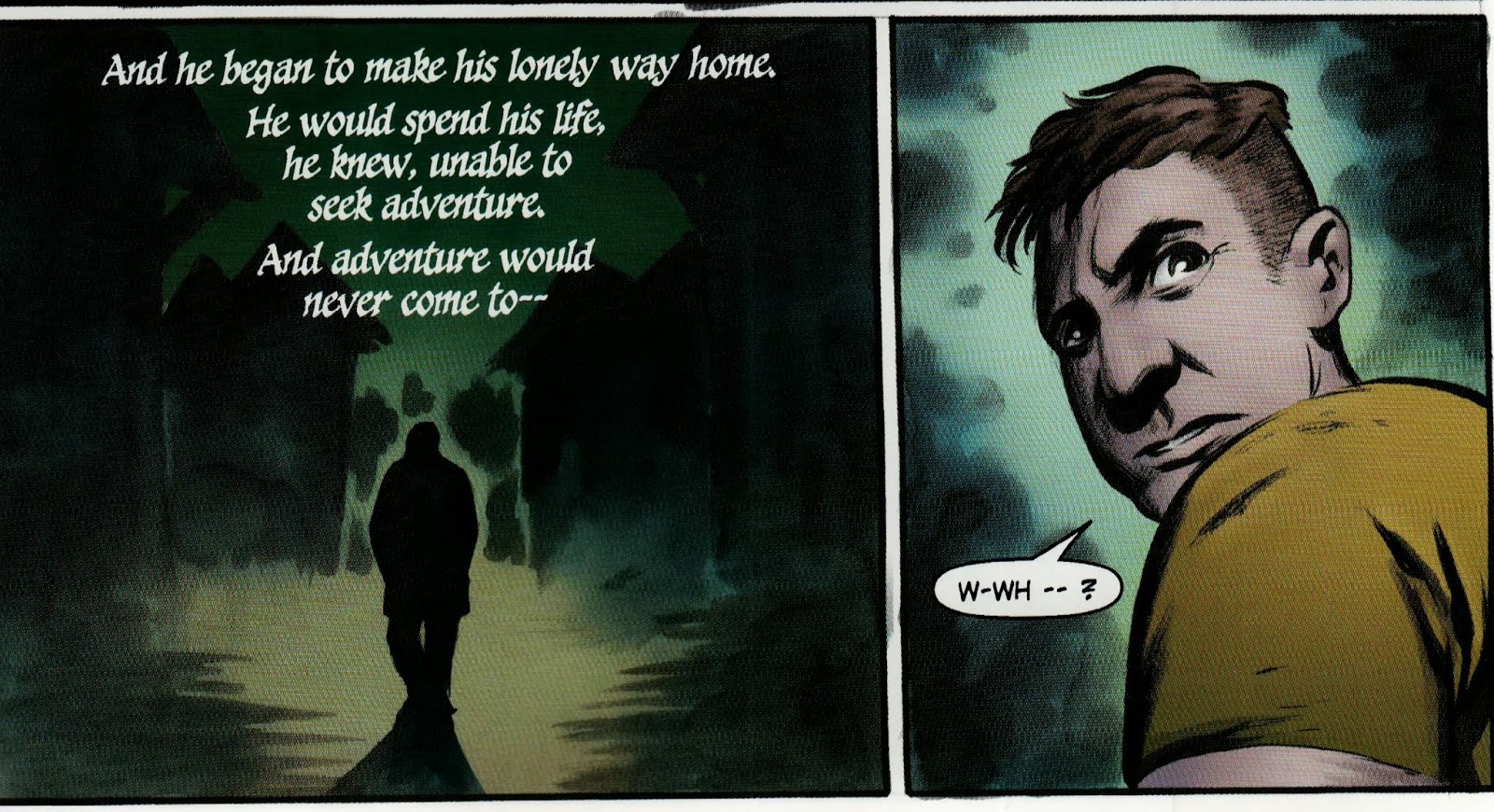
This art, by Eric Powell, who is, coincidentally, also the artist responsible for The Goon (see previous post's art), is the final page of a short but incredibly poignant Conan comic.
It is in every way the ending to the story and thus obviously constitutes a major spoiler if you're interested in reading it but as it's really quite a short tale, only tangentially related to the Dark Horse Conan series, and a one-off at that, I'm of the opinion that it isn't necessary to be up to date or even to be familiar with Conan as a character to get the gist of what is being presented. More than that, this page on its own, as a whole, speaks volumes.

During the last days of the year the more morbidly inclined of us (or those more thoughtful than others) traditionally tend to dwell on the lingering pain of the past and the sorrows yet to come.
And sorrow will come because logic and reason dictates us that it will. Pain is an inescapable part of the human condition. We suffer from loss, loneliness, guilt, feelings of inadequacy, from having no purpose, no direction, from a sheer host of anxieties and uncertainties and, at times, things can get awfully bleak. And for some of us, overwhelmingly so.

Robert E. Howard wrote many stories and has had an incalculable influence on the fantasy genre as a whole. He created Conan, the world's most famous barbarian. A character around which entire libraries' worth of books, fiction and non-fiction, have sprung up. The Conan stories themselves however number relatively few. There aren't many of them. And the panel above comes from a story called The Storyteller that was never even written by Howard.

He could've written it, maybe, but we'll never know, because Robert E. Howard committed suicide at the age of 30. He shot himself in the head, after he had received news that his mother had slipped into a coma from which she would never regain consciousness.
Despite the choice of his way out, he didn't die instantaneously and lived for another 8 hours. His mother only died the next day.

In The Storyteller, through the medium of dispassionate but earnest narration, we are introduced to our tragic protagonist as he works on his father's farm, uncomplainingly doing his duty, providing the hard labour that his father has ceased being able to provide, all the while dreaming of the wider world stretching out around him, the colourful characters it might contain and the wild and dangerous adventures they undoubtedly have.


 In the evening, at the tavern, fuelled by the stories of travelers, he spins his tales and shares his dreams to a rapt and appreciative audience.


But this very imagination sets him apart and though his audience cheers and gasps in all the right places, it also silently calls him touched, it calls him fool, and for his virtue, they demean him.


Knowing he will never have his own adventures the young nonetheless sets out to do what is expected of him.


And then a barbarian rides into town dragging his own wild and dangerous adventure with him.
As a priest casts a spell to keep the monsters out for as long as possible the barbarian commands the townspeople to fight alongside him as their village is threatened to be overrun by slavering monstrosities.

And for a time, through violence and bloodshed, the monsters are held at bay.


Until the moment when our young storyteller remembers the stories told to him by others, by those already familiar with the darker creatures of the world.


And so, the boy tries to rally his fellows to prevent what is a certain doom. 
But, they ignore him.


Dismiss him.


He is the storyteller, the fool, so his warning is just another tale, and not to be taken seriously.
And so, without options, the boy does his duty.


And while the battle rages outside, he goes to the mine on his own.


Where his worst fear meets him with tooth and claw.


And the night wears on and the desperation grows on all fronts 


In the face of fear and certain death, there are incredible acts of bravery and courage as men fight for their lives, for their families and all that they have.


And when the sun's earliest rays finally bathe the besieged village, their brightness burns away the horrors of the night.


 And as the men rejoice it is noticed that the young storyteller is not among them. He is presumed to have fled.

They don't find his body for two weeks. Having sought some privacy, two young lovers find his bruised and battered body in the mine where he made his stand.
He fought long enough to prevent most of the monsters from getting past him until they rushed out into the sunlight. With only gashes and a nicked and dented sword as evidence of having done his duty, they name him coward. Madboy.


And as the story closes, the dispassionate narration reveals itself to be filled with hidden feeling. With respect and admiration, and sorrow. It acknowledges the skill, passion and creativity of the dead boy, even if nobody else ever will.


At its close, the Storyteller reveals itself as a lament for the stories never told, and a lament for those that didn't get to tell them. A lament for Howard who could have written so much more. It's not an accident that the boy was drawn in his likeness.


I read the tale a week ago, when I was stuck in one of the worst periods in memory, and it served me well. It reminded me that people still love me, and that they love the things that I do, and that I shouldn't take my love, my promise and potential away from them.

We all have stories, we all have creativity to share and though I'm not exactly planning on writing any novels, I think I'll stick around and keep being creative for a while yet.