Everyone who doesn"t like Assassin"s Creed Odyssey hasn't played with Cassandra as the Protagonist.
Showing posts with label Terror 8. Show all posts

Monday, 16 December 2019

Exquisite Corpse, Poppy Z. Brite


*Wide-Eyed Stare*

I had loaned this one out to The Ink-Stained Beard a while back, immediately having realized it would be right up his alley after skimming through the first few pages. The Beard has a rather disconcerting fascination with serial killers and the like. Anyway, afterwards, he gave it a short review wherein he stressed really quite alliteratively just how dark, debauched and depraved the book was. At the time I did not yet know just how much the man was fond of a good old understatement.

Because really, calling this book debauched and depraved does not do it an inch of justice.

I normally try to hide a lot of the story but I'm afraid I really gave up quite a bit on the plot here.
I'm going to leave it as is, because it's not a conventional novel, structure and plot-wise, and conventional cover blurb is almost impossible. Spoilers.


Convicted serial killer Andrew Compton wiles his days in solitary away by ruminating on pleasant memories. Dubbed the 'Eternal Host' by the sensationalist papers, after his tendency to eat the men he took home with him, and with his cannibalistic and necrophiliac proclivities known and feared by the world at large, it is unlikely that Andrew will ever see the light of day again. He has nothing to look forward to but an endless stagnation and a lonely death. But as he writes down his experiences, as he looks back on his joy, his exaltation in committing acts that society would condemn him for, Andrew comes to the realization that he would do anything to be out in the world again. And so, Andrew begins to plot his escape.

Half the world away, on the neon-soaked streets of New Orleans' French Quarter, the wealthy Jay has been hiding his dark cravings for flesh and blood by being quite selective in his male liaisons. Though the gay men in the neighbourhood know to be cautious, or that at least they feel that there's something 'off' about the muscular pretty boy and that they shouldn't stray too close, the frequent tourists, the intransigents and vagrants that wild New Orleans inevitably attracts have no such presentiments to save them, and so Jay is kept happy and content, knee deep in warm quivering flesh.
But recently a local Vietnamese teen has caught his eye, has thrilled his heart and loins and Jay is finding it quite hard to keep his distance.

Tran spends his days trying to forget the pain of a relationship turned hateful, selling drugs, and seeking comfort and solace on the neon-soaked streets of New Orleans, away from his traditional family home, but his ex-lover's voice hounds him from every radio, blaring in anger and hate, warning him of the doom that could befall any gay man, and he finds that solace and comfort are hard to find. But one of his clients could possibly provide a cure for the sickness in his heart, and as circumstance propels him out from under his parents' roof, Tran inevitably seeks his refuge with Jay, who himself has just met a dark and dangerous stranger recently arrived from the shores of the old world.

And on the radio, and in the throes of aids and the corrosive knowledge of impending death, Lush Rimbaud talks on and on about hate and despair. But is there still room for love in the dying man's heart, and is he still willing to become a part of humanity to save a doomed ex-lover?

     I have never read any single book that gave such lovingly graphic descriptions of such a wild variety of upsetting things: Necrophilia, murder, torture, cannibalism, rape... sometimes even all of those at the same time. To put it simply; think of the most depraved shit a human being can do to another of its kind and it's likely in here.
I've said it before; the subject matter is one that is chosen by the author and if you can't stomach it then you better get off the bus. But this one is pretty extreme though.
This is alleviated, or rather this one has the impact of its shocks diminished, occluded, by the artistry of the author, and even the most ghoulish scenes have a sort of glamour surrounding them, as if its all unreal, or as if you can't really take it in.
     I'm not sure that makes sense, even to myself, but the truth is that even though I can objectively see that the stuff in here was way more shocking than anything I read in Palahniuk's Haunted last month, it never actually felt that way.

It's a compelling little novel. Gore, horrible sex and violence, and it's... niiiiice?

It's a novel that only has gay characters, and said gay characters also have a lot of quite gay sex, frequently depicted graphically, so if you can't take that, best stay away. Since it was written in the nineties, its story has a marked focus on the whole Aids- scare. When the men in the novel have sex there's a heightened awareness of the possible consequences of that act, and a few of them, at the novel's beginning have already come face to face with their impending death from the disease, and the disease itself is almost another character in the story, its shadow almost always present.

That all being said. I did quite like this one. Don't know anyone I could recommend it to myself. But, if you're still reading, then maybe you would like to give it a go? I guarantee you'll be horrified.

-----

MASSIVE SPOILERS

So then, on my overly expansive blurb: The title, Exquisite Corpse, might come from the artistic idea of crafting a story from one point to the next, not being aware of the end result at the novel's outset.
This is probably why, even though we start the book with Andrew Compton, his incarceration and subsequent escape from prison, quite soon the story is taken over by Tran, Jay and Luke, their relationships and the inevitable direction that will take.
Upon reflection, this really seems undeniable, as it seems clear to me that regardless of how the novel ends, Andrew Compton didn't actually have much of an influence on its ending. He's someone that just coasts into town, sees the sights, and then leaves again for greener pastures.
It's why devising a blurb was such a hard thing to do, and why I was so unimpressed by virtually all of the book's previous blurbs; they mostly all focus on Andrew Compton, despite him having no real bearing on the plot.
Take him out and you can't quite prove that for our three principal characters, things wouldn't have ended up the same way. There's a strange horrendous beauty to that ending too, that haunting finale.

Monday, 28 October 2019

Review: The Green Mile


In the Georgia Pines' nursing home, Paul Edgecombe spends his days trying to exorcise his demons. He's been writing about his experiences of the time when he was employed as the chief guard of the Death Row staff at the Cold Mountain prison in the far-gone year of 1932.
To Paul and the other guards of that part of the prison that was to be the final destination for hundreds of human lives, the year of 1932 was a year of cruelty, of botched execution, of miracles and darkest sin, and no-one who lived through it was left untouched by the events that took place there.

To Paul, regardless of everything else that happened, he would always remember it as the year of John Coffey, the black man convicted for the rape and murder of two 9-year-old white girls, the depraved killer with his eyes full of tears, the man whom Paul began to believe was innocent.

     I had previously seen and loved the movie adaptation of Stephen King's stab at a prison novel somewhere in my childhood, a few times even, and I remember having been in tears at a few points throughout. Mostly because it's such an amazingly impactful movie, able to sweep you up and away in its emotional rollercoaster. It's isn't very horrific though, which is why I was very dubious about its inclusion in Gollancz's Terror 8 series.

     But it turns out, that there are reasons enough to include it.
The novel obviously has a large measure of its time devoted to ruminations on death and death-dealing, and these are interesting, though less than adequately explored through our narrator Paul Edgecombe, who is a little Blasé (internally at least) about the executions he has performed, but it ios also implied at one point, hinted, that there just might be something more involved, something evilly supernatural.

     Of course, having seen the movie, I knew that Coffey himself has an extraordinary power at his command, and it's also more than clear that he has it in the book itself. However, what wasn't clear in the movie (I think) is that, at one point, Coffey appears to exorcise a woman of an evil spirit. It's hidden, occluded, behind known science; the vileness is cloaked behind the symptoms of dementia and Tourette's, but King gives enough hints here that whoever is so inclined to will be able to see it. It's especially clear since the novel evokes the name of God more than a bit, and in horror, where there's the light there must be darkness as well, and not just human darkness.
     The human darkness is presented mostly by Percy Wetmore, the sadist guard who's only at the Green Mile to be able to execute a man himself, and William 'Wild Bill' Wharton, both of whom are different shades of irredeemable all on their own.
     I should make mention of Eduard Delacroix who never ever fits the role of rapist-arsonist-murderer, and who only ever comes across as pitiful, likable and silly by turns. This is remarked on several times in the story, of course, but this does not excuse or validate King's portrayal of this particular prisoner, who's ever only here to evoke sympathy in the reader, and isn't well explored because of it.

     Mr Jingles is perfect of course. And if I hadn't seen the movie I probably would've been bloody shocked and angered. As it is, I remembered where the story went and took it in stride, only to then be surprised, in not so nice a manner, at the end of the novel, which does do things a bit different, epilogue-wise. Brutal, Harry Terwilliger and Dean Stanton are all very likable characters, and it was a little bit disconcerting to have their eventual fates revealed as well.

     There's a lot of Melancholy in this book, and though it's reasonably light on details concerning the time period it takes place in, it does manage to evoke a lingering sense of the time. It's a slow, ruminative novel, filled with a gripping sentimentality, and it should be, the conceit being that this is Paul writing his story 60 years after the facts, but it's remarkable how well this reads.
     I'm not a fan of King, at all, but the man does consistently write the proverbial page-turner.

Friday, 29 December 2017

Review: Darker Than You Think, Terror 8 edition.


As for being a Terror 8 novel... Yeah sure, obviously another good addition, its tropes fall either squarely within the Noir or the Horror camp. Pacing is good though pulpy. At times, there was some genuine suspense where the outcome of one scene or another is left somewhat in doubt leading to surprising moments of gory violence (though not too overly described), which I can always appreciate, and which through good build-up are given some extra emotional weight.

There's also a curious similarity to every novel of the Terror 8 that I've read up until now, where each of these stories has a horror beastie center stage, to then develop a complete all-encompassing mythological framework for them: Fevre Dream, Ghost Story, Something Wicked This Way Comes and now Darker Than You Think.
Song of Kali is the odd book out where this is not applicable, but it does leave me eyeing the remaining three books, and The Green Mile in particular to see if they might follow in these four books' footsteps.

I say Green Mile in particular, because I've seen the movie a few times now, and been swept along for its emotional rollercoaster every time (hey, shut up, Michael Clarke Duncan was gold.), and though initially baffled when I noticed it was included in the Terror 8, I'm interested to see if there's actually more to the novel than the movie made it out to be, whether there's in fact any horror or mythology to be found...

Sunday, 19 November 2017

Review: Song of Kali, Dan Simmons, Fantasy Masterworks and Terror 8 addendum


It is June 1977 and an Indian poet lives.
The long-presumed dead writer M. Das, is rumoured to have resurfaced in Calcutta, with a significant new body of work to his name.

Fledgling writer Robert Luczak is sent by his editor at Harper's Magazine to meet with the poet, to verify if the work is actually by M. Das' hand and to negotiate the purchase of the manuscript.

With his wife and new-born daughter in tow Robert travels to ancient Calcutta where it soon becomes apparent that there's more to the place than meets the eye.
And what the eye meets is already disagreeable enough; at the height of its raining season, with mountains of garbage and filth coating the streets, drenched sodden one moment, and baked dry by the searing summer heat the next; the place is a reeking dungheap, and a heaving sea of people, the uneducated and the destitute, swarm over every inch of it.

A city at its lowest point in decades, it has become a place of monstrous slums, and it's where Robert swears he can feel an evil intent simmering beneath the surface.

 And when it turns out that the poet M. Das might well have been thought dead for a good reason, then that intent is given a name.

Kali.

Four-armed goddess of  preservation and nature, and mother to all.

But she is also considered the goddess of death and destruction and the one to ultimately be the devourer of reality itself.

And Robert Luczak is running straight into her waiting arms.

----

Dan Simmons is one of my favourite writers and, so far, all his novels have been built with a consistent level of quality and craft. However, unfortunately Song of Kali isn't one of his better ones and I found that I had a few gripes when done with it. In the main, this is down to the negative portrayal of certain elements of the plot. Most of those have reasons for being depicted the way they are but one of them has come about because of a rather narrow-minded focus to it and it honestly doesn't merit much excusing or rationalising.
I'm referring to the malign force at the heart of the story, the goddess Kali. Or rather, that's what Simmons makes of her. She is clearly just demonized and there's no doubt about it. Her better aspects are forgotten or left at the wayside and there's no real mitigating factor here other than that this is how Simmons made chose to tell the story. Maybe he needed a villain, but then he's chosen to represent her in an extremely nebulous manner.

The other main problem is the novel's depiction of Calcutta, which has a reason for looking the way it does and I'll divulge that information in just a moment.

There are spoilers in this post at several points throughout, mostly because of inferring and hinting, but because I've written too much it's become hard to give a good cut-off point. I'll just put the disclaimer here and move on with the program.

Outside of the book's themes and elements the writing felt a little austere, unlike Simmons' usual self.
He is usually a comforting writer, mainstream but rather more aware of himself, holding himself to a consistent standard, notable in its readability and yet, holding up to criticism. neither overly poetic nor overly workmanlike.

Literary Influences


Simmons is a clever writer who loves putting his literary influences on his sleeve and it's pleasant to see that this element has been present in his work since this, his first outing; Song of Kali. The main character is, like Simmons at the time of writing, a beginning writer and editor of a literary magazine with only a small volume of poetry under his belt. Simmons himself sold his first short story in 1982, coincidentally, on the birthday of his daughter, 3 years before the release of Song of Kali.
As Simmons notes in the early pages of the novel; decent, rational people who one used to be able to have memorable intellectual conversations with are reduced into cooing halfwits by the birth of their child. And as it is with those people, so it is with Simmons' first novel as you'll notice when reading that Luczak's little baby Victoria is an ever-present gurgling, burbling and drowsing entity. Also, she's very relevant to the plot.

The various other characters found throughout the novel have, at the very least, a passing acquaintance with the world of literature, occasionally throwing in observations and opinions on various writers and famous works of literature, occasionally tying them into India and its culture.  p37:

"I quit in disgust when a fool of a professor would not accept my paper on Walt Whitman's debt to Zen Buddhism..."

But not all writers need to be tied into the setting, sometimes there's a little time for the occasional absentminded barb. p52

"Her interest and belief in the supernatural had until now seemed non-existent. I had never even been able to interest her in the trashy Stephen King novels I would bring to the beach each summer."

It's not a literary novel if the author can't at least throw a barb at a writer he doesn't respect. That it's Stephen King here is ironic, of course, as that gentleman's generous cover quotes grace (or deface) many a Simmons novel.

Most interestingly though, the novel is a homage to Rabindranath Tagore and has more than passing reference to the work of William Butler Yeats, through whose work Simmons likely became acquainted with the former.

Rabindranath Tagore, or Thakur, was an Indian writer, and the first non-European to win the Nobel Prize for literature, specifically for his Song Offerings, which is a selected collection of songs or hymns, much in the same vein as the Biblical Song of Solomon, that were previously published in other volumes in India (the largest part of Song Offerings is comprised out of selected songs from Gitanjali). Written in complete isolation and tranquility on a houseboat, they were subsequently translated to English from his native Bengali by Tagore himself. They were carried with him on his visit to Britain where it was passed to W. B. Yeats who promptly fell in love with it.
It was he who, also generously, graced it (this time without a doubt) with an introduction that might just have been a tad overselling it.

"I have carried the manuscript of these translations about with me for days, reading it in railway trains, or on the top of omnibuses and in restaurants, and I have often had to close it lest some stranger would see how much it moved me."

Whatever your opinion, it was Yeats whose glowing praise introduced Tagore's work to the west.

As you might gather from the quote, the songs/poems are idealistic and uplifting, despite having undertones of loss which are a reflection of Tagore's own. Throughout the novel we are regaled with the events of his life at several points.
Oddly then, it skimps on mentioning something quite important; the death of Tagore's wife and children in 1902 (yes yes, the house boat thing was earlier, but I've got everything hopelessly muddled at this point). Tagore suffered this tragedy and it's easy to see, when read, how this might have influenced Song of Kali's story, but the real reflection lies in Tagore's (and Robert Luczak's attitude towards their loss; even with their pain and their loss, there is still, once past the focal point of the horror in their respective lives, a renewal of hope and self-love; Yeats' 'self-delighting, self-appeasing, self-afrighting' spirit. Love for life itself.

The quote (p 301) comes from Yeats' A Prayer For My Daughter. Witten at her birth, it is full of hopeful and well-wishing sentiment, but this part of the prayer has undertones of tragedy and loss, swiftly followed by hope and self-love, mirroring the arch of the main characters in Song of kali.

Yeats' doom-laden Second Coming poem is also quoted before the climax, but after the worst has already happened. Simmons has a penchant for a good quote, applicable to his own work.
More than that however, he weaves it straight into his narrative, and the poem's bleak prophesying of an apocalyptic future further strengthens, and maybe only because of its inclusion, the tense build-up of the final parts. The suspended breath before the storm, but it's a storm that does not materialize because just like where Tagore's Song Offerings acknowledge the coming end of life, they also acknowledge and, more importantly, hold on to the love for life in and for itself.

Where the song of Kali, in the novel, is one of coming death and destruction, Simmons, after having put us to misery and death, offers up the idealism of Tagore by ending the story with (p 311):

"The Song of Kali is with us. It has been with us for a very long time. Its chorus grows and grows and grows.
But there are other voices to be heard. There are other songs to be sung."

-----

There's a part in the novel where one character regales the others with a description of the last days of Tagore, and I'm not sure if we can take that at face value. The other native characters seem keen to drown the teller out, possibly to suppress less than desirable information to get out, but it is more likely rather, to stop erroneous, embellished information to get out.

It was my idea that Simmons had heard this story somewhere and, despite knowing it to be false, incorporated it anyway, to illustrate how stories grow and morph in the telling.
Letting it be regaled to us in the novel, doesn't have to mean that he stands behind the facts as they are told, as the other characters seem to protest against the telling, because they are also him. 

Its inclusion is evidence of a rather sly sort of humour.

Simmons has a love of storytelling and an interest on how the tale alters with the telling. There's another part in the novel where we are told the story of a man in three whole chapters, with possible hints of the supernatural peppered throughout, but it could be that, showing one character to be an unreliable narrator, the other narrators might then fall under this as well. Maybe even the prime: Robert Luczak himself (The novel is in first-person past tense).
It gives rise to something I'll talk about later:
 Explanations that negate, though with leeway to the contrary, every supernatural element in the novel, to root the story squarely in reality.

Another thing to note is that throughout these stories in specific and throughout the novel as a whole he also shows himself acutely aware of the problems that crop up between languages incorporating both the clash of world languages and the difficulties within a language's varied dialects.

Calcutta

Like in every novel that Dan Simmons delivers, there's been extensive research into the background of the various elements of the novel, as with Tagore, so it is with the city of Calcutta.

However; something that's been noted often and a ready point of contention, is its depiction.
It's the novel's greatest strength and at the same time, its greatest problem.

The city is so well depicted, so ever-present, towering over every scene like the backdrop of a theater production, and so memorably unique, it has become one of the characters in the novel (as much as I hate typing that cliché sentence, it conveys exactly what it accomplishes).
There is garbage and filth towering up at every street corner and clotting shut dark alleyways,
accompanied by an all-pervading smell of corruption and decay, it is swelteringly hot, loud and wild; a veritable human sea of sweat-matted flash, to be cooled only by downpours of biblical proportions.
It's impressive and memorable but there is an issue with this.

For many mainstream readers, this might be one of the first novels that gets you acquainted with India and its culture, it certainly was for me, and here is the problem I spoke of: Knowing nothing of India but the depiction of Calcutta presented to you in the novel, you could be forgiven for thinking India might just be an unmitigated hell-hole.

But you see, the city as it is depicted by Simmons isn't exactly a false depiction. It's in fact a time-period chosen exactly to suit the plot.

On a yearly basis the months between June and September are the monsoon season where most of its rainfall happens in June and where maximum temperatures easily exceed 40 degrees (celcius, for you cretins in america) on a daily basis.

For historical Calcutta, now Kolkata, it is also one of the more clearly distinguishable times wherein the city suffers its greatest socio-economic woes in quite a while.
There's an enormous influx of destitute and low-schooled refugees from Bangladesh's Liberation War. who cause an incredible drain on the city's resources and which is hit by severe power outtages and is overal lacking in general infrastructure. Furthermore the city is plagued by severe worker strikes and suffers from violent insurrectionists.

Insurrections, because before the events of the novel in early 1977 the 'tyrannical' government comes to an end and is followed by what became the 'longest serving democratically elected government in the world'.
The populace was so fed up with its own government that it chose it's ultimate opposite, and more than that, it kept it like this for the longest time because everything was better than what was before.
It's an extreme response and clearly shows how deep the divide between rulers and the ruled was.

All these things manifest themselves, their consequences, in the immense squalor that Simmons puts at the forefront of his narrative, with filth and waste covering, seemingly, every square metre of the city and with slums on every other street, leaving the impression on the reader as if the city has been covered in a blanket, of garbage instead of snow.

Simmons puts his tale in one of the periods which serve the tale he wants to tell incredibly well, but which also serves to show the reader an incredibly negative snapshot of a culture and city which the overwhelmingly large amount of the readership might not have been familiar with.

More than that; through the benefit of hindsight, the novel presents a hopelessly negative point of view on the city in some of the worst straits it's ever been in.

In chapter 9 Robert meets with a mr Chatterjee, and discusses, among a host of  pleasantries and mutual interests, the state of Calcutta itself.
Robert professes that he feels the city itself might have an evil undercurrent, as if the squalor has a singular source of supernatural intent. which is, through our bias as a reader looking for a supernatural horror element, readily acceptable.
However Chatterjee responds with disdain and, taking a book of his shelf, responds with a quote (p132):

'... a dense mass of houses so old they only seem to fall, through
which narrow and tortuous lanes curve and wind. There is no privacy here and  whoever ventures in this region find the streets - by courtesy so called - thronged with loiterers and sees, through half glazed windows, rooms crowded to suffocation... The stagnant gutters... The filth choking up dark passages... The walls of bleached soot, and doors falling from their hinges... and children swarming everywhere, relieving themselves as they please.'


When asked by his host if this might be an accurate description of the Calcutta of 1977, Robert Luczak responds that, yes, indeed, the description is an apt one.
Mr Chatterjee then smiles and reveals the quote to be part of an account of London written somewhere around the 1850's.

Chatterjee, at this time in the book, with paranoia infecting both reader and Robert at this time in the book, is an unwelcome element of rational argumentation.
In hindsight, where we might want and expect supernatural horror, Chatterjee provides an alternative.

And time has proven mr Chatterjee reasoned pronouncements correct because today Kolkata is an economically thriving city. India's third city in terms of gross domestic product.

It's problematic in that it almost directly contradicts the novel's suggested premise of a malignant goddess of destruction, decay and violence having sway over the city.
40 years on, in a totally different Calcutta, now called Kolkata, it slaps a time-stamp on the novel that could be called malignant and xenophobe at worst, and giving an unfair view on the city through choice of an unfortunate time frame at best.
(The depiction of Kali as a solely destructive entity is also, of course, a very reductive view on the goddess but I've mentioned that before.)

It's not all doom and gloom though and I wanted to note that occasionally Simmons brings a comfortable and almost magical atmosphere in a scene to then, without much comment, introduce an element of life's many unpleasant truths.
To reflect that with life, comes death and despite of rationalizations, to have the joy that comfort brings usually means that there is someone or something paying a price for the option of having that comfort. He contrasts fleeting beauty with the messy everyday realities that humanity has to deal with on a day by day basis, in order to survive or to progress. It hints, much like the clipped information dumps of violent madness in America at the end of the novel, that none of this is unique to Calcutta and is more a symptom of the human animal's violently 'altering' presence in the world.


World Fantasy Award Winner

Alright, let's deal with the personal nitpick here. The most glaring problem I have with this one.
Published in 1985 it won the World Fantasy award the year after and, it also is nr 44 of the Gollancz' Fantasy Masterwork collection. 

This is in spite of the fact that it's not actually a fantasy novel.

In 1986 there were a few other nominees for the award.
-The Dream Years by Lisa Goldstein, which is apparently a novel with surrealist overtones and time travel
-The Damnation game by Clive Barker, Faustian novel set in modern times
-The Vampire Lestat by Anne Rice, the tale of a vampire, apparently Rice writes well and I love the Interview movie
-Illywhacker by peter Carey, magical realism novel with humour
-Winterking by Paul Hazel, myth, gods and mystery set in scandinavia

As you can see, half of these are easily considered to be works of horror and in my book they should be instantly disqualified.
Illywhacker's synopsis tells me I should probably avoid this novel, even though it has some metafictional elements. And The Vampire Lestat (horror too right?) and Winterking are both sequel novels in a series.

Song of Kali is indeed accomplished and this is notable because it's a debut novel. It's obviously well-researched and its ending, especially if you know enough about its influences, is poetic.

Now, the eligibility of any given work to be considered for the world fantasy award hinges on a few things, but mainly it is up to the discretion of the judges and the nominators.
Broadly speaking: any work of fantastical fiction can be eligible, regardless of subgenre or style, though the wordcount always needs to be higher than 40 000 words. (it also needs to be published or at the very least translated into English but let's not get into that now. mainly because of personally preferring to read in English anyway and I don't have any actual beef with the rule other than to note it here and to say that it's a very non-all-inclusive stance to take.

So technically, as Song of Kali is horror, and horror being a subgenre of fantastical fiction in general, it was very much eligible for the award.

And yet, the very fact that Song of Kali is even here, whether it is as the world fantasy award winner or as an entry of the fantasy masterworks collection, rubs me the wrong way. If it's anything it's horror and it's fantastical elements are subtle and downplayed.
It's a good novel, absolutely. I love Dan Simmons.

But I have the sneaking suspicion that the big draw here with this book, for all these so-called judges of literary fiction, is that its fantastical elements are so marginalized and so easily explained and ciphered away. It's a novel that might as well have no fantasy in it, if you choose to view it so.
It is a singularly elitist stance to have, so dismissive of fantastical literature at large.

As I'm working on this already hugely lengthy post I'm reading the final chapters of the sprawling 'Providence' of Alan Moore and Jacen Burrows and I've hit this particular line of reasoning by the main character, the very heart of what I'm getting at.


It's one of those things that irritates me by the exaltation of this type of fiction, the barely-slip-stream type of genre, where reality is mixed with almost less than a smattering of fantasy. Where it disassociates itself by sidelining all these supernatural elements, as if fantastical fiction is something to be looked down on by the literary elite.
More specifically, those who are responsible for the World Fantasy Award, as it is they who shouldn't proscribe to popular sentiment and adhere more to the 'Fantasy' element of the title.


And lastly, because I don't know how to quit: Wrapping up and thoughts of the novel's inclusion in the Terror 8.

Flat- out Spoilers for the plot.

Friday, 4 August 2017

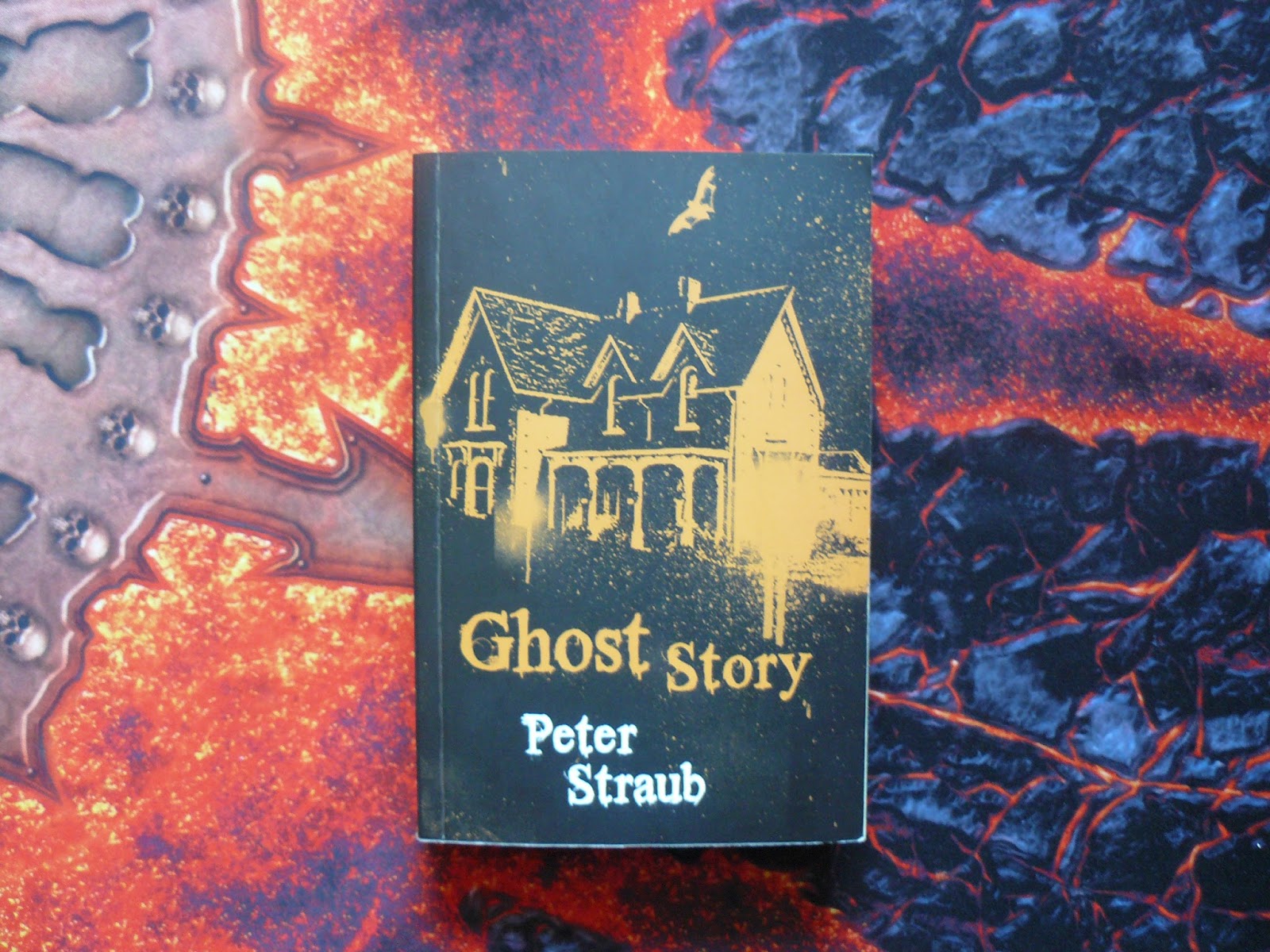
Review: Ghost Story, Peter Straub


A year after the death of one of their members, the tight-knit Chowder Society, consisting now of 4 old men, invites the deceased man's nephew over to shed light on the frightening things that have been happening around them. The young man is a writer and they find curious similarities to events in their own lives and to that of some of the elements of his horror novel.

They hope to find an answer to the dreams and the nightmares that impress them with a terrible sense of doom upon awakening, and the hideous feeling of being watched when no-one could be watching, or to the matter of the livestock that is being slaughtered and drained of blood in their peaceful town of Millburn.

Have they been simply scaring eachother or could it be that the horror stories they've been telling amongst themselves since the loss of their friend are more than just stories? Have they stirred something up that was previously forgotten? Because the four old men have ancient secrets. And some secrets have lives of their own and do not permit themselves to be buried and forgotten in the dark.

Meanwhile the arrival of a young and mysterious woman heralds the turning of the weather and an unseasonable cold. And who can tell what will happen to Millburn's residents should the snows build and build and cut them off from the outside world, to leave them at the mercy of the things that hide in the dark.


Review

Wow. What a novel. At times I truly felt joy while reading it.
Might seem odd to say that about what is supposed to be a horror novel, but there it is.
Some books can remind you just why you love reading.

Ghost Story managed to do something that many and almost all of the horror novels that I've read up to now have failed to do with me: Entertain me consistently over the length of the entire novel while never making me feel as if I wasn't reading something that is supposed to be horror.

There are practically no dips in quality and never a moment where I'm completely sure how the plot will go or the story will end. Of course I had my guesses and I did end up being largely in the right. But hardly completely.

Keep in mind, this is of course solely my opinion and the general response to this novel seems to be very divisive. Of course, looking through reviews, a large part of that lies in certain people naming this one of the best horror novels of all time *Cough* Stephen King *Cough*. That man has both the admirable and lamentable quality of praising every single thing he likes to the moon. The blame can not be laid solely at King's feet though. As far as I can tell, there's a widespread negative response, mostly because of and in response to excessive hype, going on with this novel.

But even I kinda think it's one of the best horror novels I've ever read, but at the same time I can concede that it isn't that extraordinarily special... You can easily see the problem.

With  'one of the best horror novels I've ever read' I mean that it's an incredibly competently plotted and well-structured novel with both its feet planted firmly in horror tropes, though I should add, as has been my experience with horror novels in general; it's not necessarily scary. Fear is a hard to thing to get right in reading fiction, and I personally have been only scared a handful of times while reading.

Build-up is key in horror.
The moment we see the ghost, the monster, the horror; the fear drops away and release comes in its place. The thing has shown itself. And it's not as bad as imagined. Nothing can ever be as bad as rampant imagination builds it up to be.
It's always a let-down, however so slight. The hope and dread and fear can never sustain itself when the climax comes. In response to this, Ghost Story lets the tension build for as long as possible and then even when the resolution draws near, it won't let up. It's never terrifying. but it always holds its cards close to the chest. Right up until the very end, of course.

I found the climax less interesting than the time the story takes to get there. Though it still wasn't bad.
It resembles, for instance, Stephen king's Salem's Lot more than a little, you know, if that actually would've had something of a resolution. But where I found that one's set-up both labouriously boring and way too fast-paced at the same time, for me to get invested, here everything glided along naturally into a compelling narrative. This was helped by me being receptive to what the book was trying to do and giving it the time it needed. This might not be for people who chug down books as fast as they can, then. (translation; it might be a little slow.)

One of the things about horror literature is that it needs accomodating. It's not going to work on you if you don't let it. reading it in the sun on an easy chair by the pool isn't going to let you. Reading it at night, in the silence while the house is darkened, with every room harboring shadows and your imagination running wild at every creak in the dark, is what will.
It's a good rule of thumb for many types of fiction.

Writing Style and Literary Influences

There were a few notable times  where Straub experiments with his techniques when he travels between different characters. It's a technique that makes the reader anticipate the next chapter. It's like when you anticipate reading a new writer, and a new accompanying writer's voice. But here the voice depends wholly on the character of the moment. This is of course not a new thing in fiction, but it's been a while that I saw it done this well.

The narrative consists for the largest part of heavily interconnected stories told by the varying protagonists of the novel who are reasonably well characterized.
And like the title of the novel itself, I might be giving the wrong impression here (The story isn't exactly about ghosts, though it does have its fair share of them, so be wary of disappointment there). This is one narrative, but throughout the whole novel, it's built up out of various lifestories of an intimate circle of people. That way every story has bearing on the rest, and this becomes more and more clear the longer the story goes on. When everything is revealed the various lifestories will be more closely linked than at first was apparent.

Straub effortlessly keeps the reader guessing about things that should be obvious, elliciting reasons and explanations in the reader that would fit with the narrative he is weaving but leaves one unable to pin down any one suitable explanation, because every time a veritable horde of them manage to present themselves.
At the same time all the explanations hinge on being fantastical supernatural horrors and the reason why I was, in part, kept to guessing was because the caliber of the writing was very much literary and not at all in keeping with past experiences of reading horror.

The writing is very much of a literary bend.

A large part of this can be found in the character of Donald Wanderley, who's literary erudition is at times on full display; p194


"I found a statement by Hawthorne which helped to explain this method: 'I have sometimes produced a singular and not unpleasing effect, so far as my own mind was concerned, by imagining a train of incidents in which the spiritual mechanism of the faery legend should be combined with the characters and manners of everyday life.' 

It's a very mainstream way of thinking about this. A means of imbuing relevancy and diminishing the fantastical elements by undercutting them, because see! The Real Life stuff matters more, so don't be afraid of liking the silly fantasy nonsense that comes with it.

A very elitist point of view. *Tut tut*

Anyway.

There's a playful meta-introspection going on on p42;


 'A nice exercise in genre writing. More literary than most. A few nice phrases, a reasonably well-constructed plot.'

I really enjoy when the writer can talk about himself like this.
And that reasonably well constructed? Haha, no. That was very well done, sir.

Apparently Straub read alot of classics in the genre in the preparation to penning his own story down. and it really shows.
From name-dropping books like Carrie and having similarities like having a small-town bully as one of the characters' compatriot and foil, plus the obvious echoes to Salem's Lot.
Some of the characters' names are homages in themselves; Sears James is a reference to Henry James and his Turning of the Screw which I sadly haven't read yet, while Ricky Hawthorne's, is a homage to Nathaniel Hawthorne, who I know nothing about and for once feel no pressure to read up on. I've got enough on my plate thank you very much. I don't need to be wooed into reading more authors I'll never actually get around to reading.

Terror 8 Notes

The negative rests solely on the editing or maybe just on the Terror 8 edition, where I noticed alot of typos and a particularily bizarre sentence, stretched out over a few lines, that just didn't make any sense. I didn't understand it and as a result I can't even find it again to see if it might make some sense in retrospect or in a new light. Not even to quote it here for those curious enough.

But apart from that; not too scary but yeah, definitely Horror with a capital H and more than worth it to be planted amongst the 8.

At this point I have to go and read Straub's other books, specifically Koko, though that one probably isn't really horror. On the other hand, it did win the World Fantasy Award for some reason. I'm reasonable interested in reading it so I'm not going to look to closely before picking it up because I don't want to spoil it for myself.
Also, looking through the World Fantasy Award winners list, I'm finding alot of novels that would clearly be labeled as horror.

Ah well... So many good books, so little time.
Happy to have taken some time out to read this one.


More Terror 8 notes and SPOILERS for Fevre Dream, Ghost Story and Something Wicked This Way Comes


Sunday, 23 July 2017

Update

I'm trying to take it all a little less serious nowadays, so here's me being relaxed.

What's next on the blog is some stuff concerning Paradise Lost. It'll be a longer project which I'll be dipping in and out of. I've read two out of the 12 books already and I'm looking at how to approach writing about them. I'm thinking a very relaxed way of writing.


Right now I'm reading Ghost Story by Peter Straub, as part of the Terror 8 set of books. Also because I've heard enough about it over the years and guess what, though I'm only 150 pages in, It's very good. I love how it's structured and how the mysteries seem very close to the surface but yet are able to remain just out of reach. It also has complex and interesting characters, though the women seem unanimously unlikeable.

Final Fantasy 12: The Zodiac Age

Gaming-wise I'm replaying a childhood favourite that's just had a remaster. It's quite a substantial difference from the one I played, with updated graphics, markedly better sounding music (which always was one of the best things of the game) that was re-recorded with a new orchestra.
A new trial mode (which I'll see when I'll try it out, if I even do), and apparently there's also new stuff in this one, as it's the remaster of the version of the game that the western release never got.
I have little problems with the game but it still irks me hugely that I can't change the ridiculous dressing choices of the characters. That and Vaan's hideously unlikable English spoken voice.
The Gambit system is complex, but rewarding once you figure out how it all works and the combat starts moving like a well-oiled train.

It's been a while since I've been so involved in a game. Might have been since Metal Gear Solid 5.
The best kind of plain ol' escapism. A whole world to conquer.


I also managed to see Kong: Skull Island this weekend, which was way more brutal than I thought it would be.


It was pretty great but I found that the plot kept jumping between scenes sometimes, which gave me some disconnect with the film. John Goodman and Samuel L. were amazing, as per usual. All of the other actors seemed a little miscast. Tom Hiddleston's posh british accent, in particular, made me gibber with mirth every time he opened his mouth.

Something I did not expect at all were the numerous homages to Apocalypse Now. Very obvious and very, very welcome. Just lovely.

I still might prefer Peter Jackson's King Kong, though. There was something so magical about that movie. And the music is still very beautiful.

Fuck that insects part though.

Sunday, 9 July 2017

Something Wicked this way Comes, Ray Bradbury. Terror 8 edition


Some mild spoilers, particularily for the character of Charles Halloway.

Review: Something Wicked This Way Comes, Ray Bradbury. Fantasy Masterwork edition


In Green Town, Illinois, it is the week before Halloween, where Jim Nightshade and Will Halloway meet a travelling salesman, selling arcane lighting rods and making wild claims of a terrible coming storm. Will's Father, the introspective Charles Halloway, catches a glimpse of a man posting flyers in town advertising for 'Cooger and Dark's Pandemonium Shadow Show' while through the streets familiar scents drift on the wind evoking memories of a better time.

The boys, aged 14, born minutes apart with only midnight dividing them, are nonetheless as far apart as two boys can be. Despite this, they are inseperable and a haunting melody will draw them both from their beds to witness the arrival of a dark carnival. The unnatural events that they will behold there, with glimpses of terrible power and the promise of an answer to childhood wishes, will set the boys off on a dangerous and desperate adventure that will test their friendship to its limit. 

Because the October people have come again, and with the carnival comes terror and darkness and a tempting ride on the carousel.

Title and origins

The title derives its origins from Shakespeare's Macbeth. The three witches at the start of the play are brewing whatever witches brew in their cottages on lonely nights and lonely heaths when one of them states;

"By the pricking of my thumbs, something wicked this way comes."

It points to that whatever comes next is of its innermost nature wicked. Of course then Macbeth shows up and as the 3 witches then prophecy that he'll be king of Scotland, they in fact then serve as the primary impetus for the developing plot and the downward spiral of Macbeth himself. They really are one of the prime examples of why time-travelling stuff or prophecying doesn't work with foreknowledge that has an actual hand in the narrative itself as nothing might have happened had they kept their mouths shut, self-fullfilling prophecies and... eh, was I going anywhere with this? Anyway...
In Macbeth it points to the coming of the darkest and bloodiest of Shakespeare's tragedies but also to the character of Macbeth itself, who over the course of the narrative loses his nobility, doing generally wicked deeds of murder and bloodshed to eventually dwell in paranoia and madness.

In Something Wicked this Way Comes it points as well to the coming of a dark tale (for its time), in themes if not in execution. It also points to the coming of the October people to the small-american town of Illinois and how their natures are irredeemably and irreversably wicked.

Inspired, in part, by the magnificent The Circus of Doctor Lao and Bradbury's own meeting with a coterie of travelling circus performers as a child, which honestly is a tale interesting enough of itself, Something Wicked is a blend of fantasy, horror and the loss of childhood innocence story;
a story that usually depicts, or tries to depict boyhood's self-righteous claim to hope and the promise for the future and the magic that goes along with it, along with the joys of untested and thus seemingly unbreakable friendship.

I suppose the 'loss of innocence' story is so popular and revered because it is an easily identifiable parable of growing up, but with every traumatic mishap and formative event on the way to adulthood condensed into a single cohesive narrative, usually even compressed into a single calamitous act in the story's climax or at the start as the tale's driving force. It's so popular because everyone can find that child somewhere inside of them, to have that moment of transcendence, from child to adult, reappear provides an opportunity for melancholy reminiscing.

Of course the novel has an extra interesting aspect where it asks certain characters that if given the choice, if they would go back to that time.
But certain things can not be undone, and the wisdom gathered over a lifetime still has a certain weight, and we can never truly go back to the time of our youth, not in our mind and not to our place in that bygone world. Innocence once lost is gone forever and life will have moved irrevocably on.


Problems

There were some problems for me with this book. I'll talk about them first so can talk about the good stuff later.

The main problem for me is the incredibly corny ending. Originally written as a screenplay for a movie, in a time when movies were not as they have become since, it's very obvious that it was conceived as such. The magic that would be present in seeing it depicted on screen isn't present here and only serves as a harsh contrast with the seriousness of the novel present up until that point.

I won't give spoilers and only say that it really annoyed me and that I've already given some of my thoughts on it here; Something Wicked This Way Comes, thoughts on the ending.

Looking back at when I did that post I'm amazed it took me this long to actually write the novel's review. Also, that interpretation manages to give back some of the good feeling that the novel originally gave me, though I sincerely doubt that the meta-explanation was Bradbury's original intention, but damn me if that wouldn't be smart.

There's another problem, and it's one you'll find in most every other review on this novel. either as a centerpiece or as a begrudgingly given afterthought.

Ray Bradbury's writing style.

His style is a prime example of why the english language is so beloved. A language where a bunch of words can just be thrown together to create layers of meaning, or simply to convey and inspire the summoning up of moods and images by pasting words unto one another.

But on the other hand; this is flowery prose that even Tolkien would think was too much.

It is overly prosaic, overly crafted and moulded with desperate meaning. It's good in short bursts but as someone who is not a native english speaker Bradbury's prose can be at times, simply put, aggravating. I'm assuming that a native reader would be easily swept up in the flow of his writing patterns but this really doesn't and presumably can't happen with me. Time and again I had to stop, go back, and re-read whole paragraphs because of how of the mark his style sometimes was.

There seems to be an inability to choose and select what is best and getting rid of the less than perfect phrases. The continuous use of more, if less would be better.
I've said it before in different contexts and different writers but, it's like he's throwing everything at the wall, seeing what sticks and what plops on the ground and then he ends up using it all anyway. The effort, good in small doses, because it's used in its entirety, turns on itself and diminishes the whole by its sheer extravagance.

That's mostly my response when it's bad.

But, you know, at times it does manage to hit the good spot. when the prose, progressing steadily into poetry, glides along naturally and manages to draw me in. When the intention, restrained in words, is looking at its sentences with poetry as the end goal, and then in turn, it will find in me a welcoming resting place.

But, overall, for me the bad mostly outweighs the good, because there are a hundred novels that do this better, and very few that can be as of the mark as this book.

As of this time I've read Fahrenheit 451 and now, Something Wicked This Way Comes. Both have, because of their style, not hit me in any meaningful way. Though the themes connected very well, particularily in these times for myself in the case of Something Wicked This Way Comes and for the world in general for Fahrenheit, It's just the style that will keep me from going back for a possible re-read.

I've also read in a Penguin Horror collection; The Fog Horn. Which I thought was excellent but at the time was dissappointed with because it was not even close to being horror. So then, for various reasons dissappointed in his full length work, But very satisfied with the one short story that've read of his.

Themes and Characters

But despite the few problems there's also alot of good stuff to be found.

This is a novel with themes of fear. On the one hand the mundane and worldy fear of change and growing up and growing old and every regret that goes hand in hand with that, on the other; the fear that arises from the dark and of the things that might dwell in it.

There's longing and there's regret. Of an old man's fearful heart and the cost and weight of living. Of children's uncertainty in the face of growing up and the things they can't control, the ways of dealing with that and how that is represented in the differing viewpoints of Will and Jim.

Of death and loneliness and an ever present sense of melancholy in the face of those things.

But there are also themes of friendship, love, humanity, the power of laughter and joy for life's simple things.

As you can guess at this point I found myself very much in synch with the character of Charles Halloway; his musings (though not his ramblings), his fears, his worries, (though not his regrets, but the possibility of their eventual coming is there,) his desire to do good and recognition of his own fallibility and his mounting despair at the seeming insurmountibility of it all; all these things I imagine can be found in most of us. Specifically in the people given to thought and introspection.
All in all, a character that provoked a specific introspective response from someone who is already very introspective.
I recognized alot of myself in him and it somehow feels like a warning.
And also maybe an admonishment; go and live a little.

And the concept of the October People is an interesting one, though not as well developed as I would like there are nonetheless enough moments in the novel that invite speculation and interpretation involving origins, nature and a place for these beings in the grand scheme.
Their nature reminded me very much of Dan Simmons psychic vampire novel Carrion Comfort, which is way more bad-ass than that sounds, I assure you.
It also reminded me of another true vampire novel; Fevre Dream by George Martin. But the background of the bad beasties was way more developed in there and managed to have an actual tangible weight to them.

Stray Thoughts: White hat, Black hat

Charles Halloway asks the boys early on in the book what type of book they prefer.

P 14
'You need a white hat or a black hat book?'
'A long time ago I had to decide myself, which color I'd wear'
'Which did you pick?'

It's an important question and it doesn't just point to your tastes in literature. It also tells you of your nature, your leanings and your world-view. It's a question that is interesting to ask of oneself. But really shouldn't be so difficult if you know what the implications are.

Annoying Michael Dirda and a Lead-in to the Terror 8 edition after the jump.

Sunday, 28 May 2017

Run-up to Something Wicked This Way Comes(Or how the ending can just ruin your reading experience despite the enjoyable road to get there, or maybe not.)

I just finished Ray Bradbury's Something Wicked This Way Comes.

What an utterly silly ending.

And that silliness, the juvenile antics, the desperate laughter against the coming dark, is, of course, the point. "...We can't take them seriously...".

But when a scene doesn't connect with the reader that scene can only come off as bad. Badly and deeply silly. foolish and corny and ill-advised. There's a complete disconnect between the emotional investment in the various understandable and quite likeable characters, the various chapters of really well paced build-up of tension (which is a really hard thing to get right and yet there were several memorable tense scenes throughout the book). But then suddenly at the resolution its hoped for catharsis is then made a mockery of.

I feel let down.

By the end we're meant to laugh or cry in joy, in relief at the passing of danger and the end to mounting tension.
A heartbreaking moment in which we and the characters choose to give over to joy rather than fear. A hopeful message and a good one too. Like many lessons in the book, it is one to live your life by. The problem is that they, in what is a fraught and hopeless moment, the characters, deliberately make the choice to become happy in order to change the ending.

In a desperate and dark situation you can not just choose to be happy. To genuinely laugh, joyfully, in the face of your own despair is almost ludicrous, to laugh in such a situation is to tempt madness. And I'm not talking about wry laughter in recognition of some irony.. I'm talking about genuine Happy Joy, in full knowledge that that joy will change the outcome of whatever happens next. Knowing that without your positivity you get a bad ending. We're treading close to a paradox here. Belief as a tool powerful only in proportion to the power of your believing. And you, a rational being, knowing it.

But there's more.
At that point, in that scene, the writing is just as strained as the decision of the characters to be joyful.

Bradbury's writing and in particular his dialogue, already overly crafted, gets to be even more so. Dialogue in general is a hard thing to get right, but he seems to go an extra mile here; stunted sentences induced by despair and near-panic, juvenile expository exclamations. accompanied to the singing of several corny songs.

For other people this might very well be perfect. It just didn't connect how it should have with me.

And yet, it was close.
I know it was. I could almost feel it.


So this ending at first glance seemed like it just ruined my good reading experience up until this point.
But then, maybe I found something else in this scene.

The scene isn't genuinely touching, it isn't happy, it doesn't easily give rise to joy. And maybe it's not supposed to.

Just like the characters, we actually have to work for it. Deliberately create that emotional response. You have to strain for it to achieve it, strain to accept it. And then like our heroes, suddenly you deserve the happy ending.

In the end,
maybe that is the genius of this scene.

A perfect parallell of intent between reader and characters.


Or maybe I'm just emotionally dead.