Everyone who doesn"t like Assassin"s Creed Odyssey hasn't played with Cassandra as the Protagonist.
Showing posts with label Vertigo. Show all posts

Tuesday, 1 October 2019

Swamp Thing Appreciation 5: Space Odd-yssey


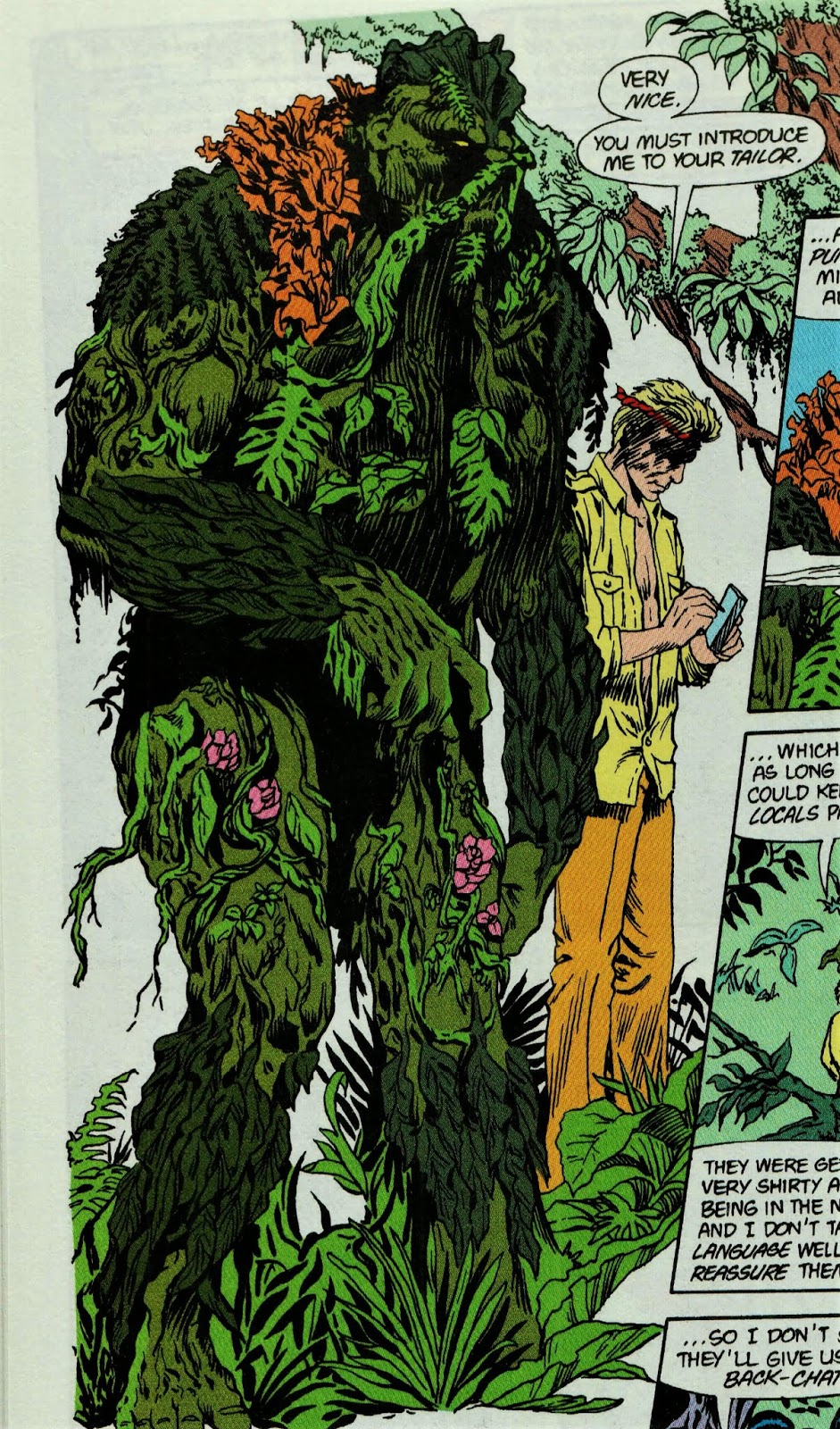
Yeah, for a while I was torn between using the above picture in this or the last post, but eventually I just used them in both. It's just such a cool piece of art, effortlessly showing that this is indeed going to get very weird, and yet, it's so bad-ass isn't it? I wouldn't mind having a massive poster of this one on a wall somewhere. Beautiful and weird.

-----

After the rather brilliant sequence where we slowly, panel by panel, to the narration of a devastated Abby Cable, take our leave of planet Earth, we move out into the cold darkness of the universe, where we eventually arrive at another strange blue world, where in the silence we watch the transformed Swamp Thing stand reborn. And it is an awesome moment, but it's undercut a bit by the impossibility of the situation.

Looking at this gives me Hyperion-Shrike vibes...
Man, wouldn't it be awesome to have that made into a comic?

Swamp Thing has found himself on a planet entire galaxies away from his own home world, and it seemed for a moment as if the series had jumped the shark. The sheer distance of it, a distance that has to be measured in time for it to make any kind of logicial sense it is so large.
But, if you've read comics for a while, especially the DC or Marvel kind, you've by now learned that some things just won't or can't hold up, and if you want to continue to enjoy yourself, you're just going to have to learn to let some things go, and besides, in the DC Universe, as we will see, there was precedent for this kind of nonsense. But more than anything, it is Moore that does most of the work, letting you forget those minor quibbles by making this next arc of the Saga the most interesting one yet.


The issue that kicks it all of, My blue Heaven, is almost a meditative piece, because as the exiled Swamp Thing finds himself light years from home, desolate and completely alone, he finds the need to explore himself and the possibilities he had glimpsed himself capable of when conversing with the Parliament of Trees during the Crisis saga. From there Swamp Thing had to rush from one battle into another, having no peace and not a single moment to come to terms with the gained knowledge, not a second to test himself. But here, on this alien world, he has nothing but time and so embarks on an experiment. 


My Blue Heaven was a massive departure from what one would expect from the Saga of the Swamp Thing and this is because Moore was going through a fundamental change in his personal life. Though the true change would really only become something that had to be relentlessly pursued when he was writing From Hell a few years later, where in the course of writing he would stumble on a life-altering revelation, here there already was a marked interest in work that was way more concerned with identity and the greater questions of life and existence, than the ecological horror that Swamp Thing was known for. Together with Rick Veitch Moore went with a decidedly more Sci-fi approach, though the horror would still be very much present, as becomes clear when Swamp Thing with only his imagination and the powers of creation at his fingertips ends up creating a perfect homunculus of his wife and lover Abby Cable.


The whole issue, as the informative introductions from Volumes 5 and 6 from the Saga of the Swamp Thing tell us, is basically a creator in conversation with himself, exulting in the power of art and exploring himself through his chosen medium. The Abby Cable homunculus is created by Swamp Thing because he misses her, but it all swiftly devolves into a masturbatory nightmare as he begins to realize what he's actually doing. It is a creator in thrall to his imagination, plodding in the wake of the unreal, avoiding what should be done because of the false delight at hand.


After Swamp Thing's subconscious creates a homunculus of John Constantine, the one man he knows who would never accept willful self-deception like this, Swamp Thing is forced to face that he is wasting his time in a very dangerous and unhealthy manner. The lie has been given to his creation and he sees the road of pain the seductive imagery could take him, and so, in self-loathing and rage, he destroys the Abby Cable Homunculus and then sets out to, somehow, reconnect to the Green of Earth in order to be reunited with it and the woman he loves. Leaving the Blue World behind, his creations falling apart as his will departs them, the space odyssey begins.


-----


I wouldn't have minded this arc to have been double the length of what it actually is, because there's really only 4 different stories until Swamp Thing gets to go back to Earth and it would have felt more like an actual journey if the whole thing had been more drawn out. 
And the arc itself is also really captivating. A lot of the appeal is in how the art is coloured and juxtaposed, which is always striking, but the stories themselves are also quite fascinating.
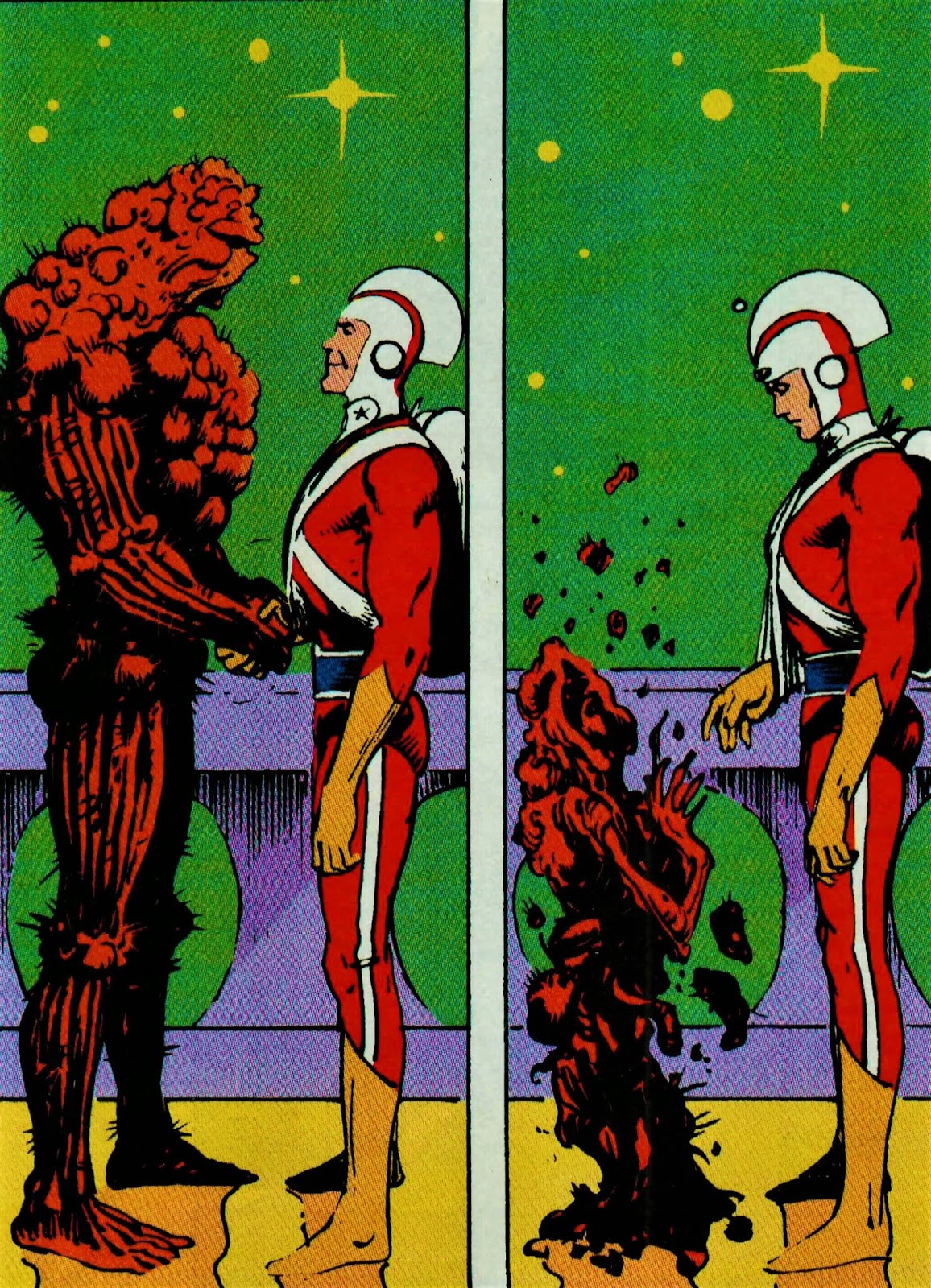

They are obviously very strange stories though, the weirder of which tie into the existing DC universe, and which are weird exactly because they are built around these established characters that Swamp Thing can go and interact with and who'll help him to find a way that'll allow him back into the Earth's Green.


But among this strangeness there are 2 stories that stand out, both genuinely horrific in concept and execution. The first of these is the issue with the incredibly suggestive title of 'All Flesh is Grass' which is a story that Clive Barker himself would be proud to have come up with. The concept is basically 'The Swamp Thing on a world of sentient plants', and given that the Swamp Thing is built up out of plant life meshed together by a consciousness you can pretty much see how this might become a problem.


The other is my personal favourite of all of the Saga of the Swamp Thing, and it's the reason why I began the Swamp Thing Appreciation posts. I set out to just give a quick run-down how Swamp Thing got to this point and then just talk about this one single issue but it all grew way out of proportion because I found that I wanted to do a little extra for the title itself. I wanted to show that despite the ludicrous concept of a hero who was called Swamp Thing there was definitely something to be had here. A little bit of a primer for those of my friends who would scoff and never pick it up. I felt the series deserved it.

-----


Anyway, issue 60, Loving the Alien, is remarkable and quite unique in all of the Saga of the Swamp Thing as it's an issue that sprung from the artist's hand before it did the writer's. John Totleben drew some (or most?) of the story's art undirected, and only afterward gave it to Moore, who poured over the pages until he found a narrative presenting itself.


The story turned out to be one narrated by an alien intelligence, who's telling it to her soon-to-be-born children. She tells how, once upon a time, she was an island alone in the vast darkness of the universe, desperate for a mate, desperate to become a mother, and that she was unable to find one who could procreate with her.


And then she notices a blazing star in the dark as something alien approaches.


It's a disturbing tale, both in its imagery and story beats, the alien intelligence itself coming across as truly alien, its designs on Swamp Thing and how it goes about getting what it wants quite horrific. The brutality of what happens, the clinical detachment, the organic and metallic imagery, it all is indelibly imprinted on your memory, even though the images and language used to describe what is happening are abstract in the extreme.


You'll notice when reading that there's not a single page with individual panels to break up the art, which in some cases is even double-spread. Most of the artwork, certainly those where the story allows it, somewhere, hidden or not, the face of the Swamp Thing can be found, superimposed or part of the detail. Usually the artwork itself is made up out of individual pieces of art, all integrated into the whole, with narration to back it up and to identify what the art suggests. 

And strangely enough, somehow, this all ends up being a satisfying story. I think it is unique in comics, though it probably isn't, but either way, for me this story, this experience, just stopped me in my tracks and held me spellbound and, afterwards, pretty contemplative.

-----


Loving the Alien takes place before Flesh is Grass, which, with its intelligent plant-life, would teach Swamp Thing how to alter himself in order for the Green of the Earth to accept him again.
And, after a few tiny missteps, he makes it back and makes it his first order of business to deal with the men who engineered his banishing from Earth.


Of course, the man who figured out exactly how to exile him, Lex Luthor, is too big of a name to kill off, and since he was pretty much just an advisor in the plot to kill Swamp Thing he isn't remarked on. But the others very much get their due.


And then, with his enemies taken care of, Swamp Thing, with flowers blossoming all around, reunites with his wife.


I've not said much about Abby Cable, and her rather shitty situation on earth, as she struggles and fails to come to terms with the death of her husband as I feel these posts have been going on for too long already, and at this moment I'm itching to be done with them. But she is a good character in her own right, with her own recurring problems to make her interesting. When I first saw her in the extra two Swamp Thing issues included in the Hellblazer Original Sins trade paperback, I though she looked ridiculous, and her function in the story seemed immensely unappealing. I never thought that I would actually come to like her, never mind that I'd be happy to see her reunited with Swamp Thing.

We end the Saga of the Swamp Thing with Abby and Swamp Thing, who by the way was called Alex Holland before he became the Swamp Thing which is why Abby and others call him Alex most of the time just thought I'd mention it here at the end, with Abby and the Swamp Thing enjoying each other's company and deciding to live together. Swamp Thing of course is in charge of constructing their new domicile and together they're about to let the good times roll.


Of course, as this is just the point where Alan Moore stopped writing Swamp Thing, leaving Rick Veitch in charge, the Saga of the Swamp Thing continued, even though Moore did end his run on a pretty satisfying and conclusive note. As I got what I came for, I won't be continuing my journey with Abby and the Swamp Thing. Or at least, I won't be continuing right now, but maybe, if in the future there'll be full and complete collections of Swamp Thing made available I'll decide to read the entire thing. I would be interested to finally understand who the hell precisely Alistair Arcane was. I'll admit he was pretty appealing, in an over-the-top theatrical kind of way.
But for the moment I'm being buried under an ungodly amount of comics anyway. I can wait.

Friday, 27 September 2019

Swamp Thing Appreciation post 4: Gotham Thing


After the exhausting affair of Crisis on Infinite Earths and the subsequent battle between Light and Dark the Swamp Thing returns home to Louisiana only to find out that his wife has been publicly shamed and humiliated for her relationship with him, and that after breaking her parole while she awaited her decency trail she has been jailed in nearby Gotham city.


In an awesome fury Swamp Thing tears across the nearby Green in search of his lover, rampant bloom spreading in his wake, the echoes of his rage spreading throughout the psychic stratosphere. 
And we, the readers share that rage, as Moore does manage to lay it on quite thick. Poor Abigail's the subject of such disdain, disgust and ridicule that when finally the Swamp Thing bursts into the courtroom, one might be forgiven for punching the sky in glee.


But Gotham's justice system is unwilling to hand over Abigail without a fight, and so on her urging the Swamp Thing leaves, although he does deliver to the city an Ultimatum.


If they do not give him back his friend, then Gotham will be overrun by the Green completely, and as he takes his leave he gives the city a taste of what is to come if they don't comply to his demand.


Surprisingly, many of the city's inhabitants, their jobs and the busy schedules of day to day life paralyzed by the jungle quickly sprouting up outside, are seduced by the joys of nature and abandon their homes and offices to revel in the healthy throb of nature. And there are many who revere the Swamp God who turned crime-ridden Gotham into a kind of paradise Eden.


But, Gotham has its own response to those who upset the established order.


Yes, indeed, Batman is pretty prominent, and rather crucial, in this story arc.
Batman, and his many ingenious gadgets, easily wipes the floor with the Swamp Thing, but the Swamp God has learned that he does not a need a body to survive as long as he has the Green. And his mastery over his powers has grown exponentially.


Batman is defeated and though he urges Gotham's leaders to release Abigail the city refuses and so continues to be plagued by uproarious nature and various displays of the breadth of Swamp Thing's powers. It is honestly pretty neat.
As events threaten to come to a head Gotham's defender ends the stalemate by arguing with the city's mayor by stating that there is a precedent for the strange relationship between Abby and the Swamp Thing, and that if they designate the odd couple's relationship as against the law, then they probably would have to arrest various other superheroes, who would also be breaking the law by being alien life forms in relations with humans. And really, would anyone truly want to even try and arrest Lois Lane?


So the city backs down and releases Abigail after Swamp Thing restores Gotham to normal. The lovers rush into each other's arms, but before they can savour the moment, the trap is sprung, and Swamp Thing is assassinated.


Unbeknownst to Batman, Lex Luthor had been hired to annihilate the Swamp Thing, and the criminal mastermind had devised a way to cut off the Swamp Thing from the earth's Green, trapping his consciousness inside of his body, and then he unleashed hell upon the unsuspecting Swamp God.


And in the blazing inferno, within the cage of his body, the Swamp Thing dies, much in the same way as he was born the guardian elemental of the Green. 


Time passes and Abigail, Batman and the entirety of Gotham mourn his passing. They erect a statue in his honour, to apologize for the betrayal; and then... people go on with their lives, as best as they can.

And that's it.
Life moves on and people try to forget and come to terms with the death and loss.

But of course, the Swamp God did not die. Though the fire took him and death came close, the Swamp Thing's consciousness didn't die. Cut off as he was from the Green of earth, he made a desperate leap into the great dark of the universe in search of another planet, another Green that would house him.

And he found it. Or at least something like it.


Swamp Thing Apreciation 3: Self-Realization and the Crisis

Alright, by now these have become full-blown recaps, with spoilers and all. But I guess they do flow forth from my appreciation of this really weird superhero comic. So, read on, Macduff.


Ahead of Swamp Thing loomed great challenges, but the character as Moore envisioned him, was still seized by doubt and uncertain of his nature and power, and too blinkered by his human point of view, and so to lead him, in a very roundabout manner it must be said, towards self-realization Moore thrust him into the American Gothic arc under the guiding hand of John Constantine.


It was called American Gothic because in these adventures Swamp Thing dealt with various Americanized Gothic monsters; 


There were a bunch of Vampires, the leftovers from a Pre-Moore Swamp Thing story, a Werewolf tale with its roots in the menstrual cycle and even a curse that led to some pretty likable voodoo zombies, and along the way Swamp Thing gained a new perspective on himself and how he could interact with the world around him.


And then the Multiverse shifted.
And the Crisis on Infinite Earths arrived.


And, luckily, it didn't stick around for very long. At least, not in the pages of Swamp Thing, where our heroes are in and out of the main event without barely having seen action. It is comfortably the oddest of the Swamp Thing's already pretty strange adventures, more because it feels as if he's a step behind everyone else, and because the story itself feels very wonky. Crisis on Infinite Earths is the massive crossover event in the 1980's wherein DC brought together all its disparate superheroes, and made all the different multiverses into one universe harbouring all of the superheroes. As someone who's never read the main series (and likely never will) it all came across here as... lacklustre, and pretty barebones.
But as John says it, there was a point to it anyway, as the Crisis was to be used as a springboard by an ancient, evil force, and Swamp Thing was going to be crucial in the battle ahead.


After the Crisis, for a little while all of reality would be unstable and vulnerable to attack, and the Brujeria had been waiting for it, and more than that they had been waiting for the Swamp Thing in particular, knowing him for what he was, knowing his nature and true power. And they were prepared for him. And so Constantine finally pointed the Swamp Thing to the place were it all was to be revealed: South America.


Deep in the jungle of the amazon forest in the company of the Parliament of Trees, the Swamp Thing learns that he is but the latest in a long line of Swamp Things, all of them protectors of the Green, all of them transformed from man into elemental life by fire, death and water, all of them part of a recurring pattern throughout the history of the world, and he finally sees the possibilities inherent in his nature.


But though he asks the Parliament for help in controlling his power in order to be ready for the danger ahead, the evil to come, they rebuke him and state that all is simply as nature is. They refute his human point of view, so laden with doubt and prejudice and so uncertain of what to do, and so they refuse to help him, and they cast him out from the sacred place where the Swamp Things come for their final rest.


And so, disappointed and unprepared, the Swamp Thing goes to war against the Brujeria, and it all goes dreadfully wrong.


-----

I actually did like pretty much all of this arc. This is in large part down to the heavy involvement of John Constantine, it being his team of friends and hangers-on that gets pretty much annihilated. I had seen some of them in the Hellblazer series, which also had a few vague references to the events here, and it was nice to finally have it all seemingly filled in. In the Abigail Arcane's side story, which serves to set up the last story for Moore's Saga of the Swamp Thing, there are also some quite intriguing moments with Sandman's Cain and Abel, who seem to predate their whole Sandman shtick. And would you please bask in the violent glory that is this awesome panel?


-----

But anyway. The Brujeria manage to hold off the Swamp Thing for long enough to succeed in their ritual, releasing a bird of doom that wings its way past the end of the universe, where it wakes something huge and dark, something that will destroy Heaven.


The odd thing here is that Moore introduces it by calling it heaven, instead of just what it is; the light. Attention is given to the just-awakened thing, the oh-so-dark thing; that for some it is Satan, for some it is Cthulhu, for some it's just a massive energy field, either way, that it is the enemy, the thing to be stopped, and the goal of this thing would be 'Heaven'? Anyway, it's just a bit of an oddity I thought. It's obvious that this is the about the dichotomy between light and dark, good and evil. That the metaphor of the endless struggle is about to reach its climax.
But then, the confusion of the matter is also here for quite a crucial reason: The reader is not supposed to be completely clear on the exact identity of the two forces that are about to clash, just like the thing they're about to fight doesn't exactly know what it itself is. This gives it a reason to embark on a dialogue, which is where our hero comes in.


Swamp Thing and Constantine split up, Swamp Thing to travel ahead and gather up a team of heroes in order to try and forestall the coming end, and John to gather a cabal of magicians and warlocks to lend their psychic strength to the confrontation to come. And here we come to the second precursor for Justice League Dark (apologies if I'm in error about Swamp Thing having the first and or second DC-wide precursor for the Dark Justice League, I've barely read a thing from DC).


On the physical confrontation side of things there's a whole menagerie of characters some of which  are quite undeniably superheroes, and on the psychic backbench we have a roster of masters of the Dark Arts, most notable are of course John Constantine himself, Sargon the sorceror, Zatanna and her father, Zatara.


And what follows is quite awesome actually. The heroes and the circle of magicians square off against the massive dark thing that bears down upon them and, doing what self-important superheroes do they mostly engage with their enemy in grand-standing one-on-one engagements.


They are of course promptly defeated, as this force is so beyond them that they stand no chance at all.
They are swallowed up by the dark, and in their helplessness are asked a question pertaining to the nature of the dark thing itself, it having lived so long that it has forgotten its purpose and doesn't know what it wants. And each hero, according to their own temperament and way of dealing with their enemies answers as they are wont to do, leading to disastrous results.


On the Magicians' side of things, in trying to shield the battling heroes from the worst of the dark thing's power, the casualties have been severe, a few of the more notable members of DC's Dark magicians simply having burnt up, in quite an impressive and affecting manner.


And as all the climactic confrontations have happened, the greatest heroes having been defeated, as all seems lost and the dark's advance seems inevitable, the Swamp Thing, knowing there is nothing he can really do but unwilling to look on without acting, in silent humility steps forward into the dark.

He doesn't struggle, he doesn't fight, and as the dark asks him whether he knows the answer to the question of its nature, this nature that has been called evil, the conflicted and uncertain Swamp Thing responds as only he could; he responds with doubt.
He says he doesn't know, but he tells the Dark about his conversation with the Parliament of Trees and their assertion that all existence is simply as it is, that evil does not exist, and he adds that though he does not truly believe this, he believes that maybe evil and good are more intertwined and less independent than everyone has made it out to be. The dark lets him leave, and then continues on its way, and in a pretty awesome scene of metaphor made physical the great powers of dark and light clash and mingle, altering the very fabric of reality with their harmony.


And so, with all and done with Swamp Thing can go back home to Abby Arcane, who, because of her close relationship with him, has become the target of outrage and censure, the consequences of which will lead to the Swamp Thing's strangest and most experimental adventures.