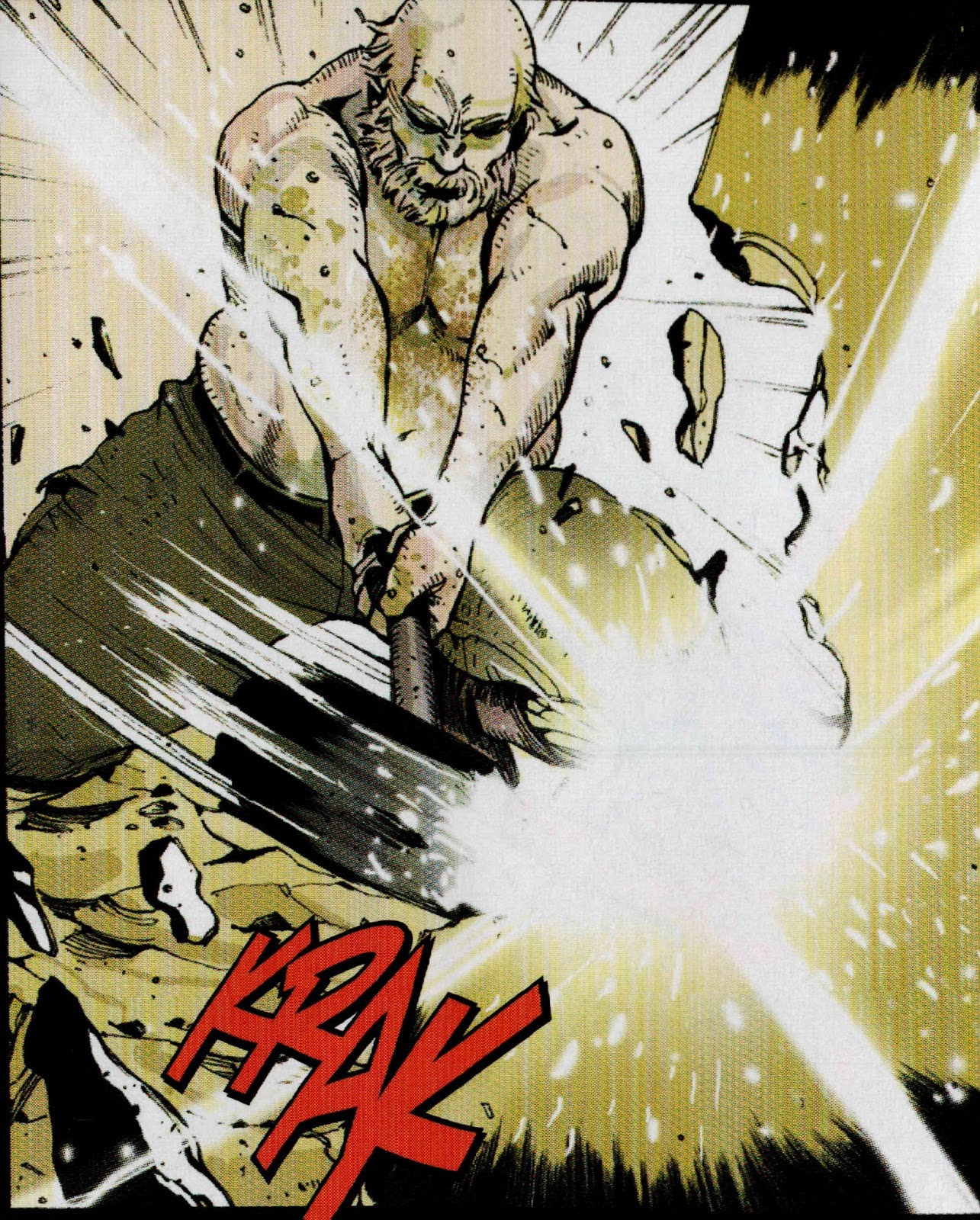
Oh man, I've been waiting for this one for a while.
It's eh... not what I expected...
Granted, the comedic value might just be a little too present because of the odd choice of the song (somebody really fucked up there) but... hmm... I don't know about this...
This was supposed to be darker and have a more 'horror' vibe. It's very odd to be focusing on the humour. Again though, that might just be the song.
Harbour isn't Perlman, obviously, so we'll need to adapt to that. But it's got some ways to go yet. At this point Perman's voice just is Hellboy for me, especially since I've also seen sword of storms and blood and iron, where he also does the part of Hellboy, further cementing a warm, gruff and yet understated quality that was perfect for the character. This one also looks very unlike the comics and rather more like somebody's idea of a superhero Devil. All bulk and none of the dejected quality we got in the comics. We'll see I guess.
I've never liked Ian McShane, and for me he's a total miss as Trevor Bruttenholm. He's just always come off as sleazy and I can't reconcile him with the caring Bruttenholm.
No idea who the girl is but regardless, she looks too young to be here, and the dreadlocks suggest a tone I wasn't expecting. More than that, if you look online, you'll see that this lady is supposed to be Alice Monaghan, which is baffling, since everything surrounding that character is to do with Ireland.
Maybe they'll just be using 'The Corpse' story as a springboard though. It makes sense; take the most beloved of the short stories (which works well on its own) and use it as (maybe) a sort of prologue in the movie. It's got comedy and darkness, which would also fit in with this trailer. I'm just speculating though. Corpse Prologue, fast-forward 18 years, and you've got a great, believable friendship between her and Hellboy.
And even though I have questions with all of these characters, Daniel Day Kim as Ben Daimio looks fucking spot on. He's a favourite, but the fact that he's here suggests a highly rewritten grander scheme of things, a mix and match of the BPRD and Hellboy.
I spotted the Baba Yaga and Gruagach which, to be honest, I wasn't expecting... the Baba Yaga sure, But Gruagach? Isn't it a little early to be introducing him already?
The fact that Nimue is here also points to a very strict focus on the central Hellboy storyline.
For fans this can't be anything but jarring. Dragons, that white monster... There's simply too much endgame stuff here. I'm very much wondering where exactly this movie will end...
Even though the trailer itself is getting a bit of a negative reception, and it's easy to see why, it's best to keep in mind that the movie itself screened to high praise, which doesn't mean dick, of course, but hey, I'm trying to be positive here...
Fantasy masterwork nr 2; Time and the Gods collects 112 short stories in 6 short story collections. Written by Lord John Edward Moreton Drax Plunkett Dunsany, these collections quite rightly made the earliest cut of the Fantasy Masterworks, back when they were still being published under the initial Millennium imprint.
There's no reason to talk about this one too much (*manic laughter*) as anyone who's ever read Dunsany knows; he belongs to the greats, his work having had enormous influence on the genre as a whole and still being very readable now, over a hundred years later.
Style
Dunsany is another one of those few writers whose style and themes effortlessly evokes a gloriously mythic quality.
Many influences contributed to the creation of this style, but one of particular interest to me, and something which I had already noticed in his work before learning of it, was how much of an influence reading the King James Bible had on him. I've talked before how this style; the collage of epic pedantry present in the Bible, is one that has resonated with me most whenever an author employs it.
This ornate style doesn't stay the same throughout the book though, and in fact Dunsany changed his approach to whatever he was working on whenever he felt that he had exhausted the possibilities of a style or medium. And this is already very noticeable in the 6 short story collections in this Masterwork.
The Fantasy Masterwork
Dunsany's 6 short story collections are undisputed classics, both for their influence in the fantasy genre, and purely for their own dreamy lyricism.
But, it must be said, because of the aforementioned shifts in style, Time and The Gods (,the Gollancz Fantasy masterwork edition of) as a whole is a bit of an uneven work and could have done with a clearer divide in which works fitted in which universe. To wit: I've named them; the Books of Wonder, the Pegana Universe, and the Tales of Faery.
The first book in this collection; Time and the Gods, together with its last; The Gods of Pegana, form Dunsany's Pegana universe, a place of Gods, petty or not, and the men that worship them, willingly or not. These tales are clearly the most serious and are where Dunsany's the most in love with his world-building. Parabel and metaphor form an intriguing and deep narrative and occasionally serve to drive home a barb or two against organized religion.
Although it is the novel's last collection, The Gods of Pegana is more of a story cycle collecting 30 tales over the course of 50 pages. As their individual story threads tend to run one into the other, they are rather more inter-linked than the rest of the short story collections in this book and should be considered as one extended story. These should preferably also be read before beginning the Time and the Gods read.
Then you have the stories of The Sword of Welleran and A Dreamer's Tales, which are a collection of serious and occasionally quite beautiful Faery tales. And although there is on occasion made mention of several gods, named or not, and the ubiquitous entity 'Time', I never felt that these were the same characters as those from the realm of Pegana. But then it is my opinion that Dunsany was a bit careless about his continuity overall: Time switching from the Hound of the Gods, to their Swarthy servant with sword dripping red, to being the father of the gods in the House of the Sphinx (Book of Wonder).
And for the remainder you have The Book of Wonder and the Last Book of Wonder which are for the most part most clearly indicative of one of those shifts in Dunsany's style and his views on his work. Unlike both the Pegana stories and the Faery tales, these are more self-deprecating, more aware of themselves, and occasionally even outright mock the serious narratives of the previous collections.
Time and the Gods
Time and the Gods, the second collection, here put first (foolishly), was published in 1906, and builds on the mythology in the Gods of Pegana short story collection, which was released the year before.
Though the stories here proceed from the same basis, of Gods and the men who worship them, there's less tolerance of what was once so reverently created, those stories and themes once paid such dear homage to. There's a wistfulness here, a slight mockery that wasn't present yet in the Pegana tales. An attitude of small-mindedness where before was only awe and a sense of being separate from these beings and this mythology so far beyond ourselves.
The vignette-style of the Gods of Pegana has also vanished almost completely, with the longest story of the collection; The Journey of the King, comfortably taking up over 30 pages.
The Sword of Welleran (1908)
Contains among others, the (arguably) first ever sword and sorcery story; the Fortress Unvanquishable, save for Sacnoth. If that wasn't enough, also present is titular The Sword of Welleran, which, with its portrayal of an 'almost' sentient sword, delivering victory through bloody and horrific slaughter, likely influenced the creation of Sword and Sorcery's most famous anti-hero: Elric of Melniboné. It's also notable for shifting the focus from the divinely inspired narratives to one of a more human frame.
A Dreamer's Tales
In A Dreamer's Tales, published in 1910, we find many a memorable and influential tale. For instance; Idle Days on the Yann which directly inspired Lovecraft to write his Dream-Quest of Unknown Kadath.
It also has the sad but triumphant melancholy of one the best Dunsany short stories, and my absolute personal favourite; Blagdaross, which is an anthropomorphic tale of a bunch of discarded objects left in a waste disposal park which regale one another each with a tale of how they ended up there. From an old wine cork, to a piece of rope, to the wooden rocking horse Blagdaross itself, the short recountings start out ordinary and whimsical but soon touch on profound themes of human darkness and loss. (Fun in-universe note: the House-God of Broken things is called Jabim. I enjoy lumping this particular tale in with the Pegana universe.)
The Unhappy Body reads like the lament of a creative soul, wishing he had more time in which to release his creativity.
The Book of Wonder
For the Book of Wonder Dunsany changed his work methods, and experimented a bit with his storytelling.
During the original short story publications Dunsany contracted Sidney Sime, a fantastical artist using monochromatic colours and frequently employing satire, to illustrate every collection, but of these it is the Book of Wonder that is the odd one out. Published in 1912, where before the art was created to suit the story, here Dunsany wrote stories to suit the art. Apparently Sime had complained that his editors did not offer him suitable subjects to work his art around, so Dunsany, in the hopes of adding some extra mystique to both his writing and Sime's art, wrote his tales inspired by them. Which led to some pleasingly memorable tales, such as The House of the Sphinx, a mystifying tale which offers up the possibility of reading the story in several ways; as dream, analogy, parable or just as a straight-up fantasy.
But is also leads to the side-effect that these 14 tales are even more than usual, very unrestrained in their imagination; a detrimental effect, as if Dunsany cobbled together a short tale by flinging anything together that he could come up with, leaving them more inconsequential, and unmemorable than previous tales.
A great many of the stories present in this one and in the following Book of Wonder are exercises in infinitely delayed gratification, with their plot and resolution remaining unresolved as Dunsany almost coyly drops back the curtain that he previously had only barely lifted.
There's a lax attitude to his own work here, as if unconvinced of previously held convictions of merit on his own stories.
The Last Book of Wonder
From The (first) Book of Wonder to the Last Book of Wonder (initially published as Tales of Wonder), where Dunsany clearly was more energized as he found his original idea, of working from Siney Sime's artwork, paying off. The idealism returns, the love of the telling, the romance.
This is most readily apparent in A Story of Land and Sea, which is far and away Last's longest tale, tying back to the (first) Book of Wonder's The Loot of Loma. In the Last Book of Wonder, originally published as Tales of Wonder in 1916, Dunsany revisits many of the characters and settings he visited for his previous Wonder outing, most notably, Captain Shard and his merry crew of pirates from The Loot of Bombasharna, get the lengthy prequel story: A Story of Land and Sea; set in the time before the crew's retirement on the floating island. It's a tale that unlike most other tales in the collection is more focused on historical adventure rather than outright fantasy.
Many of the tales in this collection end whimsically humorously: for instance; How Plash-Goo came to the land of None's Desire is a darkly ironic tale of a giant developing an irrational hatred for a dwarf, the title only given meaningful relevance at the very last sentence.
The Long Porter's tale, ends with self deprecating sentiment. A tactic Dunsany frequently employs in these, the latest written tales; Something to take the wonder out of the narrative, an unhappy denouement. However Thirteen at Table is one the few that doesn't take the wind out of its own sails and is instead a pleasant little ghost story.
The Gods of Pegana
Paid for publication in 1905 by Lord Dunsany himself, The Gods of Pegana is the book that's readily the most interesting as it flat-out gives you a whole mythology; The Pegana universe. Written and published in 1905, and despite being chronologically the first of the short story collections in this book, it is in this collection at the very back (it should not have been), probably because it's a bit of an unusual one, and any modern mainstream reader should be forgiven for exiting immediately upon being confronted with a narrative of this nature. It is in effect a linked series of character vignettes of various metaphors and parables. The longer the book goes on the more you can see Dunsany's narrative style shifting from vignettes to the longer form of his later short stories.
Upon its completion I found a few questions lingered, most interestingly; who is the victor in the game before the Beginning, Where lies Pegana, and what does it look like, and: when and what exactly will be THE END?
My second Penguin Epics acquisition; this time it's number 14 out of the 20. I'm reading this one in preparation for the Grendel Fantasy masterwork, which will give an alternate take on the old English epic, which I (for shame!) hadn't read yet.
I've also already finished Gilgamesh, which I found okay, but very repetitive and with a little too much name-dropping without relevancy; a roll-call of Gods and Goddesses without end. But it was a quick read and hugely important in its place in world literature. So, kudos to me; more experience and another book under my belt. Not hugely memorable though.
But Beowulf on the other hand: on page 5 already, I hit a point where I practically squealed.
This little part alludes to an interpretation of what the mark of Cain might be:
God looks at Cain's act, humanity's first murder, and gifts/damns him with a beast's horn, which makes him the father of Monsters. The beast's horn, supposedly, is also what causes his death: Cain, because of the horn, is in a hunt supposedly mistaken to be an animal and then shot to death with a bow and arrow, by a blind man and his something-something grandson. Who upon realizing who it is he has just shot to death, in recognition that Cain's curse will hit his line, claps his hands together in despair and hits his something-something grandson accidentally to death, thus immediately taking care of the curse of the first murderer.
It's pretty incredible to see the link here in this particular text, the most important work of Old English literature.
I'm glad I picked this one to read next; it's already an interesting and compelling read.
After I finished Final Fantasy 12 and its mile-long train of mythologically inspired bosses, silly or otherwise, I looked into getting some literature on one of the more memorable ones, with a name that has resounded in many another game and work of fiction: a name of power; Gilgamesh.
As I tend to be thorough, I quickly stumbled on the Penguin Epics, a smallish collection of about 20 works, which had the epic of Gilgamesh under its many well-known titles (of which I'd only read Exodus).
I thought the series' artwork was striking, and my interest was piqued pretty quickly when I saw how Gilgamesh in particular looked.
I didn't wait long to order it.
Second-hand of course, as these are generally out of stock, though the pricing seems to be rather reasonable.
And when it arrived I found out exactly why so reasonable.
It is pretty with reflective gold spotting, but if you can't tell from the picture above, it wasn't exactly what I expected. When I opened the mail box and saw the package I genuinely didn't have a clue what could be in it, it was that tiny.
I mean look at how small it is to a modern day epic novel.
Quality over size, I hear you whisper, and that might be the case, but I'm not here to compare the two in what's between the covers. This is just to illustrate how small the book is.
I'm very happy though. It's beautiful, and oh so tiny.
I just can't stress how adorable it is, it's just ridiculous.
It's actually a little bit larger than a standard mass market paperback, but because of its small page count, it just seems slighter.
-----
I've also already read a chapter and though there seems to be occasional repetition, the style is familiar enough to be comforting to this old Bible-reading soul.
I'm not chomping at the bit to read it through in a sitting, but am interested enough to read some pages in the idle moments. Its length is quite inviting too. Short but indeed; epic. They don't write 'em like this anymore.
Alright, after seemingly endless revising it's time to send this one out into the world.
It's about time, because I'm in a state where I'm blithely staring over errors as it's become an inextricable mass of information for me now. It's become too close, and I'm unsure whether I've said enough, though it certainly feels that way. Which means it's very much overwrought in some places and woefully inadequate in others but, well, right now I just need an exit from it.
Doubtless there will be some revision in the future, possible clarifications and so on. But for the most part, the big ideas are done.
It's doubly ironic then that the ideas that started the write-up are nowhere to be found.
Very clear and definite spoilers for Weaveworld.
Interview, The Ritual and Gardens
I've been checking some interviews with Clive Barker, one of which where he gets interrogated, cross-examined asked questions on his work, both film and writings, by a bunch of brainwashed simpletons well-adapted and intelligent studio audience. This was around the time that Weaveworld had just been released, or was just about to, and the Hellraiser movie was still making waves.
As a result, the atmosphere is positively hostile, and it's surprising how calmly responsive Barker stays, slapping down most attacks/arguments easily and eloquently, even though he might have evaded one or two here and there, while patiently reiterating and clarifying his stances, even in the face of what are almost exclusively leading questions. I would've blown up at one point, but then I don't have any business being in front of 2 people, never mind a whole crowd of self-righteous little armholes😊.
There's a reason for both the audience and (to a lesser extent) the host's self-righteous aggressiveness towards Barker of course; mainly that society of thirty years ago certainly wasn't as desensitized like we are to some things. And Hellraiser might've been responsible for some of that, though I honestly don't profess to know, as I'm not a horror movie expert. Hellraiser the movie IS a very good adaptation of the novella though, I know that much.
Anyway. What I took away from that segment was how Barker states he almost exclusively tries to use supernatural themes as a metaphor to broach certain themes and ideas he wants to address.
-----
And don't you 'duh' me on this one; this is the age of escapism, it is rare to find this level of thought in contemporary fantasy authors. and either way, it's the 'exclusively' that bothered me a bit. There should be room for escapism and entertainment, both for author and reader. But with the grilling he receives in that clip he can be forgiven for reining some of his views in. Reduce the food for the fire, as the fire has got its blinds on, and all that.
Shortly after writing this I was re-reading the introduction to the novel again, and I read the part where Barker specifically addresses this sometime-attitude to his own work. So eh, yeah, this bit wasn't superfluous at all... Maybe I just wanted to show off I've been doing my background for this thing.
-----
Just as a little aside because that other horror movie is still prowling around in my head. I was looking at the interview because I had some trouble in starting the Weaveworld write-up, as I often do with the ones where I want to talk about a lot. And when I reflected on The Ritual, it becomes clear, a little on the nose even, that is also does this thing where it uses horror and supernatural elements to get to the heart of a matter.
The beast as metaphor and, also, as literal incentive to combat cowardice and for pushing past that cowardice, so when that same beast demands you to sink low, in terror and obeisance, you stand up and fight. Barker would like the film I'm thinking.
And so would you.
-----
And with Weaveworld Barker explicitly stated that he wanted to explore the idea of an ideal paradise at the heart of most creation myths, a garden of peace and plenty, and as Christianity informs many of his fictions: that garden is Eden.
Now, in the novel, you obviously have your Weaveworld itself; The Fugue, the collection of magical places and the individuals who populate them. There's magic around every corner, underneath every blade of grass and when the reader is first introduced to it, the overwhelming impression is one of ribald peace and plenty (yes, that is exactly what I mean), harmony and wonder. The Weaveworld itself is an overtly, explosively, magical shade of Eden.
But there's also another part in the book where we are treated to another garden entirely.
And maybe it is even the original garden itself, but there's deliberately no way to know for certain. And those parts of the book are genuinely spellbinding. I didn't set out to find a story with Biblical themes this time, it just happened. But when I realized what was being put on display I really was quite taken with it.
It's here where Barker introduces the book's hidden mythology, supplying enough elements that you can fabricate a number of possible scenarios to have given rise to this 'Paradise garden' myth.
-----
There's an element to this scenario that I absolutely loved; something that seems to sit engraven as one of the basic 'given truths' in this world: Uriel's situation, his alone-ness. Among the things it infers and the most interesting to me is that it implies an absence of supervision. Coupled with Immacolata's comments, likely inspired by hidden 'true knowledge', which is supplied by the Menstruum or from knowledge gained behind the veil or as an oral legend from the Kind, points to a Creator absent and forgetful, wilful or not, or if not forgetful; one who is not omniscient. Absence can imply many things, but the consequence of it for those not in the know is that it can only be felt as abandonment.
So then; the issue of divine abandonment rears its head again. It's a theme more explicitly touched in Barker and Miller's Next Testament.
Loved seeing it here, even if it wasn't the heart of the matter.
The Mythology
On the Arab Peninsula, there's a place so inhospitable and empty, it has remained to this day unmapped. This place is called the Empty Quarter. And in its very heart, closed in by a seamless wall of smooth rock, lies the Garden.
Under the sun, it is an empty waste. And nothing is visible other than vague avenues and patterns in the sand and dust, with meaning seemingly present but indecipherable. But during the night the garden gains another dimension. One of seeming life, made manifest through dust. But of course; the dust, the sand, being reared into a simulacrum of teeming, blooming life, is a simulacrum only. It is white and sterile, reduced to crumbling dust at the lightest touch. The structure and patterns are proved meaningless, they are merely an echo of what once was.
The garden is inhabited by a being of geometries, eyes and wheels of fire. It calls itself Uriel. It is the one that raises the garden of dust every night, in memory of what once was and maybe, also as a signal, to broadcast to whatever or whoever might be listening, that it is still doing its job.
At the time of the story it is a being that, a hundred years earlier had looked into the minds of men who'd read the Bible, either correctly understood who he was by the given context, or who misappropriated the Garden's mythology for himself.
Barker leaves it up for interpretation which is the correct one here.
I choose to take this at face value, as an extension of the Biblical myth.
Barker, in Uriel's initial meeting with Shadwell and in Suzanna's conversation with Immacolata in the Shrine of the Mortalities, of course offers up something else, something wilder; hints of the absolute base truth informing, giving rise to Biblical mythology.
But, again, as this is all the information we have, and there's nothing but fruitless speculation down that particular road, I choose to approach it my preferred way.
Uriel, only arriving at the garden after Adam and Eve's banishment from earthly Paradise, as the angel with swords of fire, is left behind to bar entry to any who would enter its idyllic premises.
But over the course of some time, new life begins to grow there. It is unplanned, wild and rampant, varied and completely against normalcy as it was established up to that point, in a word: inhuman.
As this is an unknown, uncalculated for 'miracle', or that at the very least Uriel was given no orders for, he can do naught but watch them grow. And as it his duty is to prevent entry, he does not mind letting the Curious Seerkind leave to find the world outside.
But then, after their leaving, the ages pass and the once-clear angel slowly starts to succumb to the madness of loneliness, and forgets all of what it was, until a group of travelers break its isolation.
From their minds it pieces together the Biblical mythology and, reading of the angel of fire placed at Eden's gates, is reminded, but not shown (very important), of what it once was.
It abandons guardian duty for that of executioner, and strides into the world to hunt the Kind that once had left the garden.
Years pass as the Kind are hunted and killed in violent conflagration where ever they are found. In the end the survivors secrete themselves in the Fugue, the carpet that hides them from the eyes of their "Scourge", to wait for the day that they'd be safe again.
I hate the world, I was there once before.
Finding no more Kind to extinguish, and, as a being of utter purity, repelled by the grubby world outside of the garden, the being that calls itself Uriel returns to it and again takes up its guardian duty to the now-dead, absent the angel's power, Paradise.
-----
It is an assumption that the angel's leaving causes the garden to wilt.
It's not gone into in the novel, I think.
-----
It continues watching over a garden of dust every night, forgetting everything but the thing in front of it. Nightly building empty meaning out of a jungle of dust, an imitation-echo of once-teeming vibrancy, and as an empty gesture, a sign to the heavens: Hineni. Here I am, God. But enacted, expressed, to a God, unwilling or unable to witness, One who maybe, through the endless ages, has become just as forgetful of Himself as this one wayward angel.
----
There is comfort in oblivion.
Though able to go anywhere, Uriel, this being of immense God-like power remains in the garden, clinging to derelict duty, because, having forgotten itself, and basing itself on the inaccurate depiction as glimpsed in the minds of those who had read the Bible, this depiction of itself, with all the duties that that entails, are all that it knows.
Furthermore: It verbatim states that it does not like the outside world. It remains in the dead garden, conjuring the vanished Paradise from dust, because unlike the outside world; dust is safe, dust is peace, as in; dust proclaiming, being the symbol of oblivion. To bring back the plants, colour and life as they were, must have been within this creature's possibilities, but it keeps instead the white and sterile garden of dust, crumbling into nothingness at the slightest disturbance. Because emptiness can not be tainted, it is pure unless something is added. Safe and void, ever always predictable.
Later on in the story Uriel also continues on with this, when it voices the desire to scorch the entire world into dust and ash, void it of life.
The Persecution of Imagination
There is something obvious I have not yet addressed. It is the question of why Uriel leaves the garden. Why he goes after the Kind, to burn them wherever they are found.
It's not because of Shadwell's suggestion of going after them, he was merely the reminder, because Shadwell was not the cause for Uriel's first leaving of the garden.
So why? What makes this being leave his duty? What enforces this malign, destructive course of action, prompting him to go out and renew its hunt? And more than that, when taken to its extremity, the path that begs the end to life itself?
It is the Bible, of course.
As Immacolata states: "That's what it believes, having read the Bible."
Or rather; The origin of it comes from the stance offered, demanded by the Bible.
Implicit message of strict adherence. Do one, not the other.
-----
On top of, of course, the Bible's 'Kill the sorcerer wherever he is found', which would be an easy but boring explanation and thankfully it isn't mentioned in the novel.
-----
The Seerkind in their wild multiplicity of life, with all their magic, all their differences, their colours, their everything that isn't fixed, represent everything imagination can possibly summon. They are representative of Barker himself too, the irrepressible creative.
Destroying the Seerkind is to destroy life itself in all its unending imagination and creativity. Because Creativity is life, and life is creativity. It is thought, it is hope. It is the constant momentum forward.
Creativity is anathema to lines of constraint. Guidelines are abandoned again and again in the face of passion and experimentation.
The Bible goes opposite to that.
It demands us to adhere to a strict sets of rules, in order to be without sin, to be pure. Failing that: Believe, submit, follow and be saved, or burn; there is no alternative. And in the mind of Uriel, it is this path, when followed to its extreme conclusion leads to only one place, and this is where we find it by the last stretch of the novel. These beings are impure and can not be redeemed. And the world itself is too far gone.
I hate the world, I was there once before.
By Uriel's reasoning, purity can only be regained, be made certain by the absence of life; an absolute sterility. Judge Death, but Biblical.
-----
Barker himself claims that this is not about the message, forgiveness, submission or commands themselves, that this is about the voices on earth, all those demagogues and figures of power who demand all their followers to bow down to them, who claim to speak for Heaven and the sinless purity it demands, who take that divine message, regurgitate it, mold it in a shape to suit it to their own profane ends.
That in truth, this is about those who interpret and who claim 'this path to follow': The organized religions.
But it can not be denied that all what these people do is follow the rules as as they are laid out in the Bible. For their own ends to be sure, edited maybe and altered, but from the same restricted heart, inimical to unruly, errant humanity.
-----
But.
Resolution, and Flawed Man
All of this reasoning is gleaned from the minds of man, and their assumption that the Bible gives the be all, end all knowledge and answer to these things.
Uriel takes this entire reasoning and subsequently solely acts from that premise, but can not KNOW that it's true. So: there is still doubt.
So when at the end, when Uriel is offered its heart's desire, which is to see itself, to finally again know itself as it truly is, it gazes into the jacket and draws forth from it the thing it wants most; itself. As mirror and more than mirror.
And in that moment it understands, is reminded, and knows what to do. And immediately it shoots away from Earth, leaving behind misguided humanity and all its flawed texts. Not a word given, not a backward look. The end.
There is no clarity for us, no final reveal. Only the baffled gaze of the outsider. The being Uriel knows, finally knows, when it is reintroduced to its own knowledge, its own truth, and then it leaves, immediately upon remembering only it knows what. The only deducible truth from this, is that neither humanity, or the Seerkind, in Uriel's ultimate comprehension, matter to it.
Anything we've held true is void because of this. We don't matter in the truth of this creature.
Our relevance to this thing of divine origin, is nonexistent.
Half of this is projection, tainted by an unwillingness to acquiesce to what Barker hints at, and me sticking to the Biblical lens. But also, because, if we base ourselves solely on what Barker presents, there clearly can be no clean answer, because what little he's hinting at has an inconceivable amount of possibilities behind it. Think of whenever the angel speaks, that it offers only seemingly coherent sentences, but it is unclear if they indeed always belong together. There is a possibility of disjointedness here as its mind, stimulated for the first time in a hundred years, jumps around from one thing to the next without pause, abandoning one idea ceaselessly for the next. There is body language, but that is interpretation, as are the visions we are shown; passing windows offering up words and scenes without context; blooming gardens, higher spirits, dripping matter of pure creation, and worlds of fire, cloud and rock.
In the end, Barker delivers on what he set out to do; he makes it clear that something bigger than mankind has touched it. And that Man, in response, created legends and myth in an effort to understand it. And that then, that thing, in all its unknowability, left. From ourselves there can be no answers to this, as everything is tainted by our own myth-making, our bias and ever-present self-importance. We're inside and, as such, can not see the whole picture. And there is no-one else to offer up a solution.
Meaning, but no answers.
While chasing his escaped prize-winning pigeon through the streets of Liverpool, Cal Mooney stumbles on the miraculous. In a moment of terror and exaltation he catches a glimpse of a world of wonder before it submerges again in an old, fraying carpet. It's a sight that takes him back to the innocence of his youth, to the time when magic was still possible. It is a vision that, in the days after, leaves him shaken, disturbed, and profoundly changed. Unable to get the carpet out of his head he goes back to the look for it. But he soon finds that others are also looking for the carpet and for all the secrets that it hides, and that in a world where there is room for wonders, there is also ample place for horror.
Suzanna has done her best to put the past behind her. All the troubles of childhood, all the innocence lost. All thoughts of the supernatural and the strange shoved aside in the path of her pragmatism. But, when at her grandmother's hospital bed, she is shown a vision in her mind's eye,she finds the old truth returning; that the world is less clear cut than she wanted to believe. Following up on the glimpse of magic she returns to her grandmother's house and there meets up with Cal, and together they take a stand against the forces of darkness that wish to use the carpet's mysteries for their own, nefarious ends.
Weaveworld is my first novel-length brush with Clive Barker's writings and it's a bit of an odd one.
On the one hand it's very good, incredibly imaginative and horrifying, which is what you would expect from a Barker story.
On the other, it is a story that could've done with some stretching out, some more buildup and a higher page count. Another writer would've made this into a trilogy. And with that it might have been better, or it might've not. Either way, during the read, I never felt completely engaged and wasn't completely along for the ride, at least not until the very end, when certain elements that I was very interested in came into play.
-----
"But that was all; only miracles."
And that quote right there from page 442 illustrates perfectly what's wrong, or conversely if this suits the reader more; perfect, about this novel. Its imagination is boundless, running wild and rampant every other page, with Barker being completely unrestrained in what he conjures up and though it's undeniable impressive, I confess I felt I was occasionally quite unable to meet with his imagination, at times unable to depict in my mind whatever he was presenting.
There's so much originality packed into the novel, woven from disparate strands of mythology, religious backgrounds and fairy tales that I just felt constantly bewildered, but also pleased with, whenever a next element was introduced. This is a story written by a uniquely creative soul and it can be overwhelming.
The story takes place over 3 'books', made up out of 13 parts. It's densely plotted and very fast paced.
Characters come and go, and apart from our leads and our primary antagonists, they can feel a bit touch and go, suited for the moment, but always delivered with either heart or horror. Cal is the most interesting of the main, frequently looking as if he should be out of his depth, though he never actually is. Instead, in the hard times, he is buoyed up by the genetic legacy of his grandfather, "Mad" Mooney, which manifests as an imagined voice giving advice where necessary, and furthermore, carrying through some of that weirdness into an environment that it's well suited for.
But characters aren't static and they go through an entire gamut of character progression over the course of its story, it's one of those things why I feel as if the book could've used some more space.
Suzanna is fairly straightforward, which means by Barker's terms that she is the tough-ass you'd want to be. She's well-adapted, beautiful and above all; powerful, both in terms of character and in the Weaveworld mythology itself.
For the bad team, and they are undeniably bad, you have Shadwell the Salesman, wearer of a magic jacket gifting the viewer their hearts' deepest desires in exchange for obedience, who also goes through some revolutions over the course of the story, and Immacolata, who can be best described by the appellation of Black Madonna; purity but through a very dark lens. Barker usually writes characters who are either sexually healthy or who go through some sort of sexual progression during the story's plot, but he neatly subverts that by making her pure character one part of three; one who was supposed to be three, Immacolata strangled (metaphor?) her sisters in the womb, and their ectoplasmic ghosts haunt the world alongside her; The Magdalene; sexual purity turned on its head, and the Hag, with eyes sewn shut granted the gift of foresight: Neat contradictions imbuing power to the characters. For the last we have Inspector Hobart, who serves as the down-to-earth antagonist element where the others are strengthened by magic. Monomaniacal and dangerous, when he comes into contact with the Fugue's magical properties, he deems it illusion and labels all who consort with it Terrorists.
There are obviously a lot of other characters here, and a few notables that I won't touch on, as to do so would give crucial elements of the story away. And it's an epic story, well worth your time, a long winded tale of travels, magic and wonder leading into a very cool ending.
That ending is beautiful and well delivered, and although I was initially confused with the preceding climax, while reading certain parts again I was surprised to find that the end was perfectly set-up in other chapters. What at first seemed beautiful but odd, had in fact a precursor planted before it, hinting, guiding, leading into the resolution.
At the story's end, looking back at what's been on display, you can only venture to call it as Barker does; a work of the Fantastique. An undeniable Fantasy classic.
----
The thing about Barker is his imagination. It seems to have no limits. When I was checking up on some of the Abarat videos on youtube it dawned on me that there can never be enough time for this man to depict and create what he wants. There is always something else, something wild and strange and new. His creative processes are incredible. And it's so pleasing to see somebody do what they genuinely love. Fascinating dude, great fiction.
He runs blindfolded, acting on a dream, taking it on faith.
And his faith is rewarded...
... in a way.
Julian Demond unearths something that should have been left hidden, and breaking it open...
... releases something that was locked away...
...locked away for a reason.
It is called Wick...
... and it is God Himself,
freed from an imprisonment that has lasted for thousands of years.
The Creator at last stands revealed....
...beautiful, childish, omnipotent and...
... murderous.
The above is all from issue 1 of the 12 issue series. Forgive me if I went overboard on the pictures but it is quite the set-up and I wanted to convey that; this isn't a throw-away comic.
It might be just another horror comic to the audience at large, but for me, as I already made clear in the Road of Faith posts,
-----
Which are three posts that are very personal, and centered around my faith, and on how it shaped me and how, because of it, I now have an occasional predilection for stories that are biblically coloured.
It also goes off on a long ramble on some of my theories for how Bakker's The Second Apocalypse would play out (and I still haven't read either the Great Ordeal or The Unholy Consult as of 31/01/2018, this part will be edited when I finally do)
-----
anything that marries Biblical mythology with violence and supernatural overtones becomes very, very interesting, and I will seek out those tales like a dog sniffing for treats if the mood takes me.
Barker's Next Testament then, is perfect for me:
Insanely violent, horrible, blasphemous, beautiful and fascinating, it tells of God returning to Earth and proving to be an omnipotent, sociopathic sadist, giving an intriguingly plausible explanation for the 2000 year gap of divine silence since the death of Christ, while also shedding light on the contradiction between the bloodthirsty God of the Old Testament and the forgiving one of the new.
There's a quality and some genuine heart here, in both Haemi Jang's Art and Mark Miller's storytelling. The heart lies primarily in the Elspeth and Tristan storyline, who are important to the plot and its resolution, but who are so upstaged by Wick at every turn that it becomes simply uninteresting to either grant them pictures or to talk about them.
Three more pictures after the jump which do spoil issue 2, which I wanted to show you anyway because it's just such a perfect panel.
After collaborating on the beautifully demonic Prophet (collected in English by publisher Humanoids as The Book of Chaos) Xavier Dorison and Mathieu Lauffray teamed up again for a project that was inspired by a love of Treasure Island and the sense of adventure and the innocence of a better time.
In Long John Silver we follow the beautiful and wily Lady Vivian Hastings as the brother from her presumed dead husband comes back after an extended expedition to find a fabled Mayan city.
Lauffrey's women are unanimously beautiful
Lord Edward Hastings has come back home as his brother's second to take care of his affairs, before returning back to him in South America. Sent to sell everything and to fund a second expedition, he finds that Lady Vivian has not been faithful to her husband and intends to leave her destitute and in a cloister.
But the lady Hastings is a woman to be reckoned with, and fueled with resentment and unwilling to be dependent on her husband or his brother she soon maneuvers herself on board of the expedition and comes up with a plan of her own.
She recruits a certain man to infiltrate the ranks of the ship, to back up her claim on any treasure that the expedition brings. To turn to violence and piracy if need be.
Behold, the cook.
But Long John Silver is past his prime, the age of Skeleton Island a decade behind him, and his motives have ever been in doubt.
What follows over the course of the series' 4 issues is still one of my favourite pirate stories.
It's a story that is as confidently and deliberately paced as only Dorison can make it (see his Third Testament). And backed up by the stunningly moody artwork of Lauffrey it's impossible not to fall in love with it.
I finished The Dark Defiles this week,
and you better believe I've had to come back every day since I did to alter that opening sentence.
I started out stating that the book left me feeling very subdued. And though this has still remained more or less the same, I confess to feeling frustrated.
This frustration stems from seeming to be out of sorts with the blogging or something else I can't pin down, likely a lack of good sleep which results in me being (even more than usual) pretty incoherent. The aforementioned frustration doesn't even really come from the novel, it's just the write-up that consequently suffers.
It's a shame because the novel is in fact quite good. And comfortably quite a bit more than that.
I'd say it's the best violent epic fantasy I've read all year, if I hadn't also read the Crippled God in January.
The story continues on directly from where the Cold Commands ended, give or take a few months. It also adheres more to the story-beats of that book and manages to feel at its close more like its second and final part. A duology in three novels if you will, because book 1 is clearly set apart from books 2 and 3 who together form a single story and share a clear set of themes.
And it's a harrowing dark bastard of a tale too. Long, hard treks, violent bloodshed, monstrous acts and the long lusted-for, rooted-for vengeance is proven to be jarringly horrifying when we're finally delivered to what we've so unthinkingly clamoured for.
There are so many revelations and so many arcs coming full circle that have been present since book 1 that I feel that I can't give plot details without spoiling what one should find out for oneself.
Something I do feel like telling is that since The Steel Remains the characters have lived on the echoes of the past, manifested in their names.
Faggot, Oathbreaker, Black Mage, Witch, Kinslayer.
Halfblood, Hero, Dragonbane.
The names hoist responsibility, guilt, pain and pride. And in this book more than the others, the echoes of the past come forward to the present to demand action and retribution, to be lived up to. They've shaped these characters on the road to the end.
And make no mistake, it is the end, and it is beautiful. For all the blood-drenched fury and horror of the road that has led us here, Morgan, at the close, delivers his ending with an almost gentle weariness. Even when the view finally moves away, and what comes next is found to be unwritten, untouched and undeveloped, whatever the final image we are left with; voices in calm triumph or on the cusp of violence, what comes before dictates what comes after. And what comes before are the characters. They are key in all things, even past the end.
Egar Dragonbane, Ringil Eskiath and Archeth Indamaninarmal matter more than ever their world, their races and cultures do, as interesting and as developed as those might be.
If you can't find yourself in the main cast you'll be lost. If you don't understand their reasoning, and if you don't feel their pain, this book will be a let-down, because the pay-off is hinged on bleak and melancholy understanding. A beat, a double-take and stark, dawning comprehension.
At its close, A Land Fit For Heroes is a song of weary souls calling for an end, coupled with a constant acknowledgment that violence breeds more violence but that pain doesn't only ever feed pain, and that sometimes it can, and will be responded to with compassion.
An acknowledgment that happiness is love, but that for most love is a lament, a could-have-been, or at best, almost always just out of reach, with one more hill, one more wish, separating one from the other.
I state again but with a caveat, the end is beautiful to those with a particular mindset.
But before we arrive at that end, the story is subverted where it needs to be; upending expectations and dashing hopes to show and more importantly; to signpost that this never was a clear-cut tale. The story is in fact unclear, it is not easily, and should not be easily summed up. It exists only because the characters do, and over the course of the narrative they progress as naturally as is possible and they end up where it most suits them, always sticking tight to who they are and the pain that has made them what they are.
Because pain is ever the great moulder.
Where goals and plans for the future are built on love or vengeance; the drives that look forward to the moment, or do nothing but exist in that moment, all of it is unshakably rooted in the pain of the past. From the point of view of those in torment all the future is, is the hope for the panacea to that pain. But when that hope is taken from you, there might as well be no future and the only thing to look forward to, is the end.
I've not often seen a trilogy that finishes so beautifully consistent, so dedicated to its characters. Even the last epilogue chapter, touching on elements only previously hinted at, delivers a last melancholy closing of a circle, defying reason and logic simply with how right it is.
Perfect as is. Recommended.
-----
Small Notes.
-Every book title of the trilogy has multiple meanings. I'm almost embarrassed to say that I didn't figure that out until this one. The Steel Remains, The Cold Commands and The Dark Defiles. Should be so obvious but somehow I missed it.
-I've seen alot of complaints about this book. from a climax out of nowhere, to a non-existant story.
I disagree with them all.
Morgan, in my mind, clearly knows what he's doing every step of the way, every chapter further serving to hammer home the ideas that will serve those final chapters and the reasons for the decisions of the characters, if not in fully thought out reasoning then in feeling and emotion.
-When reading a book it's good to take the pace that the book offers. Expect too much and you will be let down.
-Spines that don't match. Really Gollancz? How does one fuck this up?
Well.
It's done and I'm not sure what to say.
The lofty literary achievement of Providence's chapters 1-10 is gone. Or at least undercut by its final and ultimate resolution. A resolution that ties inescapably, inextricably to Moore and Burrows' earlier outing; Neonomicon, and then goes fantastical to the extreme, subverting, recreating and building on the entire Lovecraft mythology with an ending that is deliriously impressive in its scope.
That fantastical ending by the way, for the audience at large, would be a pleasing thing, but I confess I'm just a little taken aback as, in those final issues, we're brought back to the seedy horror and outlandish sensationalism of the Neonomicon, even though I completely knew and expected that going into this work (and note above that I didn't call this post a comic book review). But, much like Robert in his 'Commonplace Book' comments, as readers we were hoping for our narrator to survive, similar sentiments apply. But I don't mean that here in the literal sense, I rather mean that I had hoped the work would be able to stay true to its beginnings, without having to abandon the literary approach that the series stuck to for so long.
There would have been an extremely easy way to do this and you can clearly distinguish the cut-off point, if he would have chosen to do it so, but Moore must've had his reasons.
I would have preferred if he had did another 4 or 6 issue arc for the final issues that are set in the present day and leave Robert's story separate as its own thing, because now, the final issue is just another comic book issue, rather than that other thing that earlier issues of Providence succeeded so well in being. It was something so completely against convention, and to turn something with so much labour and thought behind it for such an extended amount of time, into this completely lesser thing is just a little grating. But then that might be the point and If you've read it you'll already have come to that conclusion. Parallell of intent.
I might have been giving the wrong impression here. I don't hate it and it's still completely brilliant, of course.
I just miss the comfort of the sedate and familiar pace of reading Robert's 'Commonplace Book', and maybe I'm just bewildered and still struggling with trying to impose some sort of coherent view on all the story implied, plotwise. But then, I guess there's little reason to be found, there at the end, logic being far afield in the world of dreams.
What a work and what an achievement.
Meta-fictional in its execution and metaphysical in its story, Providence talked about all things Lovecraft, criticizing and commenting on every facet of the themes and styles present in his work, nothing gets dismissed, nothing is left unaddressed, all the bad and all the good, both present and what flows forth from it, while still managing to work towards building the greatest and most important Lovecraftian epic ever created.
I loved it.
-----
It's certainly better than the Fall of Cthulhu and also similar (but again, better) to the terrible, horrifying madness of Nameless.
Just thought I'd mention the other two major apocalyptic comic epics inspired by Lovecraft's fiction.
I was aware of K.J. Parker's writing fame and author status, the background of his secret identity (now revealed), the literary quality of his work and so on and so forth and it seemed like he'd be a writer right up my alley. I figured I'd get round to him eventually but I held off for a while, because, well... because that's what I do.
If I think too much I just don't commit to anything so together with a short story collection by Sartre (because of a recommendation of a friend) I went and ordered the two Tor novellas by him. The one that caught my eye immediately was the one where a world-renowned philosopher sells his soul to the devil in exchange for wealth, health and 20 years of guarantueed life. There's alot more that he receives along with that but all that isn't really relevant without having the context of the story itself.
But then again, everyone knows the basic premise:
Man sells his soul, gets everything he wants and then tries to get out of the deal.
The story's world might not be the earth you recognize, its history might not ring any bells, its hierarchy of devils and angels might just be slightly recognizable but also just not quite (There were actually some interesting moments there.)
What matters here is that this is a fantasy story.
'But of course,' I hear you say, 'there are devils and angels, of course it's a fantasy.'
'Yes,' I respond, quite patiently, ' and occasionally in a fantastical story you can take these elements as an allegory or as a metaphor to try and get at the heart of a point you're trying to make. And, you see the problem with this story is, that it sets up a character that is supposed to be the greatest philosopher the world has ever seen who signs his soul away. This, naturally, would lead any semi-intelligent person to assume that the basis of the resolution to the story; read: The philosopher will eventually get out of the deal, would be found in a philosophical argument.'
This, and you felt this coming didn't you, you clever little rabbit's bolt-hole, is not the case.
On its own, this is not a problem.
The resolution is well set up. The build-up and some of the clues are there and when the revelation comes it's one that fits with the story.
Do you see what I'm saying?
I'm saying the story is good, on its own. Rather quite good in fact.
However. For me, the problem is three-fold.
And I'm going to go and tell spoilers here.
I've said the story is good, that it's a fantasy with no strict ties to our earth and that the resolution to the tale does not reside in philosophical argument; this is a red herring by the author. He expects you to expect this so he can blindside you.