Everyone who doesn"t like Assassin"s Creed Odyssey hasn't played with Cassandra as the Protagonist.

Sunday, 9 July 2017

Something Wicked this way Comes, Ray Bradbury. Terror 8 edition


Some mild spoilers, particularily for the character of Charles Halloway.

Review: Something Wicked This Way Comes, Ray Bradbury. Fantasy Masterwork edition


In Green Town, Illinois, it is the week before Halloween, where Jim Nightshade and Will Halloway meet a travelling salesman, selling arcane lighting rods and making wild claims of a terrible coming storm. Will's Father, the introspective Charles Halloway, catches a glimpse of a man posting flyers in town advertising for 'Cooger and Dark's Pandemonium Shadow Show' while through the streets familiar scents drift on the wind evoking memories of a better time.

The boys, aged 14, born minutes apart with only midnight dividing them, are nonetheless as far apart as two boys can be. Despite this, they are inseperable and a haunting melody will draw them both from their beds to witness the arrival of a dark carnival. The unnatural events that they will behold there, with glimpses of terrible power and the promise of an answer to childhood wishes, will set the boys off on a dangerous and desperate adventure that will test their friendship to its limit. 

Because the October people have come again, and with the carnival comes terror and darkness and a tempting ride on the carousel.

Title and origins

The title derives its origins from Shakespeare's Macbeth. The three witches at the start of the play are brewing whatever witches brew in their cottages on lonely nights and lonely heaths when one of them states;

"By the pricking of my thumbs, something wicked this way comes."

It points to that whatever comes next is of its innermost nature wicked. Of course then Macbeth shows up and as the 3 witches then prophecy that he'll be king of Scotland, they in fact then serve as the primary impetus for the developing plot and the downward spiral of Macbeth himself. They really are one of the prime examples of why time-travelling stuff or prophecying doesn't work with foreknowledge that has an actual hand in the narrative itself as nothing might have happened had they kept their mouths shut, self-fullfilling prophecies and... eh, was I going anywhere with this? Anyway...
In Macbeth it points to the coming of the darkest and bloodiest of Shakespeare's tragedies but also to the character of Macbeth itself, who over the course of the narrative loses his nobility, doing generally wicked deeds of murder and bloodshed to eventually dwell in paranoia and madness.

In Something Wicked this Way Comes it points as well to the coming of a dark tale (for its time), in themes if not in execution. It also points to the coming of the October people to the small-american town of Illinois and how their natures are irredeemably and irreversably wicked.

Inspired, in part, by the magnificent The Circus of Doctor Lao and Bradbury's own meeting with a coterie of travelling circus performers as a child, which honestly is a tale interesting enough of itself, Something Wicked is a blend of fantasy, horror and the loss of childhood innocence story;
a story that usually depicts, or tries to depict boyhood's self-righteous claim to hope and the promise for the future and the magic that goes along with it, along with the joys of untested and thus seemingly unbreakable friendship.

I suppose the 'loss of innocence' story is so popular and revered because it is an easily identifiable parable of growing up, but with every traumatic mishap and formative event on the way to adulthood condensed into a single cohesive narrative, usually even compressed into a single calamitous act in the story's climax or at the start as the tale's driving force. It's so popular because everyone can find that child somewhere inside of them, to have that moment of transcendence, from child to adult, reappear provides an opportunity for melancholy reminiscing.

Of course the novel has an extra interesting aspect where it asks certain characters that if given the choice, if they would go back to that time.
But certain things can not be undone, and the wisdom gathered over a lifetime still has a certain weight, and we can never truly go back to the time of our youth, not in our mind and not to our place in that bygone world. Innocence once lost is gone forever and life will have moved irrevocably on.


Problems

There were some problems for me with this book. I'll talk about them first so can talk about the good stuff later.

The main problem for me is the incredibly corny ending. Originally written as a screenplay for a movie, in a time when movies were not as they have become since, it's very obvious that it was conceived as such. The magic that would be present in seeing it depicted on screen isn't present here and only serves as a harsh contrast with the seriousness of the novel present up until that point.

I won't give spoilers and only say that it really annoyed me and that I've already given some of my thoughts on it here; Something Wicked This Way Comes, thoughts on the ending.

Looking back at when I did that post I'm amazed it took me this long to actually write the novel's review. Also, that interpretation manages to give back some of the good feeling that the novel originally gave me, though I sincerely doubt that the meta-explanation was Bradbury's original intention, but damn me if that wouldn't be smart.

There's another problem, and it's one you'll find in most every other review on this novel. either as a centerpiece or as a begrudgingly given afterthought.

Ray Bradbury's writing style.

His style is a prime example of why the english language is so beloved. A language where a bunch of words can just be thrown together to create layers of meaning, or simply to convey and inspire the summoning up of moods and images by pasting words unto one another.

But on the other hand; this is flowery prose that even Tolkien would think was too much.

It is overly prosaic, overly crafted and moulded with desperate meaning. It's good in short bursts but as someone who is not a native english speaker Bradbury's prose can be at times, simply put, aggravating. I'm assuming that a native reader would be easily swept up in the flow of his writing patterns but this really doesn't and presumably can't happen with me. Time and again I had to stop, go back, and re-read whole paragraphs because of how of the mark his style sometimes was.

There seems to be an inability to choose and select what is best and getting rid of the less than perfect phrases. The continuous use of more, if less would be better.
I've said it before in different contexts and different writers but, it's like he's throwing everything at the wall, seeing what sticks and what plops on the ground and then he ends up using it all anyway. The effort, good in small doses, because it's used in its entirety, turns on itself and diminishes the whole by its sheer extravagance.

That's mostly my response when it's bad.

But, you know, at times it does manage to hit the good spot. when the prose, progressing steadily into poetry, glides along naturally and manages to draw me in. When the intention, restrained in words, is looking at its sentences with poetry as the end goal, and then in turn, it will find in me a welcoming resting place.

But, overall, for me the bad mostly outweighs the good, because there are a hundred novels that do this better, and very few that can be as of the mark as this book.

As of this time I've read Fahrenheit 451 and now, Something Wicked This Way Comes. Both have, because of their style, not hit me in any meaningful way. Though the themes connected very well, particularily in these times for myself in the case of Something Wicked This Way Comes and for the world in general for Fahrenheit, It's just the style that will keep me from going back for a possible re-read.

I've also read in a Penguin Horror collection; The Fog Horn. Which I thought was excellent but at the time was dissappointed with because it was not even close to being horror. So then, for various reasons dissappointed in his full length work, But very satisfied with the one short story that've read of his.

Themes and Characters

But despite the few problems there's also alot of good stuff to be found.

This is a novel with themes of fear. On the one hand the mundane and worldy fear of change and growing up and growing old and every regret that goes hand in hand with that, on the other; the fear that arises from the dark and of the things that might dwell in it.

There's longing and there's regret. Of an old man's fearful heart and the cost and weight of living. Of children's uncertainty in the face of growing up and the things they can't control, the ways of dealing with that and how that is represented in the differing viewpoints of Will and Jim.

Of death and loneliness and an ever present sense of melancholy in the face of those things.

But there are also themes of friendship, love, humanity, the power of laughter and joy for life's simple things.

As you can guess at this point I found myself very much in synch with the character of Charles Halloway; his musings (though not his ramblings), his fears, his worries, (though not his regrets, but the possibility of their eventual coming is there,) his desire to do good and recognition of his own fallibility and his mounting despair at the seeming insurmountibility of it all; all these things I imagine can be found in most of us. Specifically in the people given to thought and introspection.
All in all, a character that provoked a specific introspective response from someone who is already very introspective.
I recognized alot of myself in him and it somehow feels like a warning.
And also maybe an admonishment; go and live a little.

And the concept of the October People is an interesting one, though not as well developed as I would like there are nonetheless enough moments in the novel that invite speculation and interpretation involving origins, nature and a place for these beings in the grand scheme.
Their nature reminded me very much of Dan Simmons psychic vampire novel Carrion Comfort, which is way more bad-ass than that sounds, I assure you.
It also reminded me of another true vampire novel; Fevre Dream by George Martin. But the background of the bad beasties was way more developed in there and managed to have an actual tangible weight to them.

Stray Thoughts: White hat, Black hat

Charles Halloway asks the boys early on in the book what type of book they prefer.

P 14
'You need a white hat or a black hat book?'
'A long time ago I had to decide myself, which color I'd wear'
'Which did you pick?'

It's an important question and it doesn't just point to your tastes in literature. It also tells you of your nature, your leanings and your world-view. It's a question that is interesting to ask of oneself. But really shouldn't be so difficult if you know what the implications are.

Annoying Michael Dirda and a Lead-in to the Terror 8 edition after the jump.

Tuesday, 4 July 2017

Review: Infernal Parade, Clive Barker


Well this was a much shorter read than I was expecting. This post took about double the time it took to read it. This is mostly because the book is a little packed with, reasonably good, filler-content; artwork and title-page taking up 4 whole pages per short story, swiftly running up to about 24 pages of the whole 81. That plus the 8 pages from title page until the start of the first short story and it gets a little hard to describe this book as 'getting bang for your buck'.

Title page for Tom Requiem, other title pages look the same as this,
but of course with different titles

Tom Requiem's Clovio, Heeler and Bleb

Mary Slaughter's symbolic representation of the lady herself.
Oddly, the only artwork that doesn't outright depict a physical character of the story.

The Golem, Elijah's very loose interpretation of a golem

The thing with two heads in Dr Fetter's Family of Freaks

The Stand-out artwork of the collection depicting the beast from which the short story derives its name;
The Sabbaticus

Bethany right before she bleeds in Bethany Bled

Pure filler at work. But hey, during these days, when I'm not getting much reading done, I welcome the change of pace.
Art, both interior illustrations and cover, by Bob Eggleton which is good enough to have persuaded me immediately, on seeing the cover to try and purchase it. The interior illustrations are hit and miss but the cover, which is the illustration for The Sabbaticus writ large, is simply awesome.

Taking a few liberties with the beast's size, but its symmbolic shadow stretches long indeed.

So, with not an especially high story pagecount it was easy and swift reading and definitely not even close to the best of my experiences with Clive Barker so far, but, still servicable.

What we have here are actually six short vignettes with six different characters as the focus, within one loosely overarching narrative.

The first story follows handsome Jesus-Look-a-like and liar, Tom Requiem, as he's about to be sentenced for the murder of his partner in crime. But it soon becomes clear that there's an unnamed party at work that has a plan for his future.

Mary Slaughter takes a look at its titular character, who happens to be Tom Requiem's ex-partner in crime. Still very obviously dead, and with a newly acquired power over swords, this story is mostly about how these two characters interact after their last... ahem, falling out.

The Golem, Elijah is the story of a little boy, Luis, who tries to find a way to kill his family. It seems he could achieve his ends by being taught by an armless man, metaphorically armed, with secret knowledge of ash and divine essence.

In Dr Fetter's Family of Freaks, detective Dietrick is hired to find the aforementioned doctor's aforementioned family of freaks. Things are not as they appear though and Dietrick might have to keep his eye out to avoid getting into trouble.

Likely, an early concept for The Sabbaticus,
Repurposed here as art for the book's title page.

The prize of the collection is the short story about The Sabbaticus' titular beast. In a massive city governed by the rules of ancient and powerful religions, a group of priests, desperate to hold on to power, schemes to undo the progress of a lone man striving for righteous justice not based on cruel gods. Their actions summon up more than they can handle.

Bethany Bled's story is a story of lust and witchcraft, torture and love. Which are synonyms of eachother, of a sort. A look at loneliness and the hope for the alleviating of that sad condition through pacts which may or may not belong to this world, but probably, certainly, don't.

When I had done reading, apart from wanting to know more, what bothered me most about this book is that there doesn't seem to be an actual pay-off. Right before the final story I was still awaiting the time when I would get to see the Infernal Parade at work, scaring away the complacency of the stagnant world of man, but that never actually happened.
The stories are literaly just vignettes, focusing each on a character and the events leading to their partaking in the Infernal Parade, but nothing else; we don't get to see the Infernal Parade itself and there's no resolution. There's vague, tantalizing hints to heaven and hell, their relationship and power on and over earth, but nothing very concrete.

So I looked online to see if I missed anything and what do you know, apparently I did.

From left to right, Tom Requiem with Clovio, Bethany Bled, Elijah the Golem, Mary Slaughter,
Various of Dr Fetter's family of Freaks and the Sabbaticus with Bleb and/or Heeler.


In 2001 Clive Barker teamed up with Todd Mcfarlane to create a few sets of horror figurines; Tortured souls. They came with their own short-story vignettes and The Infernal Parade seems to be the third of those sets.

Pretty cool looking items, and unlike the other two sets, this one's more of a blend between fantasy and horror, but it's a little bit of a shame that there seems to be no substantial fiction to back it up. It would have been nice to have an actual grand narrative for these characters to move around in. As it is, the short stories seem a tad thin. For once I'd claim the artwork and the figurines are better than the written prose. They manage to summon up more wonder and curiosity than the tales themselves do, which are lacking in Clive Barker's normally wild imagination.

Just for completion's sake, pictures of the naked book.


Sunday, 2 July 2017

Personal: Time as a flat circle and déja vus


I used to have déja vus.
Over the space of a couple years, between 13 and 16, I guess, while growing up, these déja vus came accompanied with a sense of horrific and terrifying doom.
These days I only occasionaly have déja vus and then when I do, they pass pretty unremarkably.

But back then, they made me feel as if the world was going to end, or as if I had done all this before and it was all heading somewhere horrible.
During these times I moved through a waking nightmare.
Moving through the world, being dreadfully aware of everything I was doing, all my actions playing themselves out over and over again. without me being able to break the pattern.
It became a desperate game, laden with meaning, trying to anticipate where the déja vu would go.
These periods would last anywhere up to a minute and they would occur frequently, especially when I was sleep deprived.

A time of emotion close to terror. A horrible feeling accompanying every action.
I would desperately try to break the pattern of these actions, and instead; they would start to stack up.
So I would try and break their pattern by doing something a 'past self' wouldn't have done. and frequently this would only perpetuate and enhance the feeling.
It felt as if, in past lives, I had tried these same things already.

Naturally this would only terrify me even more, until after a while I would end up just sitting still, rigid in shock and horror, mostly passive, filled with a sense of doom, until it all went away.
Of course, all of this can be ascribed to growing up, to a changing body. hormones and sleep deprivation, together raging through a body under the control of a mind ill-equipped to fit into a world geared to maximum efficieny.

But still, you can never really know.

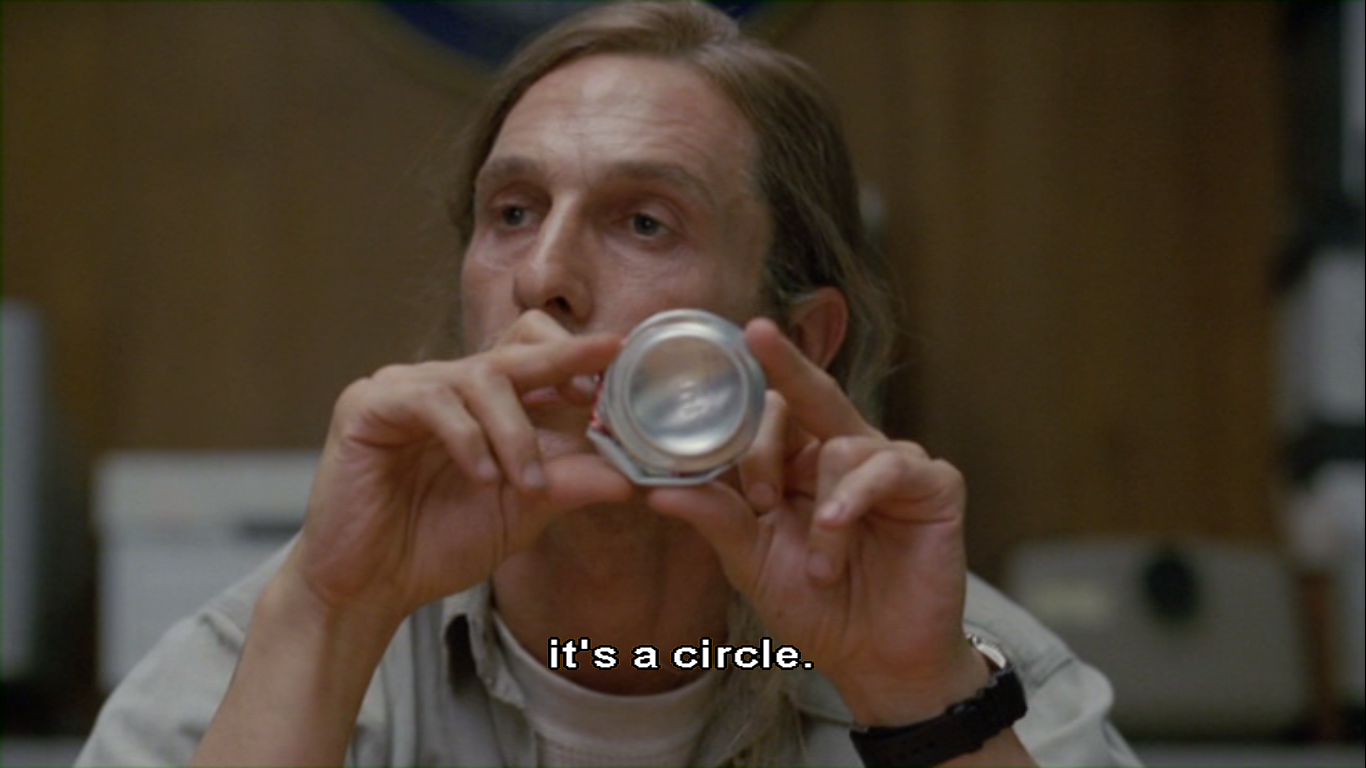
So when in True Detective, Rust Cohle starts to talk about his 'Time is a flat circle' theory. I sat up and sat waiting with bated breath.

"Someone once told me that time is a flat circle. Where everything we've ever done or will do we're gonna do over and over and over again"


"Ever heard of the M-brane theory detectives? It's like, in this universe, we process time linearly. Forward. But outside of our space-time, from what would be a fourth-dimensional perspective, time wouldn't exist. And from that vantage, could we attain it, we'd see, our space-time would look flattened. Like a single sculpture of matter in a superposition of every place it ever occupied. Our sentience just cycling through our lives like carts on a track.
See, everything outside our dimension, that's eternity. Eternity looking down on us.
Now, to us, it's a sphere. But to them, it's a circle."

"In eternity, where there is no time, nothing can grow, nothing can become, nothing changes.
So death created time to grow the things that it would kill. And you are reborn, but into the same life, you've always been born into.

Well how many times have we had this conversation, detectives?

Well who knows, when you can't remember your lives you can't change your lives. And that is the terrible and secret fate of all life.

You're trapped by that nightmare you keep waking up into."

"Again and again and again.
Forever."

Now, apparently this theory is based on Nietzsche's philosophising and I don't actually know If I believe anything of the flat circle view of the universe. But it's something that gives an explanation to something that really scared the shit out of me in the past.

A glimpse into the workings of the universe, hinged on, based on, seemingly backed up by the experiences that I myself had. A meta explanation for life. a reason, though not a purpose. In fact the opposite of purpose. A taking away of meaning. Utterly bleak nihilism. But not exactly.
There was still meaning and purpose given to moments of sheer existential dread. a tantalizing hint into the workings of reality. And it's here where the search for meaning becomes meaningful in itself.

 And for me the key is that the déja vus would end. There came moments when I would 'beat' the 're-living'; where I would do something new, that I hadn't done before and thus end up breaking the pattern.

Small victories.

Time as a flat circle.

An absurd notion, yes, of course.
Yes, Yes, but... also: Maybe.

Either way, it's one of the reasons why True Detective hits so close to home for me. It gives a meaning, to something I myself have experienced and it puts it into a grand, albeit horrific, narrative.
Purpose, out of a placing of the self that is me. Though it does place it into a bleak and uncaring, looping existence.

But hey, the Déja Vu ended, when I did something different either out of action or inaction. So, even though it's a drop in the ocean I still changed something. And though we might be placed in the same life and go through the same motions, sometimes things change. And maybe that small change could signal a big one. But then there would also have to be a final purpose and that's something that is very hard to credit.

You know, for all my shitting on King, he did do something very right.

The man in black fled across the desert, and the gunslinger followed.


Saturday, 1 July 2017

Next up...Personal stuff

With the big Ombria in Shadow post out of the way I'm at a point where I can devote more time to individual blogposts again. But during my life, I've found that my interests tend to move around in great cycles.
And now it seems I've arrived at an old one again and that this has become immediately reflected in my choice and acquisition of fiction.

Now, I've already started writing a whole bunch of personal posts to tie into this because I find (maybe wrongly) that this background information is necessary.
It's mostly personal stuff about me. Some background involving my religious upbringing, certain views I have of the world and how that relates to and influences my interests in books and fiction in general.

Some of these posts have already been brewing for a while in the background. And I guess now is when I loose them on the world.

There are alot of considerations that slide into focus with this. How much of yourself do you share? In essence, you are putting yourself on display, to be scrutinized, to be taken the piss out of, mocked, laughed at or maybe, possibly, hopefully even to be lauded or to become an inspiration for someone else. But first and foremost, without taking the consequences into account, you're telling strangers about yourself. Personal and maybe private stuff. It's scary.

There's also the pressure of getting it right. You don't want to piss people off.
For one, nobody likes being told that nothing really matters. It's a thing nobody wants to hear, let alone believe. But in the end you write what you want and what you have the energy for. And the stuff you love will end up giving you that energy. So you try to honour it and do the best you can.

You slave and you slave and there's this fear that this thing you're putting so much of yourself in can and will be shot down by some random commenter taking issue with your views, ideas or even just your phrasing. Glass houses break easily. And what comes next will take a great deal of transparency.

It's obvious that the blog has evolved from what it was in the beginning. There's less objectivity, but I believe still enough reasons to keep it up. There's always new stuff on the horizon and I'd like to share of it in the future.

To paraphrase Itkovian.
It seems my work is not yet done.

Review: The Circus of Doctor Lao, Centipede Press edition


Having previously had so much fun reading (and reviewing) the Circus of Doctor Lao, when Centipede press announced it was publishing a limited edition of the novel, jam-packed with extras, a lengthy introduction collecting every previously published cover for the novel and more short stories by Charles Finney, I knew I had to have it.

Alas, by the time I wanted to put in my order, the book had already gone out of sale. That was that and I had to make my peace with it.

Or so I thought until a few weeks later as, on publication date, being a subscriber to the Centipede Press mailing list, I received a mail that stated that I could still get one of the extra copies If I was interested. The mail wasn't specifically adressed to me of course, but rather as a member of the public at large. So, having missed my earlier chance, I didn't waste any time hesitating and promptly placed my order.

And here it finally is. Look at that beauty.


As usual, Centipede Press has gone all out to deliver a very beautiful value for money edition of its publication.

Love the look of that satyr.
The Hound of the Hedges on the other hand, while cute
probably isn't even close to what it ought to look like.

Sexy satyrs, scantily dressed creatures of various mythologies, a sea serpent and...
a golden... ass...


Naked, sexy, sexy sexy book. 

Yes, yes It's stained a bit already... I'm not sure how it happened;
I'm usually so protective of my books.


It looks even better within its covers as the book is filled with extras and Illustrations.


The introduction to the book, besides giving welcome informative background to the creation and evolution of the novel and short stories' setting and Finney's life itself, comes packed with every cover illustration for the Circus of Doctor Lao ever made.


Movie poster for The 7 Faces of Dr. Lao

The part of the book that is the novel of the Circus of Doctor Lao itself comes with various illustrations, and what do you know; some of them even look good!


The lonely God, in a foreign land.
Can you tell I love the Satyr?

A very spooked Hound of the Hedges.

Another weird illustration of the Hound of the Hedges,
still as far removed from what I envisioned it to look like.


Other illustrations are just plain odd.

Surreal oddities.

Art by Boris Artzybasheff,
The original cover artist for first edition of the Circus of Doctor Lao.

I had already read the Circus of Doctor Lao itself, not too long ago either, and I had had a good time with it. See my review here:The Circus of Doctor Lao

What I hadn't read were the 11 short stories that were packaged neatly in after the main event.
The stories don't actually tie in to the Circus of Doctor Lao itself but they do take place in the same type of town, Manacle; the spiritual successor of the town where the Circus arrives, Abalone, Arizona, which in turn was a reflection of Finney's own place of residence at the time; Tucson, Arizona. There are also a few of these stories that were inspired by his time in the army, stationed in Tientsin, that read almost like they could be autobiographical pieces.

'The Black Retriever' is probably one of those stories that while still not actually tying in to the Circus itself does stick closest to it in execution.
After the short stories events, humanity is left uncertain of the things that it just has come into contact with. One of the more humorous pieces of the novel.

'The Captivity' is an odd little tale as I find I can hardly place it. It's one of these pieces of short fiction that slides close into autobiography but of course can't actually be autobiography.
Finney certainly was never made prisoner of war and certainly was never placed in an idyllic captivity in a paradisical zone as is described here. A pleasant tale that nonetheless leaves you with questions.

'The Door' was a touching story about musing on life after death, set within the confines of a hospital ward.

'The Gilashrikes' was another big oddity, both in themes and content; in parts genuinly funny, and in parts thoughtfully introspective and with rather a 'twist' ending, if you'll forgive that particular pun.
It's one of those endings that'll make you sit down in mild shock, a horrified grin plastered on your face, provided you're invested in the story, that is.
A story of a hobbyist Frankenstein and a crossing of birds and monsters. Mankind, in recognition of both flaws and the urge for redemption in what it has wrought, looking at his own creation and still not cutting it any slack; mankind as a dickhead.

'The Horsenapping of Hotspur': Similar to The Gilashrikes story; A tale, with anthropomorphic animals, intervening in the affairs of men, funny and silly.

'The Iowan's Curse' is a darkly humorous tale of a town that karmically punishes everyone that does a good deed towards another. I loved the escalation of punishments.

The Life and Death of a Western Gladiator made me feel like I was reading a very short Jack London story, but with snakes instead of wolves. Very good.

'Isabelle the Inscrutable' was one of the longest tales and also one of the hardest to read. There wasn't much going on and half of it read like an essay on Papago indians and how humanity's forward drive engenders a sort of universal conformity at the price of one's loss of individuality and tradition.

'Murder with Feathers' was a tale of an enclosed garden that is a haven for birds of all kinds. Lovely juxtaposition there at the end about how much it hurts us when we see animals get hurt, and how we don't even notice the war-planes anymore that take flight around us, ready to deal atomic death to our own kind.

'Private Prince' reads like another autobiographical tale and I found that it managed to pack quite an emotional punch there at the end. Just like the best short stories and of course life itself, the sting lies in the tail.

'The Night Crawler' is another similar tale, recounting the events in and around an army base in Tientsin and as opposed to the sorrowful ending of Private Prince, The Night Crawler actually manages to give some happy feelings to close out the show.

To reflect that; here's a page out of the catalogue-list that ends the Circus of Doctor Lao. Finney's whimsical side on full display. Enjoy.