Everyone who doesn"t like Assassin"s Creed Odyssey hasn't played with Cassandra as the Protagonist.

Monday, 7 October 2019

BloodBorne Comic: The Healing Thirst


     I spent a short half an hour back on the streets of Yharnam, once again in comic-book form.
I really liked the first Bloodborne comic and thought it'd be a nice treat if in the horror month I were to continue the story a little bit; there are 2 more installments out right now, after all.

     Strangely enough, or no actually, not really; Bloodborne The Healing Thirst does not pick up where the first volume ended, leaving the Nameless Hunter and his really quite creepy charge to fend for themselves, and instead we are transported to the time when Yharnam was on the cusp of becoming overrun by the curse of the Old Blood. This is that story, albeit very much on a ground level.


We follow two unlikely allies as they team up to try and find the source of the terrible plague that has started to turn men into beasts, and to stop it if they can.


     What's rather new for the setting is that we get to see some of the daily lives of Yharnam's citizens in the days before everything went to hell. We get to see the moment when the city topples from relative normalcy into madness through the eyes of Alfredius and Clement, the first of whom is a scientist dedicating himself to analyzing the bacteria found in the plague victims and who concocts potions to combat it, and who harbours a dark secret, and the other is a priest of the Healing Church, and who starts out as a devout follower of the church's teachings but who over the course of his and Alfredius' investigation gradually begins to suspect that the Church might be doing more harm than good.


     There's a neat progression to both characters' philosophies and outlook, and there is even a very clear moment where the reader realizes that the two men's functions have switched places, and that the man of science has become the man of faith, and vice versa.


     Unlike the first Bloodborne comic this one isn't all that action packed, and is instead more of a character piece, concerned with the pathos of the two men as they try and keep up with a situation that is rapidly spiraling out of control. Also unlike in the first Bloodborne comic, there's a lot to read, with occasionally a page or two filled with introspection, accompanied with a panel or two where one or the other of the two men are hunched over their writings, gloomily mulling it all over.

     I thought this was a daring touch, even a little experimental, as there generally isn't much information to be found either in the game or the first comic, where spoken dialogue or reading material were kept to an absolute bare minimum and where the player or reader was forced to deduce the story from the surroundings, rather than having anything spelled out.
     It isn't like one can find massive revelations in here though. All writing serves instead to build up the characters of the two men, their relationships with the people around them, and the reasoning behind their choices and actions.


     If there is one negative about the comic then it is that it ended a little quickly, if not exactly abruptly. The fall of Yharnam was always going to be inevitable, of course, and here isn't the main point of interest. But, although the two characters' final fates are perfectly in character and well built up I would have appreciated a little more time spent on Alfredius' final pages, a little bit more time spent watching the city deteriorate around him, before his final resolution.

     But, as the comic before it, Bloodborne the Healing Church is an actual worthy addition to the universe. Ales Kot is genuinely very good at writing these things, and I really hope that there'll be more to come. Piotr Kowalski has also returned from the first one for the art duties and is again pretty good. I loved the opening panel which tied this installment neatly to the first volume, where one can see the same scenes in both volumes' first piece of art but with a clear point in time to establish when the story takes place.

     As a fan of Bloodborne I loved it. If you're new to the setting, or haven't played the game: Well, do you like the Gothic genre? Do you like violence and bloodshed, and men fighting werewolves and things from beyond the stars with cruel-looking melee weapons? Do you like being submerged in a sense of doom and terror, and are you not afraid to be completely lost and disoriented in a setting that will not spell out a damn thing for you?
     If the answers to those questions all spell out yes, and I do mean ALL, then do yourself a kindness in this greatest and most terrible of all months and embark on a journey into the universe of Bloodborne, you won't regret it.

Oh, and in the game you'll probably die a whole hell of a lot, so you probably have to be pretty patient. But trust me, it is worth it.

Sunday, 6 October 2019

Joe Golem Occult Detective vol 3: The Drowning City

Oh yes, it's finally here, the comic adaptation of one of my favourite novels of the last few years! Aaaaaand ....they only adapted the first half of the story.


God. I don't know why I'm still being taken in by anything with Mignola's name on the cover. I mean really?

     So apparently the novel Joe Golem and the Drowning City is being adapted in two parts, part one named Joe Golem Occult Detective the Drowning City 1-5 only adapts the book's first half, while the other part Joe Golem Occult Detective The Conjurors 1-5 will adapt the rest of the novel, possibly going a bit further into uncharted territory. The Conjurors is actually already out, the story over and done with, except it's not out yet in trade or hardback, which means I would have to track down either e-book versions or individual comics, which is not something I do.
And how long do I still have to wait to have the full thing on my shelf?


5 months. *sighs deeply*.


     Ah well, it's not as if I had a bad time so far, and to be fair, in the long run, having the story spread out over two volumes instead of one, gives it way more time to breathe, allowing them to linger on the crucial or emotional moments, and letting them spend time on the original story's tone rather than just getting it over with to explore the uncharted Joe Golem stuff.


     I was struck that they were already doing a very good job of this as the Drowning City 5 came to its end, when the action started to slow down and the writers let the realization slowly filter in, that this was it, that here it would end, that somehow our heroes had failed, and to the beat of repeating narration, the art slowly ramped its way up to revelation. It reminded me of the brilliant ending to Baltimore: The Infernal Train where the narration almost became a mantra, accompanying some truly awesome over-the-top art: a foreign language, incomprehensible, repeated over and over, as blood splashed the page and limbs flew, and then at the end, the final page and the final revelation revealed together with the English translation.
     Even though they'd done it better in Baltimore (mostly because of the amount of gore and blood, and the gothic trappings) I could really very much appreciate it here.


     Peter Bergting's art is a good fit for Joe Golem, treading the line between realistic and cartoony in a way that I didn't like in Baltimore, but here feels just right, adding a sense of nastiness to the supernatural horror, making the danger real and somehow jagged.
I'm still not too fond of some of his stylistic choices, but you can't deny that the man is a dab hand at faces at this point.


So, even though I was disappointed that the story was incomplete, the future will eventually see that remedied, and hopefully The Conjurors will close out the novel adaptation in a fitting manner.

If you're interested, maybe hold off until you can buy both volumes at once, or dig into volumes 1 and 2 which are also pretty good. Or failing that, Baltimore volumes 1-5, which are also set in the same universe as Joe Golem, are always a good thing to pick up, even if the series goes to hell after that. The whole priest storyline alone is worth picking these up. A masterclass in gothic horror comics and a pretty much traditional read for the Halloween month at this point.

Saturday, 5 October 2019

Crimson Lotus


The Crimson Lotus comic was a dud in pretty much every way except in the art department. The art is phenomenal, but that's pretty much all the good I have to say about this one.


     The writing, though relatively good in micro, absolutely sucked in macro. I enjoyed the characters, the two spies and their banter in particular, but the story didn't go anywhere. Though we start out with a revenge plot it peters out almost immediately after the first issue, leaving its plot threads dangling in the wind. Then, it seems as if it wasn't a revenge plot at all, but rather a sort of relic hunt with some serendipitous vengeance thrown in. We're kept in the dark pretty much every step of the way and pretty much nothing gets explained. The climactic battle is resolved with a deus ex machina, and with a completely unsatisfying open ending that can't do anything but adhere to the status quo.

     One of the problems of the Mignola-verse comics is that after a while not a single one of them can be enjoyed on their own, without prior knowledge.


     To make it worse, the writers have come to take it for granted that the reader is completely aware of what their big revelatory scenes mean, as if everyone who reads these stories has a lore bible in their heads that can be accessed whenever necessary, as if catering to the die-hard fans is what'll sell these stories. Stupidly enough I know I am one of those people. I have read all of the Mignola verse trades, except for Ragna Rok, and that is winging its way to me right now. I know it'll be disappointing, I know I'll think it'll be rushed and not well written, that it's just going to cement my opinion that the Mignola universe stories just thrive on brand appeal rather than actual quality story-telling. I hear you ask: But why, if you loathe this universe so much, are you still collecting and reading it, why have you gotten this far at all, Levi?
BECAUSE I'M A CONSUMERIST WORM, I guess. But let me rant a little more, please. There'll be spoilers for the Crimson Lotus comic next.

     Every supposedly standalone comic in the Mignola-universe, spin-off or "origin story" has these panels where all of a sudden the laws of known reality are upturned. In Crimson Lotus, what was a relatively straightforward spy/occult magic thriller all of a sudden becomes something with practical superhero-powers and demons: Vril makes an appearance and anyone not in the know will be scratching their heads because why is this Chinese lady shooting fucking lightning out of her hands all of sudden? As someone who Loves, Loves capital L mind you, Lobster Johnson I was surprised to see the Lotus using Vril. What is going on, could she do that when she met the Lobster? Have I forgotten this? Nothing is explained here, damnit!
     The climax of the story has, completely out of the blue, the little Russian-doll-girl/demon show up and deus ex machina the story to completion and I'm just wondering if anyone still cares about crafting a story that can actually be satisfying all on its own.

     The Mignola-verse has just gotten too unwieldy to get away with these types of spin-offs. Sure, given where the series actually ended up, they don't really have a choice other than to go back into the past to flesh out some of the side-characters' stories, those that'll appeal to the buying masses, but if you're doing that you should at least make it stand on its own. Give us enough information within the comic itself, seed hints and clues throughout so that when something happens we can slap our heads and shout AHA, THAT IS SATISFYING rather than just sinking deeper and deeper into a well of despondent acceptance sad and angry that this is considered "a comic to pick up".

     Good art though, it must be said. There are some genuinely awesome, and genuinely brutal, panels in here. Mindy Lee is a damn fine accomplished artist.
     John Arcudi on the other hand... I love Lobster Johnson, I love Sledgehammer 44. But this, Abe Sapien and the mainline BPRD stuff has just been monumentally badly paced, and have all left me unsatisfied.
 

Grendel and Beowulf: Avatars of Existentialism


     There are a lot of different interpretations on what exactly is happening in the last chapters of Grendel, and most of those I found to be misinformed or just plain wrong, and some of those can even be found in respected publications. I had a hard time with figuring it out myself, or at least, I think I figured it out, because the way in which Gardner wrote the last chapter was meant to be deliberately obtuse, to be deliberately confusing, in order to stick in the mind and to linger as a point of contention among the academics he so longed to be respected by.

He uses writer's tricks, to blur the lines together, so that it's sometimes hard to tell who has spoken, or if someone is even speaking at all, to make one doubt whether Grendel is making it up in the stress of the moment, or whether there might actually be something more going on. Reality blurs with illusion and it takes dedication to parse out which is which, or at least, to form a well-thought out opinion on which is which.

I've hardly figured this novel out completely (hell, I opened up a random page earlier and found myself bewildered by what I was reading) and I might be wrong on numerous points, no matter how much time and effort I spent on it. At this point I can only confidently say that all of this is informed by my opinions and knowledge gained by time spent with the book, and that this write-up can only be labeled as conjecture.


     Throughout the novel there are various hints and allusions of the thing yet to come: the doom and the death that will give meaning to the life of Grendel.
Retroactively Grendel's life will be given validity by his vanquishing: it is Grendel's death at the hands of a man, that will elevate that man into the status of hero.
We, the readers, know that this will happen. In the cultural zeitgeist, the name of Grendel is inextricably tied to the name of Beowulf, the monster destined to be killed by the hero (that is, until golden-tits Angelina Jolie came along, at least). This is known and one goes into this novel, this story that'll tell the tale from the monster's point of view, expecting some kind of foreboding, some sort of presentiment that will inform Grendel of his inescapable doom. And so when certain things begin to show up our expectations seem rewarded.

     Anyone who's read the Beowulf poem knows that the theme of Christianity is inextricably woven into it, and so, I suspect that Gardner needed to somehow weave it into his work too. And he does this in a highly intriguing manner.

     Earlier in the novel there's a very special scene, very short, where Grendel gazes on the children who are playing outside in the snow, and he becomes disturbed as he watches them lie down on the ground, moving their arms to create winged figures in the white.
     It seems to imply some sort of supernatural foreboding. And there are various little incidents throughout the novel that point to it as well. But it is in chapter 11, when Beowulf-poem and Grendel-novel begin to overlap, that the foreboding becomes undeniable.

     Even before Beowulf finally arrives, Grendel is gripped by an excitement that he can not put a name to, and strange, almost senseless, visions have begun to fill him with a restlessness. Later, as he watches Beowulf and his Geat-companions arrive on the coast, he finds himself almost recognizing the man's face, as if it is the face of one he has forgotten in a dream. He is impressed by Beowulf's almost grotesque musculature, and again and again he finds his eyes lingering on the man's shoulders, as if there's something hidden there. He looks at the stranger and begins to have the idea that the man's body is just a disguise, hiding something far more terrible than what it seems to be. This impression is one that returns again and again to Grendel's observant mind as he watches and listens to the meeting of the strange men and those of Hrothgar's court. The man's mouth doesn't seem to move in time with the words, and Grendel fancies he can smell an unpleasant scent, and he's assaulted by strange almost-memories, of twisted roots, and an abyss.

       And in the final chapter, when hero and monster have their fatal meeting, some very strange things begin to happen.

-----

      While spying on the men as they talk in the hall, Grendel realizes that the Danes aren't exactly happy that Beowulf and his Geats have come to deal with their resident monster. After all, their priests had been saying that their god would deal with Grendel in time, had been saying it for years, and as for Hrothgar's warrior-class; to be bailed out by warriors not of their clan would be supremely dishonorable. And so out of a strange respect to his acquaintances, but mostly to honour the recently deceased Shaper, and the wisdom that that one unknowingly had taught him, Grendel vows to kill the stranger.
     And so, whispering to himself, quietly and patiently, Grendel waits for time to pass and for darkness to fall. He waits until the Geats are the only ones left in the hall, and until all has gone quiet and dark. And then he moves.

     Grendel effortlessly bursts through the door that leads to Hrothgar's hall, and gazing on the silent hall and the unmoving forms of men, he thinks that he has caught them unawares, that they have been laid low by drink, and he proceeds to kill and eat a man.
     When he reaches for the second sleeping form he, all of a sudden, realizes that that man's eyes are open, and that they had been open all along, that they had been watching him to see what he would do, to see how he would set about his work of violence. The man he has reached for grabs him instead, and even though Grendel tries to get away, the man does not let go. It seems impossible, but Grendel, powerful, powerful Grendel, can not get away. And more than that, it feels like his arm is on fire and so Grendel fixes his gaze on the man and screams in fury.
     Then he feels the grip on his arm strengthen and dislocate his shoulder.
It's ironic, of course, that Grendel has been blessed by the Dragon to become impervious to steel, only to have him come to his end in hand to hand combat. But surely, Grendel isn't made from wood or kindling, surely a mere man can not just take an arm off of a genuine monster by simple force alone?
     Grendel by the pain is reduced to the here and now, and he becomes hyper-aware of the entirety of the mead-hall, and he notices that the man who his holding him is the stranger, and that his eyes are flickering with light, and that from his back arise fiery wings. He catches himself and does a double-take, but the wings are still there.
Then he shakes his head, reasoning that he can drive out the illusion, reasoning to himself that there is no possibility that something supernatural is going on here.

"The world is what it is and always was. That's our hope, our chance. Yet even in times of catastrophe we people it with tricks. Grendel, Grendel, hold fast to what is true!"

     And somehow it works. Somehow sanity returns, and darkness settles on the hall again, and so Grendel acts, and dooms himself: He kicks out, and slips on the blood of the man he's just killed.
Immediately the stranger twists his arm behind his back and forces him down, and, terrifyingly, the man begins to whisper. And feeling a terrible sense of doom Grendel whispers back at him, to try and drown out the other's words.

-----

     From this point onward, it becomes extremely difficult to parse what is said aloud and what is recited in Grendel's head, what is being said by Beowulf, and what by Grendel. And strangest of all up to a certain point, the two could even be said to be saying the same thing.
To illustrate what I mean take a look; Blue is Beowulf, Red is Grendel.


     The above is the way I think it should be read. Grendel is whispering to himself, quoting the dragon as he remembers him speaking of the vagaries of the universe, repeating to himself that all we are is pointless stardust. Then Beowulf speaks, imparting to Grendel some secret as he mentions the cave.

But it could be read differently too:


     You could read it in a way that it is Grendel who says the line of the cave, and which would certainly be in character, however, the entire 'Meaningless Swirl' monologue is an ode to meaninglessness, whereas the world is my bone-cave precisely implies dependency and thus meaning. I don't think it is Grendel who says this line. And yet, there is precedent for it, from back when Grendel mentioned his cave, as; the cave my cave is a jealous cave.

     But.
It could also be read as if Beowulf is saying all of it. That it is here where the 'Meaningless Swirl' line actually originally comes from, that the dragon has actually plucked it from the future, seeing this moment where Grendel and Beowulf meet, making it retroactively clear to Grendel that this moment could not be avoided.


     In this last one, it is precisely that because the dragon has already spoken this line as he heard it would be spoken by Beowulf, that Grendel is repeating the dragon's words at the same time as Beowulf is originally speaking them.

     It's madness, and quite frankly, this whole part is a bit of a dirty writer's trick.
But seeing as I think the first picture is most in line with what we know of these characters, I'll continue on from that one.

-----

     Grendel quotes the dragon, repeating to us words that we've read before; the Dragon's monologue of the meaningless swirl in the stream of time, a self-defeating line informing self-defeating philosophy. Grendel is here comforting himself by saying that all of it doesn't matter, and to drown out the man's terrifying whispering. But the man's words are undeniable and Grendel can't do anything but hear them. And though the sentence that comes next has never been heard before, yet it will ring familiar.

"The world is my Bone-Cave, I shall not want."

     I pondered over this sentence for quite a while.
The first words that Beowulf chooses to speak to his opposite must be meaningful, after all.
And they are: they are the declaration of his philosophy. The sentence is an amalgamation of two things. The 'I shall not want' is clearly a reference to the Lord's Prayer: The Lord is my Shepherd, I shall not want.
     But 'the world is my Bone cave' is an allusion to what Grendel had said before earlier in the novel itself, when he spoke of his cave as 'the cave my cave is a jealous cave', which also derives from a biblical source: 'the lord your god is a jealous god' (Deuteronomy).

     The first line Beowulf imparts to his mortal nemesis is a statement of religion and belief, it is an identifier, either as a way to reveal to Grendel that he, Beowulf, understands Grendel completely, or; that he, Beowulf, is rooted in reality, and that the world itself is his belief and his god.
     For the reader, this comes with associative strings attached, and their purpose is twofold. By using the Biblical language, Gardner, via the hero Beowulf, summons up the Christian faith, but then in the same breath removes that explicit tie to Christianity by substituting the object of that devotion as literally worldly, and even more than that: as the sentence only works if we have knowledge of Grendel's 'jealous cave' the sentence then becomes something quite personal to Grendel, and only to Grendel.

At this point, Grendel notes that fire slips out at the corners of Beowulf's mouth as he says:

"As you see it it is, while the seeing lasts, dark nightmare-history, time as coffin;..."

Confirming to Grendel that, indeed, life is meaningless, but then he continues:

"... but where the water was rigid there will be fish, and men will survive on their flesh till spring."

Beowulf states that, even though that life might be meaningless, life's purpose is for it to be lived.
And then he makes it clear to Grendel that he knows him and that he understands him when he says:

  "It's coming, my brother. Believe it or not."

With that line, he bestows a kinship on Grendel, the first character in the novel to do so. The human Beowulf, who stands so apart from the rest of the humans in the story as to seem like a mountain to their trees, explicitly identifies with the monster, calls him out on it.
     Of course, It is not a kinship of the flesh, but rather one of ideas, of thoughts, outlook and philosophy. It is the kinship of students. One pupil of self-actualization speaking to another.

"Though you murder the world, turn plains to stone, transmogrify life into I and it, strong searching roots will crack your cave and rain will cleanse it. The world will burn green, sperm build again. My promise. Time is the mind, the hand that makes (fingers on harpstrings, hero-swords, the acts, the eyes of queens.)"

     Beowulf, with this very obtuse way of speaking, states that life, and thus time, is only given relevance by the actions of men. It is as simple as that, Beowulf states that even though Grendel's acts of destruction might continue, the upward march, the desire of life for itself, will always continue. And then he states that he will kill Grendel for it.
     Knowing that the end is near Grendel whispers to him that the man only has won by chance; that it's all meaningless. To which Beowulf responds:

"Grendel, Grendel! You make the world by whispers, second by second, are you blind to that? Whether you make it a grave or a garden of roses is not the point.
Feel the wall: is it not hard?"

     He proceeds to try and demonstrate the way in which we make an impression on the world, the way in which we make reality exist by giving it our attention. It is the age-old philosophical conundrum of whether if a tree falls in the forest, with no-one around to hear it, whether the sound can be said to be real at all. Touch the wall and it has relevance, and it becomes real. And such too is life. Beowulf hints at the hero's philosophy, where the hero creates his own path, and his own meaning.

     But Grendel can not accept it. Though he does understand what Beowulf is saying, he is too fixated on the fact that it could have been different if he had been paying more attention to his surroundings, sure that it was an accident that gave Beowulf the upper hand, and that it could have been vastly different, that the hero, despite all his will and desire to make it all mean something, could still easily have been the one to die. But, the truth is that this didn't happen, and so comes the question: Was it or was it not inevitable? Was it destiny and thus meaningful, or was the very fact that it was an accident that gave Beowulf the upper hand precisely indicative of the meaninglessness of existence, of the absence of design and destiny?

     For Grendel the room goes white, and as he stares down he sees that Beowulf has torn his arm off at the shoulder. In terror, desperation and the mindless pain of a wounded animal, he runs out of Hrothgar's hall, leaving the scene of his wounding behind him, while behind him Beowulf stretches his blinding white wings and breathes out fire.
     Outside, Grendel sees visions of winged men that light up the night. He chastises himself once more, and again the world is reduced to darkness. He is alone, but he can still hear Beowulf's whispering. He is dying, but he still clings to the belief of meaninglessness, and refutes the hero's arguments. Grendel has a vision of a dark abyss, and a desire to tumble into it.
Then Grendel comes to himself for the last time, wet with blood, and without pain. He finds himself surrounded by the animals he shared his forest with, their mindlessness radiating out from their eyes.
And as he sees his death approach, he wonders at his feeling of joy. "Poor Grendel's had an accident," he whispers. 'So may you all.'

-----

It's so hard to see how much of this can be taken at face value, and how much is metaphor. One could argue that all the biblical imagery present is a product of the pain and stress of the situation, that Grendel is only seeing illusions, or one can argue that what Grendel sees is the truth of it. One is very tempted when reading this part to explain away the fantastical trappings that the story has, seemingly all of sudden, taken upon itself, but the truth is that there is precedent for the supernatural shenanigans: Grendel himself is revealed to have some sort of power when he screams in rage and is shocked to find that the lake he's standing by has turned to ice. Or for instance that, because of the Dragon's blessing no edge of steel can hurt him.

Either way, it's up to the reader. The book, and especially the last chapter is designed in such a way that multiple explanations are viable. For myself, I believe that one can take most of what happens as real, that Grendel is granted a look behind the veil, so to speak.

For me both the hero and the monster walk the earth as tangible avatars of their philosophies.
Grendel, as he says earlier, embodies the Dragon's idea of absolute waste, absolute destruction, destruction because why not, it's all meaningless anyway; an undeniably nihilistic philosophy.

But Beowulf, as the avatar of meaning, occupies the high ground. He is a vessel of world-altering will made manifest in the trappings of the dominant faith of that age, an agent of heroic self-actualization, clothed in wings of white and with a mouth spewing fire; classic angelical imagery. He might not actually be an angel, but as his philosophy is most beneficent to the one who wields it, the most positive, Gardner chose to let Grendel, and us, see him that way.

Grendel is a brilliant novel. But I do wish Gardner might've made it a bit more clear-cut. As it is, it is impossible to have one all-encompassing explanation that'll take into account all the different elements that the novel has. It's mostly up to each individual reader to make sense of the novel, as there really is enough in its literary make-up that multiple interpretations are possible. This is the point, of course, but I don't have to like it.

Thursday, 3 October 2019

Fantasy Masterworks: Grendel, John Gardner

There's not a moment's doubt whether or not John Gardner's Grendel belongs in the Fantasy Masterworks series. It is a magnificent achievement. The novel itself is quite short, and yet there's a lot packed into its sleight page count.


* It seems impossible to do a blurb that would be in the vein of the novel itself. It doesn't seem like this could be the case, but it really is. For starters; the novel's in first person narration: okay, that is do-able, but the problem is that Grendel himself, his character, would not allow it.
He would rail against the self-aggrandizement that a self-conscious backflap blurb would necessitate.
There is a reason why most people use the novel's last sentence to start off or end their reviews: it speaks volumes: "Poor Grendel has had an accident, so may you all."
That sentence makes it clear that Grendel loathes the world, and implicitly; us, the readers. It is a loathing flowing forth from self-pity, from recognition of his being utterly apart, utterly alone, and his knowledge that, knowing what will come from his demise, he will be given a place in a canon that will distort him, that will make of him less than what he was, and he hates us, the enablers, for it.

     Grendel is of course a re-telling of that oldest and most influential work of Old-English literature; Beowulf, but in Gardner's novel the story's told from the view of the monster. The Beowulf poem itself however devotes less than half of its page count before the titular hero meets with Grendel and dispatches him, as Grendel is in truth only his first opponent. The poem then continues on into accounts of glory, and battles with both Grendel's mother and a fire-spewing dragon.
John Gardner's novel instead focuses on retelling only the first bit of the epic poem, choosing to end its narrative just past the violent meeting of hero and monster. And in truth it's only chapters 11 and 12 that can be said to overlap with the poem.
There is a great amount of humour within these pages. It is also quite vulgar, in the original meaning of that word; base and crude, but very approachable and relatable to any reader.

     The first ten chapters of the novel focus squarely on Grendel and his antagonistic relationship with Hrothgar and that one's steadily blossoming kingdom. Through Grendel's inner monologues, never revealed to the outside world, we learn of his (lack of) upbringing, his ideas, his psyche, and chapter by chapter we follow along as he slowly broadens his philosophical views, becoming more coherent with the passing of years.
     There are few other characters that get explored besides Grendel himself, but those that do share the spotlight tend to be highly interesting. Most notable of these are Wealtheow, Hrothgar, Unferth and of course, the Dragon.


Grendel, and the Rest (Definite Spoilers)

     The Dragon is a fascinating character in the story, who's mostly here to serve as someone who has both a foot in and out of the story, someone apart, being able to look within (the Beowulf/Grendel story) and from without (as a possible reader, aware of the Beowulf poem, like us).
      He swiftly reveals that dragons have a different experience of time than humanity and that besides the past and present, they can also see the future. This allowed him to see his own death at the hands of the hero Beowulf, an event that is still decades and decades away, but that is also, to the dragon's philosophy, despite his foreknowledge of it, inescapable. The Dragon reveals that all are in thrall to destiny, in fetters and chains bound to something that can not be altered. And that destiny is in even the smallest of things.
     The Dragon inhabits the lifespan of the universe, and is in full knowledge of it every heartbeat of the way. And so he speaks of being tired of being omniscient. He gifts Grendel with imperviousness to swords and he advises him to seek out his own 'gold' to sit upon, to make the time pass in a pleasant manner. And Grendel does, and as he already has some history with him, Grendel chooses to focus on Hrothgar.

     Hrothgar is of course another major character, serving as the main focus for Grendel's ire, his territory the focal point around which Grendel works his desire to make an impact on the world. As the members of Hrothgar's court treat the lonely cave-dwelling creature as a monster, Grendel, in rage and self-pity, takes up their view of him as his own, and deliberately becomes the monster they believe him to be, committing violence and atrocity on whim and later also for his own amusement.
Notable among these acts is a specific one: Grendel's treatment of Wealtheow.
     Some ways into the novel, the young and beautiful Wealtheow becomes Hrothgar's wife in return for his showing mercy towards her brother, who plotted to take Hrothgar's kingdom from him.               
     Wealtheow, now queen, suffers her lot with admirable stoicism despite her obvious sorrow. She is endowed with much beauty and goodness, and as Grendel looks on her he is gripped by a host of conflicting emotions. He is visited by his recurring desire to be a part of things, but ruthlessly stamps it down and, in rage and self-pity, dons the cloak of the monster once more.

     Grendel denies the compassion he feels, the desire.
He hates the one he loves, desires, because he realizes the impossibility of the situation and that he will never have her love returned to him. Spite and slurs instead of understanding,
outwardly carrying a grunt while the heart carries a whisper.
     It is this that makes Grendel as a character so compelling; though he is monstrous and violent and terribly quick to anger, he can also be touched by the beauty of mankind, to the joy of their various creations; to music, beauty, art and love, but rejected by mankind as he is, spoken of as the monster, said to be cursed and cast out by a loving God, he can only carry this in his heart, and even then he has no other choice than to suppress these feelings, to call them meaningless, pointless and vague.  He does this in order not to be grasped and destroyed by his loneliness, by his complete separateness, and what once had the capacity for good; these emotions and sentiments conducive to sharing, to build, to bond, these things he can not possibly acknowledge anymore in order to not be driven insane, mad, to death. Inability for love is the pointlessness of existence. And so he forces himself to latch expressly only onto this knowledge of the pointlessness of existence. He looks at the beauty, the love, and the art of the people he watches and pretends to scoff, pretends to hate, tries to laugh at all the imposed importance of all these ephemeral things.
     And yet, he can not do anything but look at them. Because he recognizes that love gifts meaning to all. And so, to save himself, he can do nothing but respond as they expect him to.
He presents himself as their enemy. Self-actualization through others.

     He enters Hrothgar's hall with great violence and noise. Impervious to the swords of the defenders due to the Dragon's gift he stalks unstoppable through the halls. Arriving in the King's chambers he finds Wealtheow, naked in her room, and grabbing her, he holds her aloft, a claw to each leg, and holds her there, to pull her apart like a wishbone. Everyone looks on in horror and anguish.
He can not be stopped in this, and everyone, Grendel included, is fully aware of this. And more than this; Grendel knows that they know, and that they think it is inevitable that this ends with the death of Wealtheow.
And then, having it let sunk in, Grendel lets the moment linger, and then drops Wealtheow to the floor. As he exits the building he leaves behind him a shocked and confused crowd, mystifying them with the actions of a reasoning creature, rather than the monster they think him to be.

     But in shape and form he is still the monster to be slain, and it must be true that for every monster there must be a hero to stand his opposite. And so we arrive at Unferth, who would be that hero. But who makes the mistake, at their first meeting, of revealing the reasoning behind his actions to Grendel, who then promptly makes it his mission to deny Unferth both a hero's death and a hero's grace.
     In some truly hilarious and yet pitiable scenes, Grendel mocks and humiliates Unferth, who has the soul of hero and decent qualities besides, but who is so overmatched by Grendel that he should have just been killed outright at their first meeting, were it not for Grendel's malice and intelligence. And as sad as it might seem, the scenes with Unferth are a highlight of the novel.

       Important too, is Grendel's Mother, though she is not very active and is kept nameless throughout both novel and poem, she is nonetheless crucial for the development of Grendel's character. When we meet her Grendel's mother has already devolved back into a mute animal, devolved away from humanity, the idea behind which is that she is supposed to be unable to actually rear and teach Grendel, so that he can be an empty vessel to explore philosophical points of view through. This does not mean she does not love him, because she clearly does as evidenced by various parts of the novel, but she can not possibly communicate in a relevant manner with her son. She is a sad and strangely heart-warming character, capable of eliciting both pity and good-will.

-----

The Shaper, though not too active a character in the story is nonetheless crucial to some of the ideas Gardner wanted to present and as such I'll talk about him in the next segment.

Beowulf, when he finally shows up in chapters 11 and 12 is of course also hugely interesting and rather important, but Gardner had something very specific in mind when he wrote this version of Beowulf and as such I'll be talking about him separately a little further on.


A Post-Modern Monster

     But this novel is more than just a re-coating of what is already known. Gardner was an ambitious sort of fellow, and actively set out to explore Sartre's philosophy and ideas, and, with having the coming novel's ending already predetermined, and so having that troublesome story-bit already out of the way, he was also determined to make his novel stand out using Western ideas of structure and postmodernism.
Grendel was basically a bit of a grandstanding endeavor embarked on by an author interested in making a name for himself.

     As such, on its completion, Grendel turned out to be a masterclass in post-modernism. The novel switches at various points from first-person narration to third, and even at a certain point, in imitation of the poem that informed it, it also switches to verse, and later it goes further by morphing into a script format, as if the story was written to be a play. By adhering to no specific style the novel demonstrates an unwillingness to adhere to convention, and it undermines the traditional expectations of what a novel should be.

     But there is a bigger idea at work in Grendel: the rejection of the Grand Narrative. Postmodernism in literature is often marked by a rejection of conventional storytelling, and one of the main ways this manifests itself in postmodern works is that the work in question turns out to not have a conventional overarching narrative, and that it is devoid of climax or resolution.
This concept of the novel without an actual narrative, in Grendel, happens in three steps.

1

      Through the crucial character of the Shaper, a bard at Hrothgar's court, Grendel becomes aware of the concept of subjective and objective reality, when he notices that the acts of the past are rewritten by the Shaper, who in order to entertain his audience, dresses up the the history of Hrothgar in his songs. And what's more, that from then on, rather than remembering the truth, those actual squalid beginnings of Hrothgar's kingdom, the listening audience begins to believe it to have begun as gloriously as the Shaper made it out to be. And Grendel himself, though railing against it, finds himself compelled by the myth, wanting to believe in the glory and the virtue that it offers.
     He knows that it was random chance that shunted Hrothgar and his kingdom into greatness and yet...
     It is at this point, holding on to the meaningless of existence itself, that Grendel realizes that this is all that humans do. That they re-write history to make of it a grand and glorious narrative.

2

      The second way in which meaningful narratives are disputed is of course when Grendel himself claims to have had an accident' at the end of the novel. He rails against the horror that he will be used as a narrative tool, that he will be made out to have been a mere monster, as something to just be vanquished by a hero. He knows that he will be the only one to believe this, and that in time everyone will instead believe the narrative of the Hero Beowulf and the Monster Grendel.

3

      But Gardner also goes a step further. And entices us to also try and find a grand narrative in the structure of the novel itself.
Though I've seen and read various interpretations on the use of the traditional (western) Zodiac in Grendel, and even quite a few compelling arguments wherein it is explored more fully, I believe that this is also part of the Post-Modern agenda in Grendel. I'm not sure how far that Gardner chose to go with this, whether he also incorporated the four elements in his structure or whether he even used the accompanying traits in his characters, but it is clear that at the very least in every single one of Grendel's 12 chapters a reference can be found to one of the signs of the Zodiac, either explicitly or through metaphor: The signs of the Aries (1), Taurus (2), Cancer (4), Virgo (6), Scorpio (8), Sagittarius (9), Capricorn (10) and Pisces (12) are probably the easiest to find as their signs have direct physical representations, or at the very least a mention or a comparison, in the text.

     Gemini (3), Leo (5), Libra (7) and Aquarius (11) are a bit more difficult to see as they are are more obliquely explored. Gemini, the Twins star-sign, is explored in chapter three through the use of the Shaper, who, with his music, creates a subjective reality to stand alongside objective reality. Leo, the lion in the cave under the element of fire, has his representation in the Dragon. The scales of Libra, are explored though Wealtheow, who keeps both her brother and Hrothgar balanced in peace through her marriage to the latter. Aquarius, as the carrier of water, is represented by Grendel's cave where an underground river flows.

The question then arrives; What does the presence of the Western Zodiac mean in Gardner's Grendel?

     Humans are, as the novel has already offered, primed to find grand narratives in life. Accidents and circumstance will always turn out to be meaningful and crucial occurrences, inspired by the self-importance of each individual in the human race, and will always have been put together by design. There are no accidents, and circumstance must always have been shaped.
     But the truth is that it means nothing, of course. The use of the Zodiac in Grendel is Gardner making us see signs (literally) that seem to point to a grander narrative, while it is precisely the novel's point that there is none. Gardner chose the Zodiac system for it, because that system is highly interpretative, and points that overlap can and will always be found; humans will always find meaning (even) where there is none.


Post-Modern Monster (continued)

4

Which brings us to the last part.

The presence and importance of Christianity in the original Beowulf text can not be understated. Mighty deeds are constantly attributed to be achieved only by the grace of God and the deity is constantly thanked and venerated by the pretty much unanimously pious characters of the poem, which itself, after all, stems from a time when Christianity had just finished bloodily carving its place into the every-day lives of the Scandinavian peoples.


So then, Gardner also needed to somehow incorporate this religious element into his philosophical character piece, an element which is not really all that useful or conducive when you're trying to construct a narrative that will explore ideas of reason and logic-based thinking. Which is why he ended up making it another red herring: yet again, the way that Gardner chose to weave it into the narrative is something that will infallibly bait mankind's (or at least the followers/ and those familiar with the West's most dominant faith's) tendency to find meaning where there is none. Hook, line and sinker, this time with blatantly religious phrasing and imagery.

I admit, I fell for it, hard.
I kept trying to construct a working theory around the presence of Beowulf's undeniably religious trappings and speech, veering from denouncing it all as a figment of Grendel's fevered mind in the throes of pain and terror, to making an argument for the hero Beowulf's obvious angelic nature, only visible to his foe and counterpart during their fateful clashing, and then at the end there I even found a theory I was all-round pleased with, but it is very likely that it is none of these things, that this is again; just Gardner placing elements in his text with the knowledge that it would be analyzed by beings desperate for meaning and resolution.


Conclusion:

Grendel is endlessly re-readable, as it's such a tight novel, so full, and so perfectly itself. There's probably no other book like it, a genuine masterwork of literature.
It is an obtuse novel, and definitely not for everyone. And though it is short and easy to read, there are so many elements hidden that even a fan of the book will always be able to find some new revelation waiting in its pages.

There'll be another post because I couldn't do anything less than completely analyze the last chapter since I found it so baffling, but this post is already long enough as it is.

Wednesday, 2 October 2019

September Book Haul

Late, as usual, but take a look anyway at what arrived last month.
Jon Sullivan art in the background isn't new, but I'll take any chance I get to show it off.


You'll notice that most of these are comic books. This is a side-product of me still not having finished the Grendel post. You see, I made a commitment that I wouldn't start reading a new novel before I had shared my thoughts on Grendel. And so, instead of doing what I'm supposed to do I am actually spending my time devouring the comics I had left on my shelves, buying a heap of new ones (and just you wait till next month's book haul!), and making way too long posts on a comic that's pretty good, but maybe not worth the massive amount of time that I spent on it. But the time of prevaricating has passed, damnit! This month is the Horror month, and I need to read horror books! So I better get Grendel done pronto.

-----

We kick off with volumes 1 to 4 of the Sixth Gun oversized Deluxe editions which are crazy expensive, and which for that reason I had always held off on buying. They're written by Cullen Bunn, whose stories I really like, and who wove a saga around westerns and the apocalypse... 

Guns, religion and mythology and one of my favourite writers of horror comics. Yeah. I can tell you, you've no idea how frustrating it was to have to pass up on these again and again just because I couldn't afford them.


But then to make it worse (or now: better), the art in the 6 volumes of the Sixth Gun series, about 50 issues worth + spin-offs, was all done by one artist, Brian Hurtt. That's a pretty rare thing and immensely appealing to my european comic sensibilities. To top it all off, the packaging of these things! Sixth Gun Deluxe is absolutely oversize and the whole thing'll look very striking on any book shelf, provided those shelves are big enough.


So now, with the release of the 6th and final oversize Deluxe volume in sight I was trying to make myself purchase these things already in preparation to finally also begin reading the series, but the pricing was just plain out of my budget.

So I went on Ebay, had a short browse and found the first four volumes for a very low price, which amounted, together with shipping, to less than half of what you'd have to pay for these books if you're going through the Book Depository. Hurrah!

But unless I manage to get myself a discount or something I would have to pay just as much again for the last two volumes... Hmmm, I'll think of something.

-----

Yes indeed, can you believe it? The Book Depository, which previously stated that I would have to wait for my Pre-ordered Beehive Books for still more than 6 months, only went and sent me the last of the three books over to me last week.
This one'll get its own post, as it once again really is a beautiful edition.


But I guess there's no harm in already revealing that there are 9 short stories in here, with some very nice illustrations.

-----

You know how it is, a long drought of buying nothing 2000 ad related and then 6 show up at once. Judge Dredd Volumes 21, 22, 23 and 27. I waited until they were cheaper than normal, though number 23 was still pretty almost full price.


I've already read 21 and 22 and, which, together, deliver the conclusion to the Chief Judge Mcgruder long-running, low-key story line, which also resolves the Mechanismo storyline. Though it goes very, very sci-fi (like, a new planet in our solar system), it's a very good and engaging story. Mcgruder had been growing stranger and stranger as some writers just didn't seem to get what she was about.
There's a few between-issue inconsistencies: for instance, Mcgruder being in a coma since the events of Case Files 19's Inferno, while an issue or 2 before she can be seen to be healthy and well. But on the whole, I do believe that this is the most satisfying arc since Necropolis. 

What also happens is that in these volumes there's an almost exponential increase, or rather; reveal of how many Mega-cities there still are in the world. The most arresting of these is Vatican City, which has iconography immensely appealing to my tastes and the most bad-ass looking judges since Oz's the Judda, it's the judge on the cover of Case Files 22 if you're wondering. Shame that the story they're introduced in happens to be so Sub-Par. Great art, just boring and jumpy storytelling.


Anderson 3 and 4, even though I haven't read or even have, period, Anderson volume 2.
Anderson Psi Files 2 is consistently out of stock, and the second hand prices on Ebay and other sites are regularly obscene, going as high as 500 pounds. Ridiculous.
The pages themselves must be made out of cocaine or something. It's a conspiracy.

It's a bit of a shame, because as long as I don't have Psi Files 2 I can't continue Anderson's story, which looked promising in volume 1, and managed to stand head and shoulders above the bulk of Dredd stories in sheer emotional storytelling. I'm thinking of Leviathan's Farewell in particular, which sees a friend of Anderson come into contact with the earth's last living humpback whale as it dies. It's a powerful little story with a heartbreaking ending.

-----

Here's one I shouldn't have bought, probably.

I'm reading Deadman right now, as he's such a prominent side-character in Swamp Thing, and I like him as a character, even though he looked ridiculous in Swamp Thing, but the story so far is just... uninspired. It should tell you enough when the artist gets first credit on the book cover.


And Kelley Jones' art is pretty cool though, it must be said. He moved away from the superhero aesthetic that Deadman had in Swamp Thing, and made him all creepy, elongated and very defined. What I mean with that is that with every muscle standing out, and the elongation, Deadman really looks like a ghost or something. It's pretty cool.


Reading Deadman made me realize that I now can not say I haven't read any superhero comics, so I guess that opens up the playing field a little. We'll see what happens, and with next month my birthday coming up too.

-----

Next up is IDW's ridiculously glossy edtion of Steve Niles' October Faction.
I don't like IDW editions much because all their comic books are so damn reflective, making it annoying to read them when you like reading your stuff under a fixed lamp.


Either way, I'm a huge fan of Niles' 30 days of Night and I'm a fan of horror investigative teams in general and so I had been keeping an eye out for when October Faction would be collected in one volume. As there are at least 28 issues at the moment and Open Season collects only the first 12 of those it's safe to say there'll at least be one other collection yet to come. Hmm, Odd. I just noticed that the cover doesn't actually have the sub-title "Open Season" on it, even though the spine and back do mention it. What the cover does manage to mention is that this one is getting a Netflix adaptation, so keep your eyes peeled for that. It's not available right now, but given its title it'll probably be here before the end of the month.


Strangely enough when I bought this one I thought the art duty was by Ben Templesmith, who collaborated with Niles on 30 Days of Night, but apperently the art is done by someone called Damien Worm. Their styles are very similar, though Worm seems less geared to make his characters outrageous, making them more grounded in reality than Templesmith.

Either way, it's probably going to be good as Niles' stories tend to be quite fun to read, frequently also packing some good emotional payoff at the end. I've read the complete 30 Days of night, his Aleister Arcane, and a bunch of short stuff by him, so I know what I'm talking about.

-----

Next up is Berserk Deluxe Volume 2 which I had to purchase yet again from a different site other than The Book Depository as their pricing was simply too damn high. That being said, Dark Horse is firing on all cylinders with this one as it looks absolutely awesome to have on the shelf.


You can see how big these Deluxe editions are below, where I've put them with the rest of my manga. As you can see I only have the Junji Ito stuff and Berserk, and I'm getting some more Ito next month. 


Berserk deluxe volume 2 collects volumes 4 to 6 of the ongoing Berserk saga. I've already read it, pretty much as soon as it came in, and though I was less than impressed with the Golden Age Arc, the Nosferatu Zodd arc then definitely made up for that. The assassin arc was another winner, although I would have thought there to be a lot more fallout and consequences from the actions Guts takes.

Anyway, so far Berserk is turning out to be quite a well-planned saga, with seeds of the things to come planted liberally in its opening chapters, and enough time spent to flesh out its principal characters to be some pretty absorbing reading. The pages fly by though, which is down to the manga format itself I think. It's showing itself to be a medium where whole pages can pass without anyone saying a damn thing and with the art just focusing on combat or characters faces to tell the story. It's odd but I don't think this makes it lesser than other types of media. It's just very different.

-----

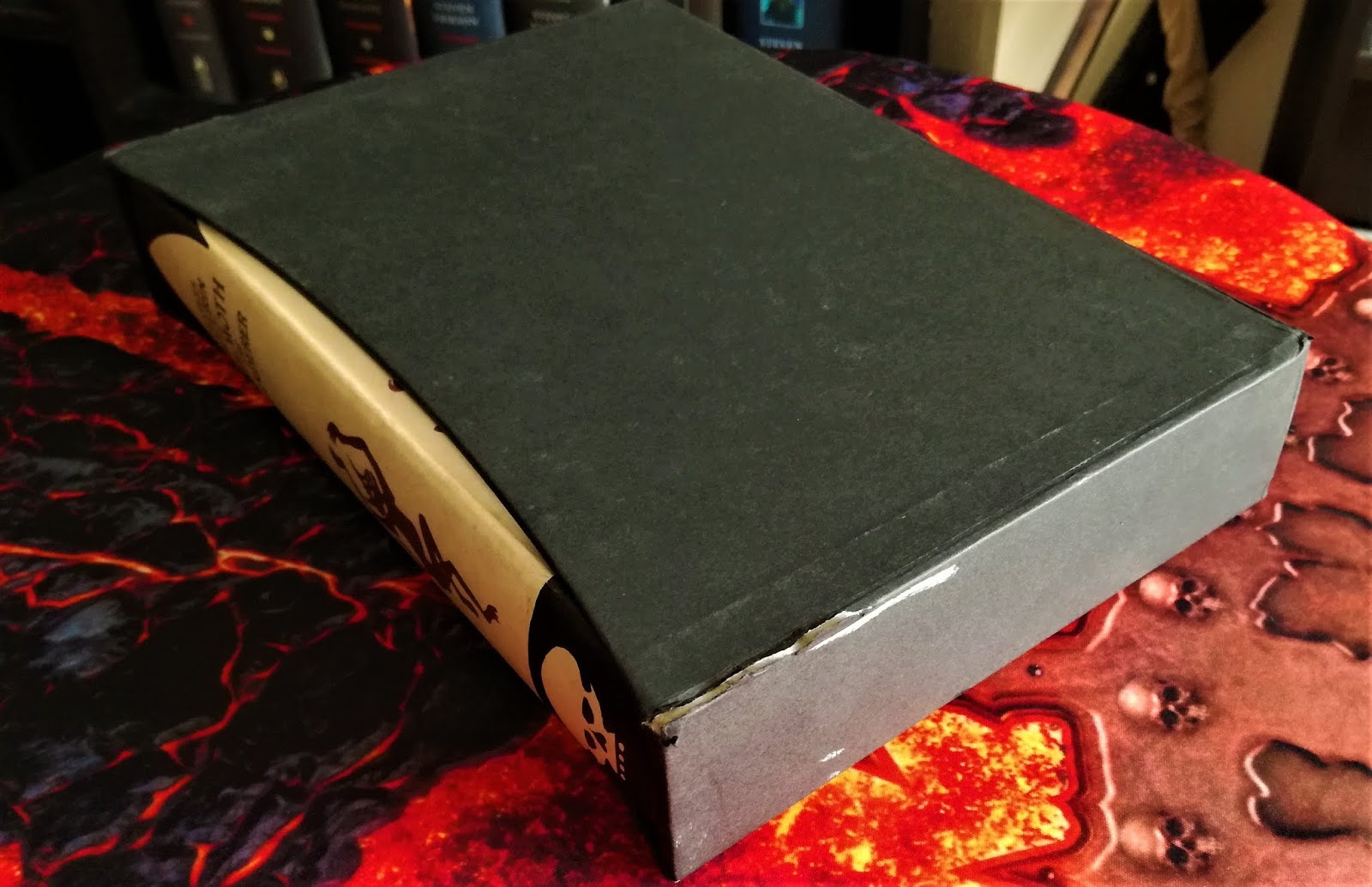
And lastly we have a book that when I saw it online I just couldn't resist immediately snatching up.
I had been eyeing several different editions of the Melmoth the Wanderer hardbacks over the years but I never was completely satisfied with what I was seeing.


And when I saw the 1993 Folio edition I was sold in a second.
Very surprisingly the price was more than fair.


Melmoth the Wanderer is one of the quintessential 'man sells his soul to the devil' tales, and it casts a very long shadow. I've been wanting to read it mainly because Karl Edward Wagner cited it as one of the big inspirations for his Kane saga.

The edition comes with a few pieces of interior art, and while I was browsing through them and came upon the last one, I realized that it gave away the ending. *sigh*. Was this really my fault though, I ask you? Isn't it natural to want to talk a look at the extras your edition have brought you?


Either way, now that I've finally got it, I'll of course not begin to read it any time soon.
Because I'm weird like that.


And that's it for September, but October's books are already starting to stack up. But, first things first: Grendel.